
Myrsine aquilonia
Common names
Poor Knights matipo
Biostatus
Native – Endemic taxon
Current conservation status
The conservation status of all known New Zealand vascular plant taxa at the rank of species and below were reassessed in 2022-2023 using the New Zealand Threat Classification System (NZTCS) – more information about this can be found on the NZTCS website. This report includes replaces all previous NZTCS lists for vascular plants. Previous assessments can be found here.
- Conservation status of vascular plants in Aotearoa New Zealand, 2023. 2024. Peter J. de Lange, Jane Gosden, Shannel P. Courtney, Alexander J. Fergus, John W. Barkla, Sarah M. Beadel, Paul D. Champion, Rowan Hindmarsh-Walls, Troy Makan and Pascale Michel Department of Conservation. Source: NZTCS and licensed by DOC for reuse under the Creative Commons Attribution 4.0 International licence.
2023 | At Risk – Relict | Qualifiers: PD
Category
Vascular
Structural class
Trees & Shrubs - Dicotyledons
Simplified description
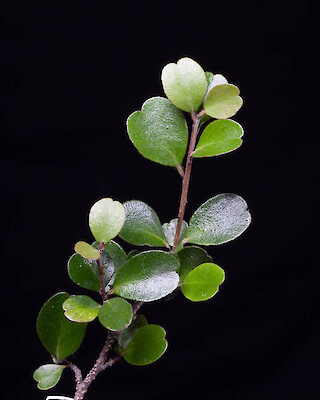
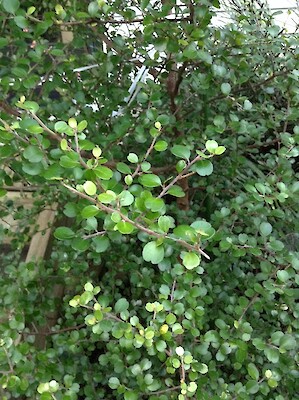
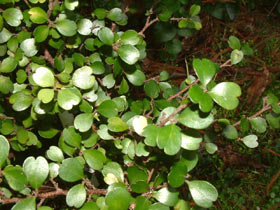
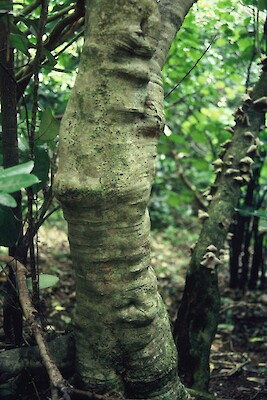
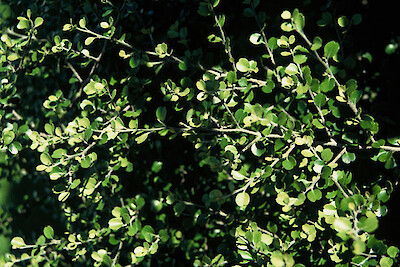
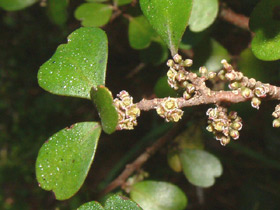
Bushy tall shrub with a ringed smooth trunk bearing small heart-shaped leaves inhabiting coastal areas in eastern Northland and offshore Islands. Leaves 12-28mm long by 10-17mm wide, with a large notch at the tip, on erect branches. Fruit purple, 3-8-4.7mm long.
Flower colours
Green, Red/Pink
Detailed description
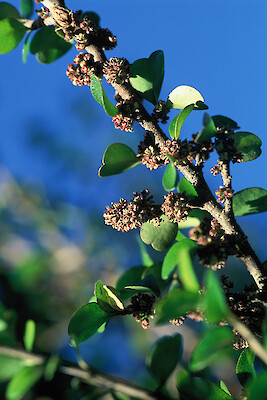
Dioecious, suckering shrub or small tree up to 12 m tall. Trunks with ring-like constrictions. Branchlets erect, somewhat spreading, not divaricating, usually crowded and leafy. Adult leaves 12-28 x 10-17 mm, without prominent blotch at lamina base, obovate, leathery, entire with leaf apex deeply retuse to obcordate. Flowers axillary, solitary or in fascicles of up to 6. Female flowers with 4 sepals and 4 petals, petals free, 1.6-1.7 x 1-1.1 mm, broadly elliptic, green flushed maroon. Style 0.2-0.3 mm, stigma 0.6-0.8 x 0.6-0.8 mm, stamens rudimentary. Male flowers similar. petals 2.5-2.8 x 1.2-1.3 mm, obovate, stamens prominent with anthers 1.2-1.5 x 0.6-0.8 mm, gynoecium rudimentary. Fruit a circular purple or violet drupe 3.8-4.7 x 3.5-4.7 mm.
Similar taxa
M. aquilonia differs from M. coxii by the non-rhizomatous habit, ring-like trunk constrictions, leafy branches, and broader deeply retuse leaves, from M. umbricola by the ring-like trunk constrictions, taller heavily branched growth form, and uniformly lighter green coloured, deeply retuse leaves. (see M. divaricata)
Distribution
Endemic. New Zealand, North Island: Known from the Poor Knights Islands, Rauhomaumau Island, Rangaunu Harbour, and Te Arai (Heenan & de Lange 2004)..
Habitat
Coastal scrub, kanuka forest and mangrove swamps.
Threats
Abundant on the Poor Knights Island group where it is often the co-dominant species in the main vegetation types. Outside these islands it is very scarce. Previously regarded (as Myrsine aff. divaricata (AK 228797; Poor Knights)) as Sparse in de Lange et al. (2004).
Detailed taxonomy
Genus
Family
Synonyms
None
Endemic taxon
Yes
Endemic genus
No
Endemic family
No
Ecology
Flowering
August
Fruiting
December-January
Propagation technique
Easy from hardwood cuttings and fresh seed. Fast growing and tolerant of a range of conditions and moisture regimes.
Other information
Cultivation
Popular and widely sold, usually as Myrsine ‘Poor Knights’.
Plant of the Month
This plant has been featured as a Plant of the Month – see Trilepidea: NZPCN newsletter for December 2009 for the full story.
Etymology
myrsine: Myrrh
NVS code
The National Vegetation Survey (NVS) Databank is a physical archive and electronic databank containing records of over 94,000 vegetation survey plots - including data from over 19,000 permanent plots. NVS maintains a standard set of species code abbreviations that correspond to standard scientific plant names from the Ngä Tipu o Aotearoa - New Zealand Plants database.
MYRAQL
Chromosome number
2n = 46
Previous conservation statuses
The conservation status of all known New Zealand vascular plant taxa at the rank of species and below were reassessed in 2022-2023 using the New Zealand Threat Classification System (NZTCS) – more information about this can be found on the NZTCS website. This report includes replaces all previous NZTCS lists for vascular plants. Previous assessments can be found here.
- Conservation status of vascular plants in Aotearoa New Zealand, 2023. 2024. Peter J. de Lange, Jane Gosden, Shannel P. Courtney, Alexander J. Fergus, John W. Barkla, Sarah M. Beadel, Paul D. Champion, Rowan Hindmarsh-Walls, Troy Makan and Pascale Michel Department of Conservation. Source: NZTCS and licensed by DOC for reuse under the Creative Commons Attribution 4.0 International licence.
2017 | At Risk – Relict | Qualifiers: PD
2012 | At Risk – Relict | Qualifiers: PD
2009 | At Risk – Relict | Qualifiers: PD
2004 | Sparse
Regional conservation statuses
Northland: 2026 | Regionally At Risk – Regionally Relict
Current regional threat status assessments prepared according to Crisp et al. (2025) are displayed when available. The Northland conservation status information is sourced from the “Conservation status of indigenous vascular plants in Northland | Taitokerau” Ford et al. 2026 report.
Referencing and citations
References and further reading
de Lange, P.J.; Norton, D.A.; Heenan, P.B.; Courtney, S.P.; Molloy, B.P.J.; Ogle, C.C.; Rance, B.D.; Johnson, P.N.; Hitchmough, R. 2004: Threatened and uncommon plants of New Zealand. New Zealand Journal of Botany 42: 45-76.
Heenan, P.B.; de Lange, P.J. 2004: Myrsine aquilonia and M. umbricola (Myrsinaceae), two new species from New Zealand. New Zealand Journal of Botany 42: 753-769
Attribution
Fact Sheet Prepared by P.J. de Lange (1 November 2009). Description based on Heenan & de Lange (2004).
NZPCN Fact Sheet citation
Please cite as: de Lange, P.J. (Year at time of access): Myrsine aquilonia Fact Sheet (content continuously updated). New Zealand Plant Conservation Network. https://www.nzpcn.org.nz/flora/species/myrsine-aquilonia/ (Date website was queried)