
Myrsine kermadecensis
Common names
Kermadec mapou
Biostatus
Native – Endemic taxon
Current conservation status
The conservation status of all known New Zealand vascular plant taxa at the rank of species and below were reassessed in 2022-2023 using the New Zealand Threat Classification System (NZTCS) – more information about this can be found on the NZTCS website. This report includes replaces all previous NZTCS lists for vascular plants. Previous assessments can be found here.
- Conservation status of vascular plants in Aotearoa New Zealand, 2023. 2024. Peter J. de Lange, Jane Gosden, Shannel P. Courtney, Alexander J. Fergus, John W. Barkla, Sarah M. Beadel, Paul D. Champion, Rowan Hindmarsh-Walls, Troy Makan and Pascale Michel Department of Conservation. Source: NZTCS and licensed by DOC for reuse under the Creative Commons Attribution 4.0 International licence.
2023 | At Risk – Naturally Uncommon | Qualifiers: CD, IE
Category
Vascular
Structural class
Trees & Shrubs - Dicotyledons
Simplified description
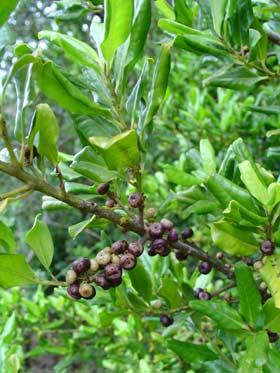
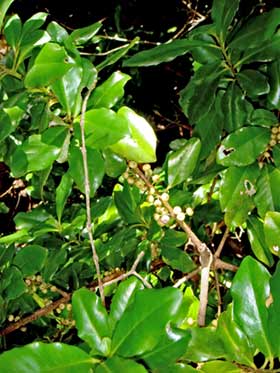
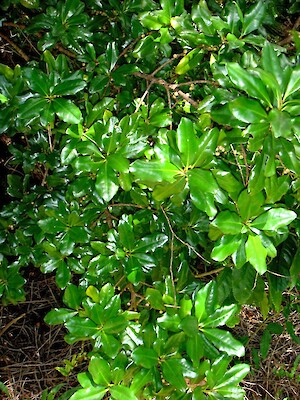
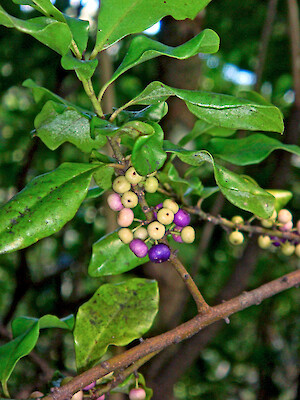
Small tree bearing wavy dark green leaves and small purple or white fruit inhabiting the Kermadec Islands. Leaves bulging between the veins, 3-7cm long by 1-3.5cm wide. Fruit 6-9mm wide.
Flower colours
Green, Yellow
Detailed description
Gynodioecious shrub or tree up to 10 m tall; bark firm, rough, initially dark red-brown, aging grey. branches numerous more or less spreading to ascending. Leaves coriaceous, dark or light green, adaxially glossy; petioles stout, 6-15 mmlong; lamina 30-680 × 25-40 mm, elliptic- to obovate-oblong, obtuse or apiculate, mostly entire, sometimes sparingly toothed toward leaf base; margins of shade foliage flat, otherwise slightly to strongly recurved. Inflorescences in many flowered fascicles. Pistillate flowers; greenish yellow with purple spotting or wine-red with purple spotting; calyx 1.0-1.5 mm,tube 0.4-0.6 mm, lobes 4-5, 0.6-0.9 x 0.6-0.8 mm, triangular, glandular, apex acute to subacute; Corolla 2.1-2.7 mm, tube 0.2-0.3 mm,lobes 4-5, 1.9-2.4 x 0.9-1.0 mm, elliptic, glandular, apex acute. Antherodes malformed, 0.75-1.15 x 0.5-0.6 mm, apiculus strongly recurved; pollen absent. Ovary 0.8-0.9 x 0.8-0.9 mm. Stigma 0.3-0.4 mm high, spreading, outer parts appressed to ovary ± 2.5 mm. diameter. Bisexual flowers,greenish yellow with purple spotting or wine-red with purple spotting; calyx 1.0-1.5 mm, tube 0.3-0.5 mm, lobes 4-5, 0.7-1.0 x 0.7-0.8 mm, triangular, glandular, apex acute. Corolla2.7-3.1 mm, tube 0.2-0.3 mm, lobes 4-5, 2.5-2.8 x 1.1-1.3 mm, elliptic, glandular, apex acute. Anthers 1.1-1.8 x 0.8-1.2 mm, apiculus upright; pollen abundant. Ovary 0.75-0.9 x 0.75-1.0 mm. Stigma 0.75-0.8 mm high, upright. Fruit (8)-6-12 mm. diameter when fresh, globose, purple, dark violet-purple or black. Endocarp 3.2-3.5 x 4.0-5.5 mm; buff brown to pale brown with pale longitudinal veins; transversely elliptic to broadly elliptic, terete with 10-12 distinct longitudinal ridges; apex rounded with a small central dimple.
Similar taxa
As the only species in the genus on the Kermadec Islands, Myrsine kermadecensis, when Raoul Island cannot be confused with any other plant there. However, limited material is in cultivation in New Zealand, and that could be confused with the Three Kings Islands endemic M. oliveri (also in limited cultivation). Myrsine kermadecensis differs vegetatively in that the adult leaves are mostly entire (only rarely toothed, and then sparingly so), and the leaves are uniformly dark (or light) glossy green rather than the sparingly toothed, dark green, yellow-green to green tinged pink leaves typical of M. oliveri. Both species also differ in their floral and fruit characters (see descriptions)
Distribution
Endemic. Kermadec Islands: Raoul Island.
Habitat
A common and important shrub and subcanopy (rarely canopy) species of dry forest on Raoul Island. Near the coast it is often the sole species under dense canopy of Metrosideros kermadecensis. However it is more commonly found in association with Coprosma petiolata, Myoporum rapense subsp. kermadecense in the canopy gaps and near the shore line and further inland with Macropiper excelsum subsp. psittacorum. Coprosma acutifolia and Melicytus aff. ramiflorus. Although most common in dry forest it extends right up into the wet forest and is a sparse component of the wet forest developed along the ridge lines and crater rim.
Threats
An abundant species on Raoul which is listed only because it occupies a restricted geographic area.
Detailed taxonomy
Genus
Family
Synonyms
Rapanea kermadecensis (Cheeseman) Mez; Suttonia kermadecensis (Cheeseman) Cheeseman
Endemic taxon
Yes
Endemic genus
No
Endemic family
No
Ecology
Flowering
October - April
Fruiting
August - May
Propagation technique
Easily grown from fresh seed. Difficult but can be grown from semi-hardwood cuttings
Other information
Where to buy
Not commercially available
Etymology
myrsine: Myrrh
kermadecensis: From the Kermadec Islands
NVS code
The National Vegetation Survey (NVS) Databank is a physical archive and electronic databank containing records of over 94,000 vegetation survey plots - including data from over 19,000 permanent plots. NVS maintains a standard set of species code abbreviations that correspond to standard scientific plant names from the Ngä Tipu o Aotearoa - New Zealand Plants database.
MYRKER
Chromosome number
2n = 46
Previous conservation statuses
The conservation status of all known New Zealand vascular plant taxa at the rank of species and below were reassessed in 2022-2023 using the New Zealand Threat Classification System (NZTCS) – more information about this can be found on the NZTCS website. This report includes replaces all previous NZTCS lists for vascular plants. Previous assessments can be found here.
- Conservation status of vascular plants in Aotearoa New Zealand, 2023. 2024. Peter J. de Lange, Jane Gosden, Shannel P. Courtney, Alexander J. Fergus, John W. Barkla, Sarah M. Beadel, Paul D. Champion, Rowan Hindmarsh-Walls, Troy Makan and Pascale Michel Department of Conservation. Source: NZTCS and licensed by DOC for reuse under the Creative Commons Attribution 4.0 International licence.
2017 | At Risk – Naturally Uncommon | Qualifiers: CD, IE
2012 | At Risk – Naturally Uncommon | Qualifiers: CD, IE
2009 | At Risk – Naturally Uncommon | Qualifiers: OL, IE
2004 | Range Restricted
Referencing and citations
References and further reading
Allan, H.H. 1961: Flora of New Zealand. Vol. I, Government Printer, Wellington
Heenan, P.B. 1998: Gynodioecy in Myrsine kermadecensis (Myrsinaceae). New Zealand Journal of Botany36: 675-677.
Webb, C.J.; Simpson, M.J.A. 2001: Seeds of New Zealand gymnosperms and dicotyledons. Christchurch, Manuka Press.
Attribution
Description adapted by P. J. de Lange from Allan (1961), Heenan (1998) and Webb & Simpson (2001) supplemented by field observations.
Some of this factsheet information is derived from Flora of New Zealand Online and is used under a Creative Commons Attribution 3.0 New Zealand licence.
NZPCN Fact Sheet citation
Please cite as: de Lange, P.J. (Year at time of access): Myrsine kermadecensis Fact Sheet (content continuously updated). New Zealand Plant Conservation Network. https://www.nzpcn.org.nz/flora/species/myrsine-kermadecensis/ (Date website was queried)