
Myrsine umbricola
Biostatus
Native – Endemic taxon
Current conservation status
The conservation status of all known New Zealand vascular plant taxa at the rank of species and below were reassessed in 2022-2023 using the New Zealand Threat Classification System (NZTCS) – more information about this can be found on the NZTCS website. This report includes replaces all previous NZTCS lists for vascular plants. Previous assessments can be found here.
- Conservation status of vascular plants in Aotearoa New Zealand, 2023. 2024. Peter J. de Lange, Jane Gosden, Shannel P. Courtney, Alexander J. Fergus, John W. Barkla, Sarah M. Beadel, Paul D. Champion, Rowan Hindmarsh-Walls, Troy Makan and Pascale Michel Department of Conservation. Source: NZTCS and licensed by DOC for reuse under the Creative Commons Attribution 4.0 International licence.
2023 | Threatened – Nationally Endangered | Qualifiers: DPS, DPT, RR, RF
Category
Vascular
Structural class
Trees & Shrubs - Dicotyledons
Simplified description
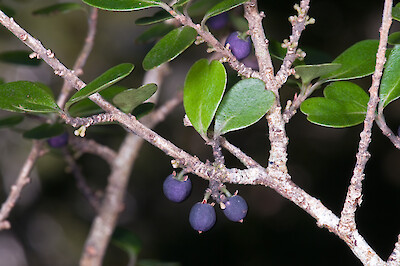
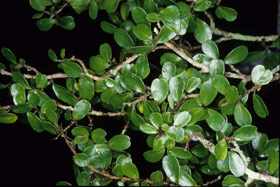
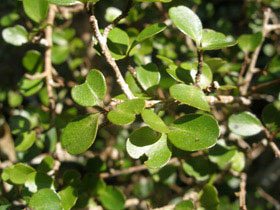
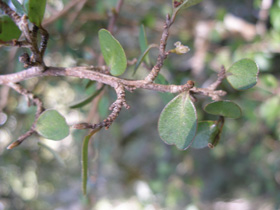
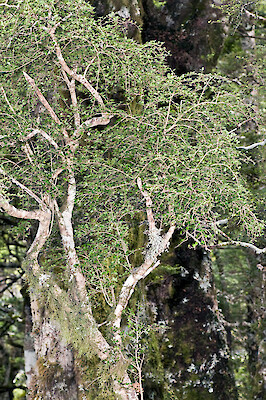
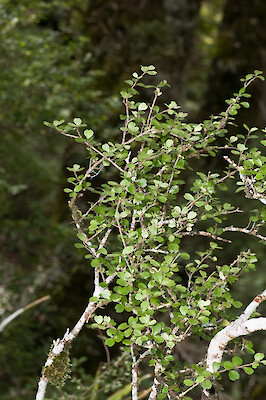
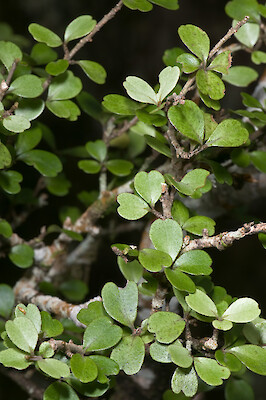
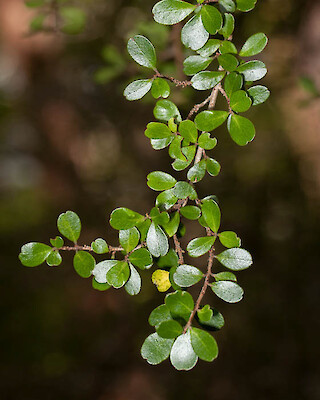
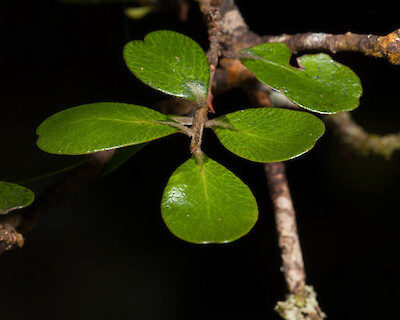
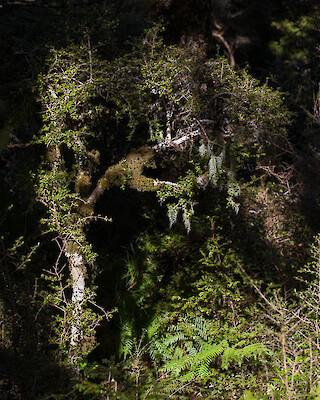
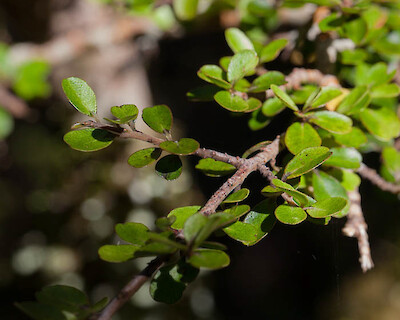
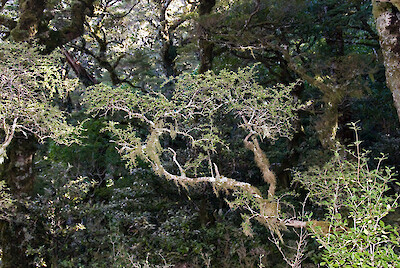
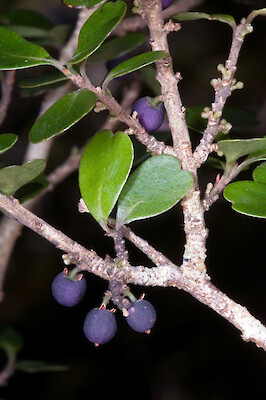
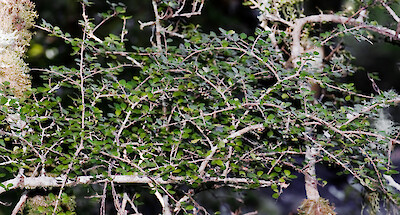
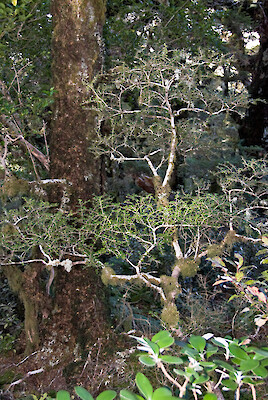
Rare spreading shrub with many wide-angled only slightly weeping twigs bearing small dark spotted oval leaves that are notched at the tip and with a dark blotch at the base inhabiting the Tararua Range. Leaves 11–22 × 7–11 mm, wavy-edged or with a more or less obvious notch.
Flower colours
Cream, Green
Detailed description
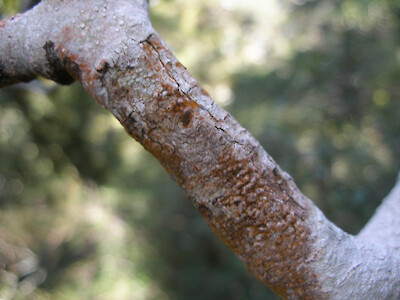
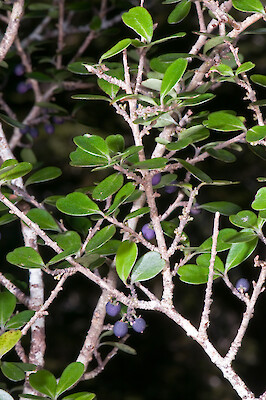
Dioecious, shrub up 4 x 4–5 m. Trunks 1–5, these slender. Branchlets horizontal, somewhat spreading, non-divaricating, spreading to upright, usually crowded and leafy. Adult leaves 11–22 × 7–11 mm, dark green, glossy, usually with a narrow brown blotch at lamina base, obovate, oblong-obovate, leaf entire apex entire or slightly retuse. Flowers axillary, solitary or in fascicles of 2–4. Female flowers sparse, often solitary, with 4 sepals and 4 petals; petals free, 1.3–1.6 × 1–1.1 mm, broadly elliptic, light green, cream or flushed maroon at margins; style 0.2 mm, stigma 0.6–0.8 × 0.6–0.8 mm, stamens rudimentary. Male flowers solitary or in fascicles of up to 4; petals 4–(5), 2–2.5 × 1.4–1.6 mm, obovate, stamens with anthers 1.1–1.4 × 0.6–1 mm, gynoecium rudimentary. Fruit a circular purple or violet drupe 3.4–5.3 × 3.4–5.2 mm.
Similar taxa
Myrsine umbricola differs from M. aquilonia de Lange et Heenan and M. coxii Cockayne, by its non suckering, smaller stature and broader spread, more slender trunks and horizontal branching pattern, narrower, entire to weakly retuse, very glossy leaves which usually have a narrow brown blotch at the leaf base petiole junction.
Distribution
Endemic. At present known only from the the Tararua Range, in the North Island. However, it was only recognised as distinct in 2003, plants having been previously regarded as shade forms of M. divaricata A.Cunn., a species with which M. umbricola is widely sympatric. As past literature refers to M. divaricata as a widespread species of the Tararua Ranges, it is probable that these records may in part refer to M. umbricola as well. Myrsine umbricola should also be looked for in similar habitats in the Ruahine Ranges.
Habitat
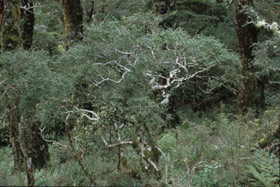
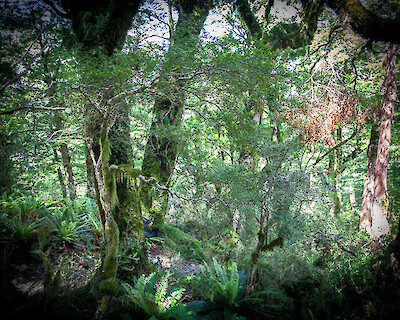
Silver beech (Lophozonia menziesii (Hook.f.) Heenan et Smissen) cloud forest from c. 800–1200 m a.s.l. Growing on terracettes, colluvium and around the margins at the bases of rotational slump scars.
Threats
Locally abundant but most populations seen to comprise adult plants only. Seedlings are scarce, and those that have been found show clear signs that they are browsed heavily by deer. Because the known populations are small, several are close to or already moribund, recruitment is virtually absent, and at some sites hybrids out number pure plants. Myrsine umbricola is regarded as seriously threatened. Since its formal description in December 2004, further populations have been found though none are large or free from the same threats.
Detailed taxonomy
Genus
Family
Synonyms
None
Endemic taxon
Yes
Endemic genus
No
Endemic family
No
Ecology
Flowering
August–September
Fruiting
October–August
Propagation technique
The propagation requirements of this recent (2003) discovery are as yet unclear. Seedlings transplanted from the wild to assist with the formal description of this species have proved slow to grow but once established have grown very quickly. This species appears to dislike dry conditions. It should be easy to grow from fresh seed.
Other information
Etymology
myrsine: Myrrh
umbricola: Dweller of shady places
NVS code
The National Vegetation Survey (NVS) Databank is a physical archive and electronic databank containing records of over 94,000 vegetation survey plots - including data from over 19,000 permanent plots. NVS maintains a standard set of species code abbreviations that correspond to standard scientific plant names from the Ngä Tipu o Aotearoa - New Zealand Plants database.
MYRUMB
Chromosome number
2n = 46
Previous conservation statuses
The conservation status of all known New Zealand vascular plant taxa at the rank of species and below were reassessed in 2022-2023 using the New Zealand Threat Classification System (NZTCS) – more information about this can be found on the NZTCS website. This report includes replaces all previous NZTCS lists for vascular plants. Previous assessments can be found here.
- Conservation status of vascular plants in Aotearoa New Zealand, 2023. 2024. Peter J. de Lange, Jane Gosden, Shannel P. Courtney, Alexander J. Fergus, John W. Barkla, Sarah M. Beadel, Paul D. Champion, Rowan Hindmarsh-Walls, Troy Makan and Pascale Michel Department of Conservation. Source: NZTCS and licensed by DOC for reuse under the Creative Commons Attribution 4.0 International licence.
2017 | At Risk – Declining | Qualifiers: DP, RF, RR
2012 | Threatened – Nationally Vulnerable | Qualifiers: DP, RF, RR
2009 | Threatened – Nationally Critical | Qualifiers: DP, RF, RR
2004 | Not Threatened
Regional conservation statuses
Wellington: 2025 | Regionally Threatened – Regionally Endangered | Qualifiers: NStr, RE, TLI
Current regional threat status assessments prepared according to Crisp et al. (2025) are displayed when available. The Wellington conservation status information is sourced from the “Conservation status of indigenous vascular plants in the Wellington region” Enright P et al. 2025 report.
Referencing and citations
References and further reading
de Lange PJ, Heenan PB, Norton DA, Rolfe JR, Sawyer JWD. 2010. Threatened Plants of New Zealand. Canterbury University Press, Christchurch. 471 p.
Heenan PB, de Lange PJ. 2004. Myrsine aquilonia and M. umbricola (Myrsinaceae), two new species from New Zealand. New Zealand Journal of Botany 42(5): 753–769. https://doi.org/10.1080/0028825X.2004.9512929.
Attribution
Fact Sheet Prepared by P.J. de Lange (1 November 2009). Description based on Heenan & de Lange (2004) - see also de Lange et al (2010).
NZPCN Fact Sheet citation
Please cite as: de Lange, P.J. (Year at time of access): Myrsine umbricola Fact Sheet (content continuously updated). New Zealand Plant Conservation Network. https://www.nzpcn.org.nz/flora/species/myrsine-umbricola/ (Date website was queried)