
Shawia adenocarpa
Common names
Canterbury Plains tree daisy
Biostatus
Native – Endemic taxon
Current conservation status
The conservation status of all known New Zealand vascular plant taxa at the rank of species and below were reassessed in 2022-2023 using the New Zealand Threat Classification System (NZTCS) – more information about this can be found on the NZTCS website. This report includes replaces all previous NZTCS lists for vascular plants. Previous assessments can be found here.
- Conservation status of vascular plants in Aotearoa New Zealand, 2023. 2024. Peter J. de Lange, Jane Gosden, Shannel P. Courtney, Alexander J. Fergus, John W. Barkla, Sarah M. Beadel, Paul D. Champion, Rowan Hindmarsh-Walls, Troy Makan and Pascale Michel Department of Conservation. Source: NZTCS and licensed by DOC for reuse under the Creative Commons Attribution 4.0 International licence.
2023 | Threatened – Nationally Critical | Qualifiers: CD, RF
Category
Vascular
Structural class
Trees & Shrubs - Dicotyledons
Simplified description
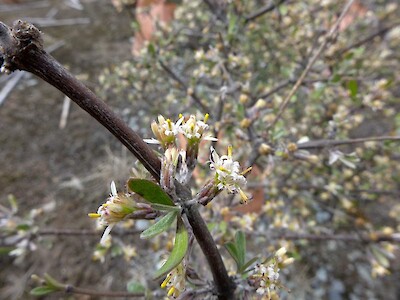
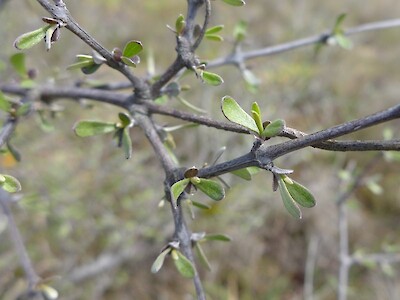
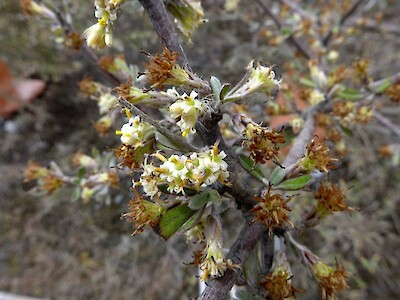
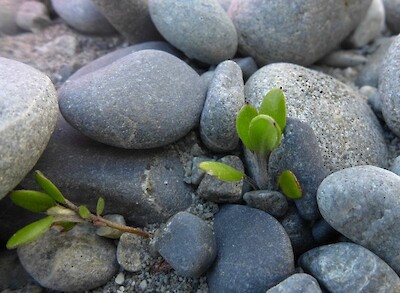
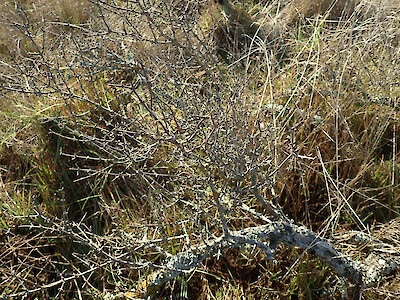
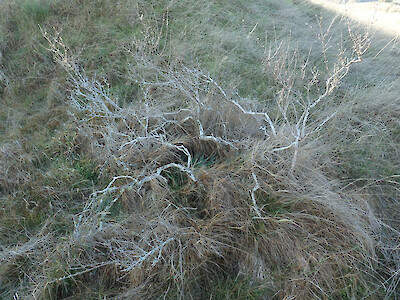
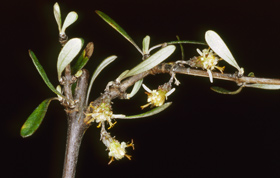
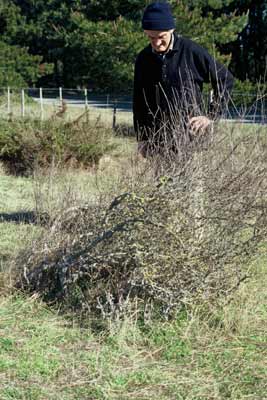
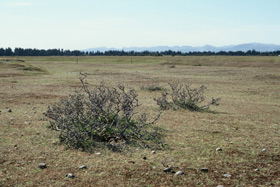
Rare shrub to 1.5m tall with many upright thin twigs arising from trailing branches and bearing clusters of oval dark green leaves that are bright white on the underside and inhabiting the Canterbury Plains. Flowers small, outer surface hairy (lens needed). Fruit dry, with mostly blob-tipped hairs (lens needed).
Flower colours
White
Detailed description
Openly branched, trailing deciduous to semi-deciduous shrub 1.2–1.5 m tall, up to 1.5 m diameter. Branches originating from near or below ground level, widely spreading usually spreading to decumbent, sometimes upright; sometimes rhizomatous. Leaves 3–14 × 2–4 mm, narrowly obovate to broadly obovate or oval, opposite or in fascicles on brachyblasts, upper surfaces light green, grey–green to brown–green with a silvery sheen, undersides uniformly silvery white, base attenuate to cuneate, apex obtuse with a small red to red-brown apiculus. Capitula 1–6 per brachyblast. Pedicels 1.2–4.0 mm long, densely covered with appressed hairs. Involucral bracts 18–22, 4–5-seriate, outer surfaces hairy. Florets 8–12, white. Achenes 2.0–2.5 mm long, light brown, sparsely to moderately covered in sessile glandular hairs.
Similar taxa
Perhaps most closely allied to Shawia odorata, from which it can be distinguished by its smaller size.
Distribution
Endemic. South Island, Canterbury Plains. Known from the vicinity of Christchurch (West Melton), Rakaia Island, and Te Pirita.
Habitat
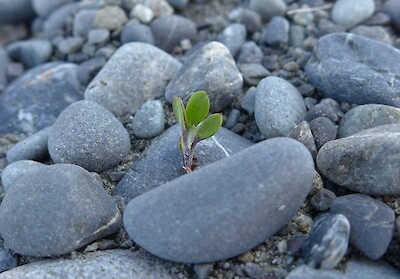
A lowland species of recently deposited alluvial gravels and sands.
Threats
Severely threatened by browsing animals, habitat loss/modification, and weed invasion. Fenced plants are vulnerable to overtopping by pasture grasses.
Detailed taxonomy
Genus
Family
Synonyms
None
Taxonomic notes
Previously recorded as Olearia aff. odorata (CHR 386084; Canterbury Plains) in de Lange et al. 2004; Threatened and uncommon plants of New Zealand. New Zealand Journal of Botany 42: 45-76.
Endemic taxon
Yes
Endemic genus
No
Endemic family
No
Ecology
Flowering
January - February
Fruiting
February - March
Propagation technique
Easily grown from semi hardwood and hardwood cuttings and fresh seed.
Other information
Plant of the Month
This plant has been featured as a Plant of the Month – see Trilepidea: NZPCN newsletter for January 2005 for the full story.
Etymology
shawia: After Thomas Shaw (1694-1751), English scholar and traveller.
Chromosome number
2n = 108
Previous conservation statuses
The conservation status of all known New Zealand vascular plant taxa at the rank of species and below were reassessed in 2022-2023 using the New Zealand Threat Classification System (NZTCS) – more information about this can be found on the NZTCS website. This report includes replaces all previous NZTCS lists for vascular plants. Previous assessments can be found here.
- Conservation status of vascular plants in Aotearoa New Zealand, 2023. 2024. Peter J. de Lange, Jane Gosden, Shannel P. Courtney, Alexander J. Fergus, John W. Barkla, Sarah M. Beadel, Paul D. Champion, Rowan Hindmarsh-Walls, Troy Makan and Pascale Michel Department of Conservation. Source: NZTCS and licensed by DOC for reuse under the Creative Commons Attribution 4.0 International licence.
2017 | Threatened – Nationally Critical | Qualifiers: CD, RF
2012 | Threatened – Nationally Critical | Qualifiers: CD, De, RF
2009 | Threatened – Nationally Critical | Qualifiers: CD, De, RF
2004 | Threatened – Nationally Critical
Referencing and citations
References and further reading
de Lange, P.J.; Heenan, P.B.; Norton, D.A.; Rolfe, J.R. and Sawyer, J.W.D. 2010: Threatened Plants of New Zealand. Canterbury University Press, Christchurch.
Heenan, P.B. and Molloy, B.P.J. 2004: Taxonomy, ecology and conservation of Olearia adenocarpa (Asteraceae), a new species from braided riverbeds in Canterbury, New Zealand. New Zealand Journal of Botany 42(1): 21-36.
Saldivia, P.; Nicol, D.A. 2025: Reinstatement, broader circumscription, and infrageneric classification of Shawia (Astereae, Celmisiinae), a large woody genus endemic to Australasia. Phytoneuron 49: 1–43.
Attribution
Fact Sheet prepared for the NZPCN by P.J. de Lange (14 April 2006). Description by P.B Heenan (adapted from Heenan & Molloy (2004) and subsequently published in de Lange et al. (2010).
NZPCN Fact Sheet citation
Please cite as: de Lange, P.J. (Year at time of access): Shawia adenocarpa Fact Sheet (content continuously updated). New Zealand Plant Conservation Network. https://www.nzpcn.org.nz/flora/species/shawia-adenocarpa/ (Date website was queried)