
Shawia rani


Common names
heketara
Biostatus
Native – Endemic taxon
Current conservation status
The conservation status of all known New Zealand vascular plant taxa at the rank of species and below were reassessed in 2022-2023 using the New Zealand Threat Classification System (NZTCS) – more information about this can be found on the NZTCS website. This report includes replaces all previous NZTCS lists for vascular plants. Previous assessments can be found here.
- Conservation status of vascular plants in Aotearoa New Zealand, 2023. 2024. Peter J. de Lange, Jane Gosden, Shannel P. Courtney, Alexander J. Fergus, John W. Barkla, Sarah M. Beadel, Paul D. Champion, Rowan Hindmarsh-Walls, Troy Makan and Pascale Michel Department of Conservation. Source: NZTCS and licensed by DOC for reuse under the Creative Commons Attribution 4.0 International licence.
2023 | Not Threatened
Category
Vascular
Structural class
Trees & Shrubs - Dicotyledons
Simplified description
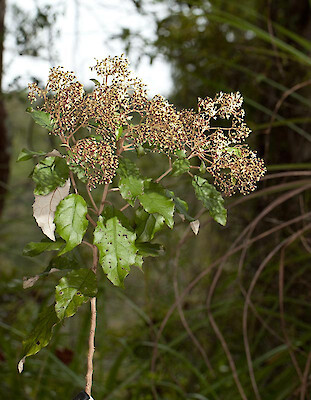
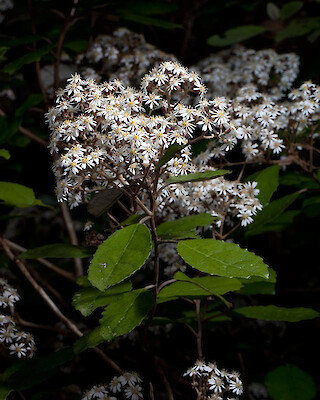
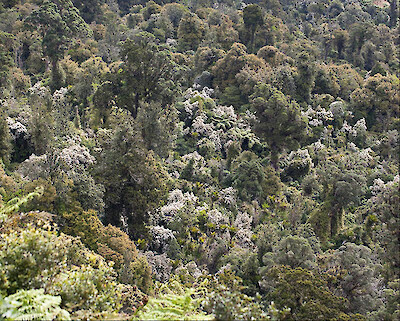
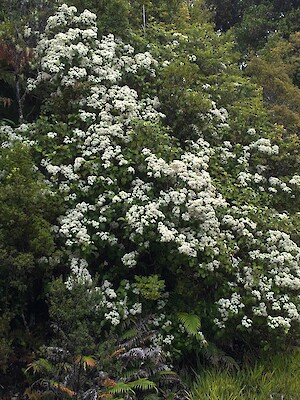
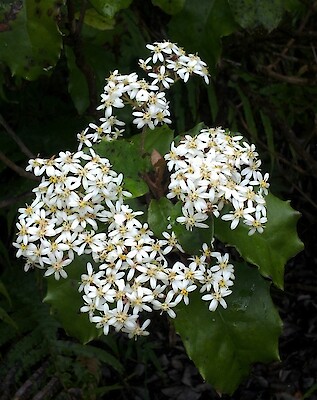
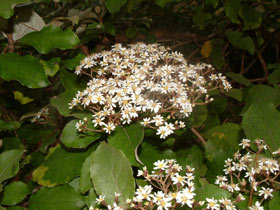
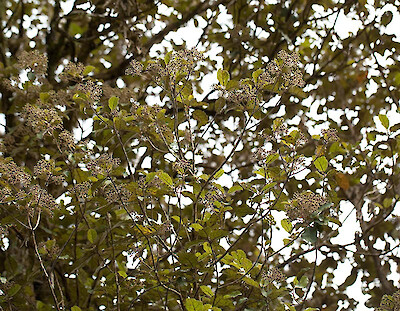
Small tree bearing thin toothed broad oval leaves that are white underneath and with the vein network easily visible inhabiting forests from Northland to the Coromandel. Leaves 8-10 cm by 5-6.5cm wide. Flowers white, body not fuzzy, in a loose spray. Seeds fluffy.
Flower colours
White, Yellow
Distribution
Endemic. Northern North Island only, from Te Paki south to the northern Waikato and near Thames
Detailed taxonomy
Genus
Family
Synonyms
Brachyglottis rani A.Cunn., Eurybia cunninghamii Hook.f., Olearia rani (A.Cunn.) Druce var. rani, Olearia cunninghamii (Hook.f.) Hook.f., Olearia rani var. miniata Kirk
Taxonomic notes
Saldivia & Nicol (2025) did not make combinations for Olearia colorata Colenso; accepted by NZPCN as O. rani var. colorata (Colenso) Kirk stating “Allan (1961: 669) did not accept infraspecific taxa within Shawia rani (as Olearia rani) and mentioned: “A somewhat polymorphic sp., the status of the different forms [not in the taxonomic meaning] not well understood”. Schönberger et al. (2021) accepted both of Kirk’s varieties (colorata and miniata [as minuta, following the misspelling by Allan 1961]). We follow Allan’s (1961) criterion because no taxonomic work validating these varieties has been done since”. This statement is not a clear reflection of what is stated by Allan (1961) who provided no ‘criterion’ merely noting that the status of the different forms is not well understood. It is our view, and evidently that of Bioeconomy Science Institute Landcare Research, that relegation of taxa into synonymy without study is premature. In Shawia rani, two units can be segregated in the field and these have long been recognised as either distinct or potentially so. Therefore, the shift to Shawia leaves Olearia rani var. colorata in Olearia, and until further study is done, NZPCN prefer to retain it as a unit that can be recognised in the field, rather than risk it being overlooked because, as yet, no one has done a proper study of the variation in Shawia rani s.l. - which was was what Allan (1961) was stating needed to be done.
Endemic taxon
Yes
Endemic genus
No
Endemic family
No
Ecology
Propagation technique
Easy from fresh seed and cuttings but very difficult to maintain in cultivation, which is why it is so scarce in the horticultural trade
Other information
Cultivation
Occasionally offered by specialist native plant nurseries.
Etymology
shawia: After Thomas Shaw (1694-1751), English scholar and traveller.
rani: Corruption of wha-rangi
NVS code
The National Vegetation Survey (NVS) Databank is a physical archive and electronic databank containing records of over 94,000 vegetation survey plots - including data from over 19,000 permanent plots. NVS maintains a standard set of species code abbreviations that correspond to standard scientific plant names from the Ngä Tipu o Aotearoa - New Zealand Plants database.
OLERVR
Chromosome number
2n = 108
Previous conservation statuses
The conservation status of all known New Zealand vascular plant taxa at the rank of species and below were reassessed in 2022-2023 using the New Zealand Threat Classification System (NZTCS) – more information about this can be found on the NZTCS website. This report includes replaces all previous NZTCS lists for vascular plants. Previous assessments can be found here.
- Conservation status of vascular plants in Aotearoa New Zealand, 2023. 2024. Peter J. de Lange, Jane Gosden, Shannel P. Courtney, Alexander J. Fergus, John W. Barkla, Sarah M. Beadel, Paul D. Champion, Rowan Hindmarsh-Walls, Troy Makan and Pascale Michel Department of Conservation. Source: NZTCS and licensed by DOC for reuse under the Creative Commons Attribution 4.0 International licence.
2017 | Not Threatened
2012 | Not Threatened
2009 | Not Threatened
2004 | Not Threatened
Regional conservation statuses
Auckland: 2025 | Regionally Not Threatened | Qualifiers: DPS, DPT
Current regional threat status assessments prepared according to Crisp et al. (2025) are displayed when available. The Auckland conservation status information is sourced from the “Conservation status of vascular plant species in Tāmaki Makaurau / Auckland” Simpkins E et al. 2025 report.
Referencing and citations
References and further reading
Allan, H.H. 1961: Flora of New Zealand. Vol. I. Government Printer, Wellington.
Saldivia, P.; Nicol, D.A. 2025: Reinstatement, broader circumscription, and infrageneric classification of Shawia (Astereae, Celmisiinae), a large woody genus endemic to Australasia. Phytoneuron 49: 1–43.