New Zealand Plant Conservation Network
  • Member login
  • Join
Facebook
  • Home
  • Flora
    • Flora species
    • Tag names
    • Vascular
    • Non-vascular
    • Lichens
    • Plant identification
    • Fungi
    • Make your own book
    • Quiz
  • Threats
    • Exotic Plants (Weeds)
    • Pest Animals
    • Other threats
  • Ecosystems
    • Plant communities
    • Ecosystem services
    • Novel ecosystems
  • Publications
    • Documents
    • Newsletter
    • Plant lists
    • Botanical Society journals
    • NZPCN publications
  • Conservation
    • Seedbank
    • Training
    • Restoration
    • Monitoring
    • Habitat protection
    • Funding
    • Botanic gardens
    • Botanic Societies
  • NZPCN
    • News
    • Trilepidea newsletter
    • Events
    • David Given Scholarship
    • Council members
    • Awards
    • Shop
    • Donate
    • Favourite Plant
    • Why join NZPCN?
    • Join
  • Help
    • FAQ
    • Query
    • Glossary
  • Contact us

Search flora

  1. Tracheophyta
    • Tracheophyta
  2. Magnoliopsida
    • Lycopodiopsida
    • Magnoliopsida
    • Pinopsida
    • Polypodiopsida
  3. Asterales
    • Alismatales
    • Apiales
    • Arecales
    • Asparagales
    • Asterales
    • Boraginales
    • Brassicales
    • Canellales
    • Caryophyllales
    • Celastrales
    • Chloranthales
    • Crossosomatales
    • Cucurbitales
    • Dioscoreales
    • Ericales
    • Fabales
    • Fagales
    • Gentianales
    • Geraniales
    • Gunnerales
    • Lamiales
    • Laurales
    • Liliales
    • Malpighiales
    • Malvales
    • Myrtales
    • Nymphaeales
    • Oxalidales
    • Pandanales
    • Paracryphiales
    • Piperales
    • Poales
    • Proteales
    • Ranunculales
    • Rosales
    • Santalales
    • Sapindales
    • Saxifragales
    • Solanales
  4. Asteraceae
    • Alseuosmiaceae
    • Argophyllaceae
    • Asteraceae
    • Campanulaceae
    • Goodeniaceae
    • Menyanthaceae
    • Rousseaceae
    • Stylidiaceae
  5. Brachyglottis
    • Abrotanella
    • Anaphalioides
    • Argyrotegium
    • Brachyglottis
    • Brachyscome
    • Cassinia
    • Celmisia
    • Centipeda
    • Cotula
    • Craspedia
    • Damnamenia
    • Dolichoglottis
    • Euchiton
    • Ewartiothamnus
    • Haastia
    • Helichrysum
    • Lagenophora
    • Leptinella
    • Leucogenes
    • Macrolearia
    • Microseris
    • Olearia
    • Ozothamnus
    • Pachystegia
    • Picris
    • Pleurophyllum
    • Pseudognaphalium
    • Rachelia
    • Raoulia
    • Senecio
    • Shawia
    • Solenogyne
    • Sonchus
    • Taraxacum
    • Traversia
    • Vittadinia
  6. Brachyglottis huntii
    • Brachyglottis huntii
    • Brachyglottis kirkii var. kirkii
    • Brachyglottis perdicioides
    • Brachyglottis sciadophila
    • Brachyglottis arborescens
    • Brachyglottis bifistulosa
    • Brachyglottis compacta
    • Brachyglottis myrianthos
    • Brachyglottis pentacopa
    • Brachyglottis stewartiae
    • Brachyglottis turneri
    • Brachyglottis adamsii
    • Brachyglottis cassinioides
    • Brachyglottis elaeagnifolia
    • Brachyglottis greyi
    • Brachyglottis hectorii
    • Brachyglottis kirkii var. angustior
    • Brachyglottis laxifolia
    • Brachyglottis repanda
    • Brachyglottis revoluta
    • Brachyglottis rotundifolia var. rotundifolia
    • Brachyglottis rotundifolia var. ambigua
    • Brachyglottis bellidioides var. bellidioides
    • Brachyglottis bellidioides var. crassa
    • Brachyglottis haastii
    • Brachyglottis lagopus
    • Brachyglottis southlandica
    • Brachyglottis traversii
    • Brachyglottis bidwillii
    • Brachyglottis cockaynei
    • Brachyglottis monroi
    • Brachyglottis buchananii
    • Brachyglottis bellidioides var. orbiculata

Brachyglottis huntii
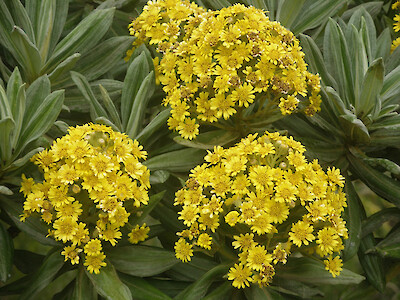
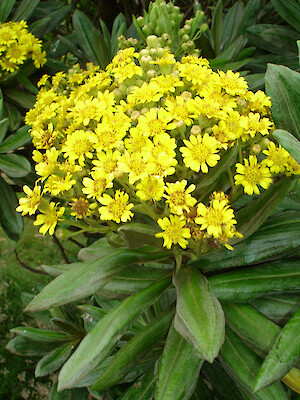
Chatham Islands.<br>Photographer: John Sawyer, Licence: <a target='_blank' href='https://creativecommons.org/licenses/by-nc/4.0'>CC BY-NC</a>. <a class='member-message' href='/nzpcn/why-join-nzpcn/' target='_blank'>Members can view a larger version of this image.</a>
Chatham Islands.<br>Photographer: Peter J de Lange, Licence: <a target='_blank' href='https://creativecommons.org/licenses/by-nc/4.0'>CC BY-NC</a>. <a class='member-message' href='/nzpcn/why-join-nzpcn/' target='_blank'>Members can view a larger version of this image.</a>
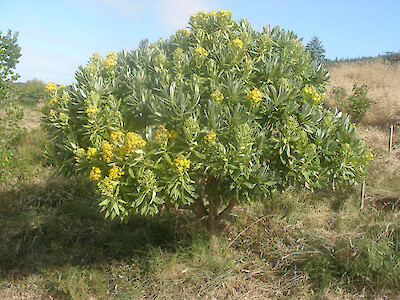
In cultivation, Queens Park, Invercargill.<br>Photographer: Jesse Bythell, Date taken: 15/12/2021, Licence: <a target='_blank' href='https://creativecommons.org/licenses/by-nc/4.0'>CC BY-NC</a>. <a class='member-message' href='/nzpcn/why-join-nzpcn/' target='_blank'>Members can view a larger version of this image.</a>
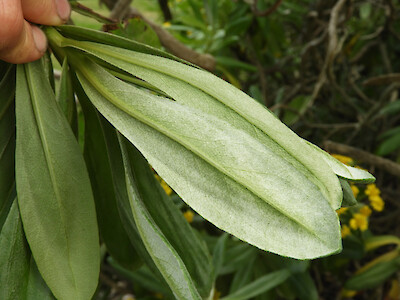
Abaxial leaf surface, in cultivation, Queens Park, Invercargill.<br>Photographer: Jesse Bythell, Date taken: 15/12/2021, Licence: <a target='_blank' href='https://creativecommons.org/licenses/by-nc/4.0'>CC BY-NC</a>. <a class='member-message' href='/nzpcn/why-join-nzpcn/' target='_blank'>Members can view a larger version of this image.</a>
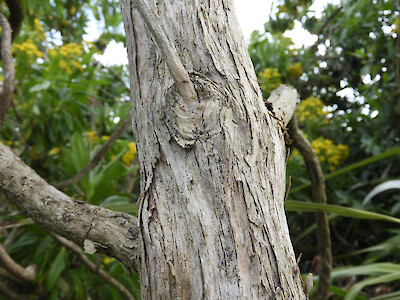
Bark detail, in cultivation, Queens Park, Invercargill.<br>Photographer: Jesse Bythell, Date taken: 15/12/2021, Licence: <a target='_blank' href='https://creativecommons.org/licenses/by-nc/4.0'>CC BY-NC</a>. <a class='member-message' href='/nzpcn/why-join-nzpcn/' target='_blank'>Members can view a larger version of this image.</a>
Chatham Islands.<br>Photographer: Peter J de Lange, Licence: <a target='_blank' href='https://creativecommons.org/licenses/by-nc/4.0'>CC BY-NC</a>. <a class='member-message' href='/nzpcn/why-join-nzpcn/' target='_blank'>Members can view a larger version of this image.</a>
Brachyglottis huntii.<br>Photographer: Peter J de Lange, Licence: <a target='_blank' href='https://creativecommons.org/licenses/by-nc/4.0'>CC BY-NC</a>.
Chatham Islands.<br>Photographer: John Sawyer, Licence: <a target='_blank' href='https://creativecommons.org/licenses/by-nc/4.0'>CC BY-NC</a>. <a class='member-message' href='/nzpcn/why-join-nzpcn/' target='_blank'>Members can view a larger version of this image.</a>
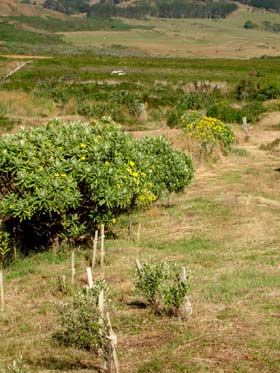
Awatotara, Chatham Island.<br>Photographer: Jeremy R. Rolfe, Date taken: 03/06/2013, Licence: <a target='_blank' href='https://creativecommons.org/licenses/by/4.0'>CC BY</a>. <a class='member-message' href='/nzpcn/why-join-nzpcn/' target='_blank'>Members can view a larger version of this image.</a>
Chatham Islands.<br>Photographer: John Sawyer, Licence: <a target='_blank' href='https://creativecommons.org/licenses/by-nc/4.0'>CC BY-NC</a>. <a class='member-message' href='/nzpcn/why-join-nzpcn/' target='_blank'>Members can view a larger version of this image.</a>
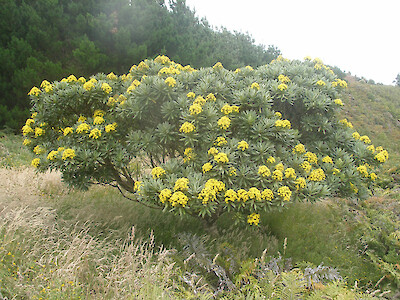
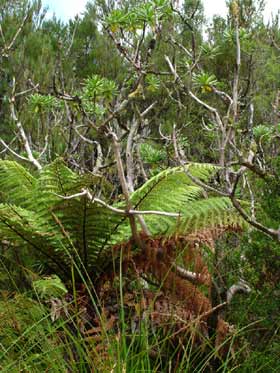
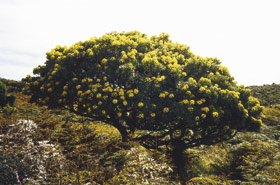
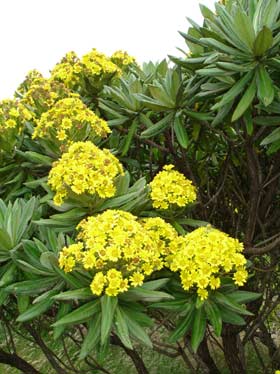
Brachyglottis huntii tree in full flower, Awatotara Covenant, Southern Tablelands, Chatham (Rekohu) Island.<br>Photographer: Phil Knightbridge, Licence: All rights reserved.
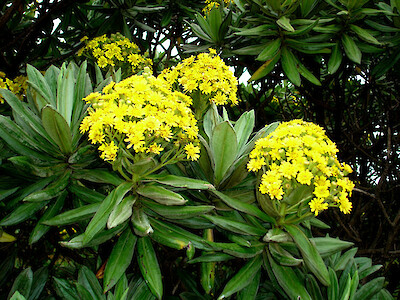
Brachyglottis huntii, tree dying from unknown disease at Gillespies Stream.<br>Photographer: Peter J de Lange, Licence: <a target='_blank' href='https://creativecommons.org/licenses/by-nc/4.0'>CC BY-NC</a>.
Brachyglottis huntii.<br>Photographer: Peter J de Lange, Licence: <a target='_blank' href='https://creativecommons.org/licenses/by-nc/4.0'>CC BY-NC</a>.
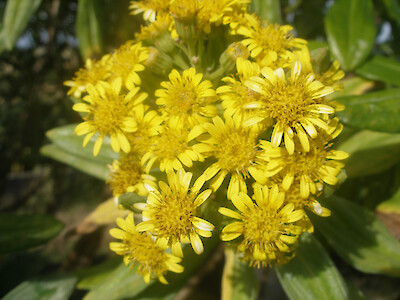
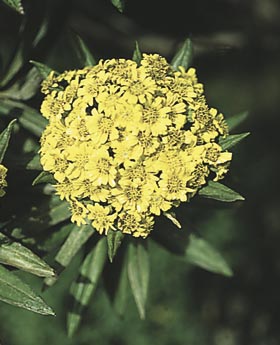
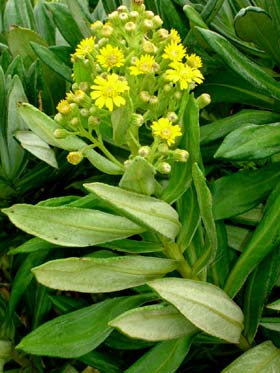
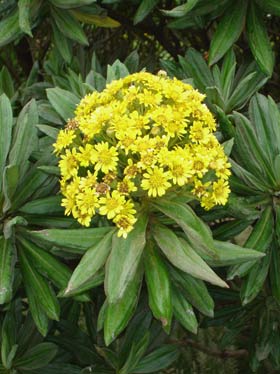
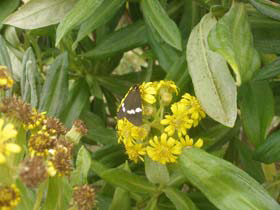
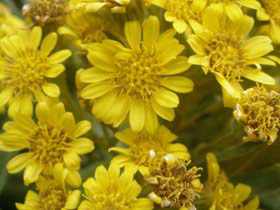
Brachyglottis huntii close up of inflorescence.<br>Photographer: Phil Knightbridge, Licence: All rights reserved.
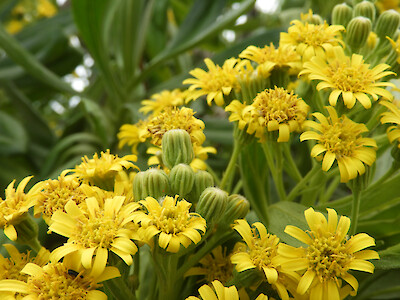
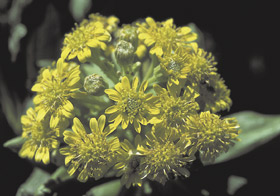
Brachyglottis huntii close up of inflorescence showing individual capitula.<br>Photographer: Craig Potton, Licence: All rights reserved.
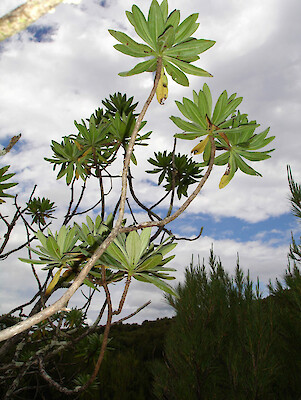
Brachyglottis huntii near Waitangi.<br>Photographer: Peter J de Lange, Licence: <a target='_blank' href='https://creativecommons.org/licenses/by-nc/4.0'>CC BY-NC</a>.
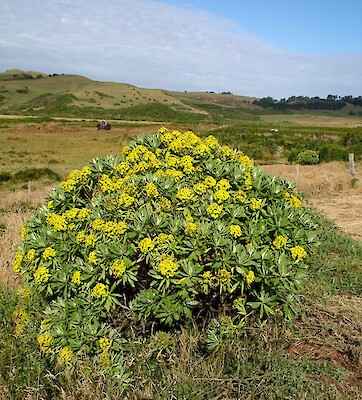
Brachyglottis huntii.<br>Photographer: Peter J de Lange, Licence: <a target='_blank' href='https://creativecommons.org/licenses/by-nc/4.0'>CC BY-NC</a>.
Brachyglottis huntii tree in full flower.<br>Photographer: Colin Miskelly, Licence: All rights reserved.
Brachyglottis huntii, Awatotara.<br>Photographer: Peter J de Lange, Licence: <a target='_blank' href='https://creativecommons.org/licenses/by-nc/4.0'>CC BY-NC</a>.
Brachyglottis huntii tree in clearing.<br>Photographer: Barbara Mitcalfe, Licence: <a target='_blank' href='https://creativecommons.org/licenses/by-nc/4.0'>CC BY-NC</a>.
Brachyglottis huntii.<br>Photographer: John Sawyer, Licence: <a target='_blank' href='https://creativecommons.org/licenses/by-nc/4.0'>CC BY-NC</a>.
Brachyglottis huntii, Awatotara.<br>Photographer: Peter J de Lange, Licence: <a target='_blank' href='https://creativecommons.org/licenses/by-nc/4.0'>CC BY-NC</a>.
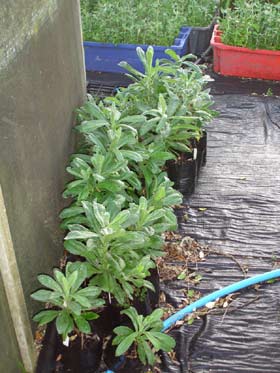
Brachyglottis huntii, DoC Nusery.<br>Photographer: Peter J de Lange, Licence: <a target='_blank' href='https://creativecommons.org/licenses/by-nc/4.0'>CC BY-NC</a>.
Download PDF Comment on factsheet

NZPCN members can select up to 20 plant species and automatically create a full colour, fully illustrated A4 book describing them (in PDF format).

  • Find out more...
  • Join NZPCN...
Find in plant lists
iNaturalist NZ View observations Biota of NZ Click here to view NZ Flora Click here to view Traditional Maori Uses Click here to view Te Papa specimens View specimens Herbarium View AVH specimens Donate Support NZPCN
Award crown

Past favourite plant winner

Common names

rautini, Chatham Island Christmas tree

Biostatus

Native – Endemic taxon

Current conservation status

The conservation status of all known New Zealand vascular plant taxa at the rank of species and below were reassessed in 2022-2023 using the New Zealand Threat Classification System (NZTCS) – more information about this can be found on the NZTCS website. This report includes replaces all previous NZTCS lists for vascular plants. Previous assessments can be found here.

  • Conservation status of vascular plants in Aotearoa New Zealand, 2023. 2024. Peter J. de Lange, Jane Gosden, Shannel P. Courtney, Alexander J. Fergus, John W. Barkla, Sarah M. Beadel, Paul D. Champion, Rowan Hindmarsh-Walls, Troy Makan and Pascale Michel Department of Conservation. Source: NZTCS and licensed by DOC for reuse under the Creative Commons Attribution 4.0 International licence.

2023 | Threatened – Nationally Vulnerable | Qualifiers: DPS, DPT, IE, RF

Jump to previous conservation statuses

Category

Vascular

Structural class

Trees & Shrubs - Dicotyledons

Simplified description

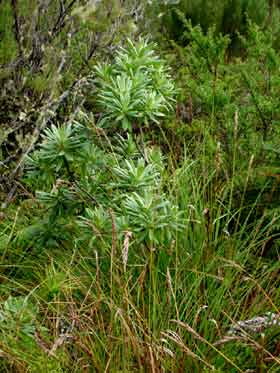
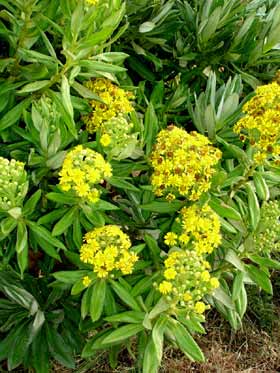
Large spreading grey-green shrub inhabiting peatlands of the Chatham Islands. Twigs brittle and bearing leaf scars. Leaves 5-10cm long, narrow, rolled, thin, grey-green, pale underneath, shiny, margin wavy. Flowers with many radiating yellow petals, clustered together.

Flower colours

Yellow

Detailed description

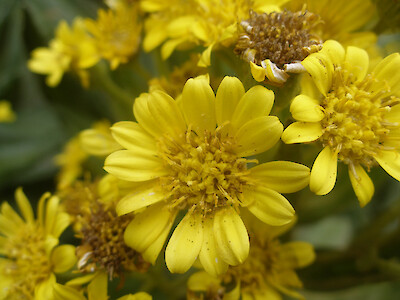
Aromatic, small woody tree up to 6 x 6 m. Bark grey, flaking usually in small shards. Branches stout, spreading, usually bearing numerous leaf scars, leaf toward apex, dead leaves long persistent. Leaves 70-180 x 20-40 mm, ovate, elliptic-lanceolate, grey green, apex subacute, lamina entire or finely toothed in upper third; buds and emergent leaves viscid, resinous, rather aromatic, initially densely clad on both surfaces with fulvous tomentum, becoming glabrescent with age. Inflorescences in dense, terminal panicles, subtended by leaves, all parts viscous, resinous. Pedicels stout, 5-15 mm long, densely glandular pubescent. Capitula 20-30 mm diam., involucral bracts 10-12(-15), narrow-oblong, obtuse to subacute, grey-green, glandular on under sides, ciliate on margins, apex surmounted by a conspicuous tuft of hairs. Ray-florets 15-20, ligules c. 10 mm long, yellow, broad, recurving with age. Cypsela (seeds) 1.5-1.8 mm long, narrow-oblong, pale brown to brown, grooved, glabrescent; pappus-hairs 5-7 mm long, off-white, slender, distinctly barbellate.

Similar taxa

Brachyglottis stewartiae is related but the leaves in this species have dark glossey upper surfaces, and pure white undersides (due to the dense covering of fine, appressed, hairs)

Distribution

Endemic. Chatham Islands, Found on both Chatham Island and Pitt Island. It was once much more common and widespread on Chatham Island but has declined seriously over the last century. On Pitt Island it is still quite widespread; expanding where stock and feral animals are in low numbers, but diminishing elsewhere.

Habitat

Brachyglottis huntiii prefers frequently disturbed and/or early successional habitats, such as those found along stream and river sides, open shrubland, drier swamps, and along ridge crests. It is usually found growing on permanently moist forest and restiad peats and cannot tolerate protracted periods of drought, or heavy shade.

Threats

Brachyglottis huntii was once much more common and widespread on Chatham Island but has declined seriously over the last century. On Pitt Island it is still quite widespread; expanding where stock and feral animals are in low numbers, but diminishing elsewhere. Threats are myriad and include habitat destruction; browsing and trampling by cattle, sheep, pigs and possums. While fire can destroy plants the disturbance caused can also provide fresh sites for seedlings to colonise.
Recent reports of the sudden collapse of apparently healthy trees are suggestive of such soil borne pathogens as phytophora and verticillium wilt. There is some evidence to suggest that the species is self-incompatible, because seed collected from isolated trees has very poor germination. This has important implications for future management, particularly on main Chatham, where the species is now seriously threatened, and often represented on parts of the island by isolated individuals.

Detailed taxonomy

Genus

Brachyglottis

Family

Asteraceae

Authority

Brachyglottis huntii (F.Muell.) B.Nord.
Synonyms

Senecio huntii F.Muell.

Endemic taxon

Yes

Endemic genus

No

Endemic family

No

Ecology

Flowering

November - February

Fruiting

Late summer and early autumn

Life cycle and dispersal

Pappate achenes are dispersed by wind (Thorsen et al., 2009).

Propagation technique

Easily grown from fresh seed and semi-hardwood cuttings. However, plants can be difficult to maintain. In cultivation they are prone to sudden collapse from such soil and water borne diseases as phytophora, verticillium and fusarium wilt. This species does best planted in a semi-shaded site or in a permanently moist, deep peaty soil, with a south-facing aspect. Once planted it should not be disturbed. In ideal conditions it is fast growing and will flower within 1-2 years from seed. This is a naturally short-lived species so it is wise to maintain young stock for replacement of older trees.

Other information

Cultivation

Occasionally available from specialist native plant nurseries

Plant of the Month

This plant has been featured as a Plant of the Month – see Trilepidea: NZPCN newsletter for December 2006 for the full story.

Etymology

brachyglottis: Name comes from the Greek words brachus meaning “short” and glottis meaning “the vocal apparatus of the larynx”

NVS code

The National Vegetation Survey (NVS) Databank is a physical archive and electronic databank containing records of over 94,000 vegetation survey plots - including data from over 19,000 permanent plots. NVS maintains a standard set of species code abbreviations that correspond to standard scientific plant names from the Ngä Tipu o Aotearoa - New Zealand Plants database.

BRAHUN

Chromosome number

2n = 60

Previous conservation statuses

The conservation status of all known New Zealand vascular plant taxa at the rank of species and below were reassessed in 2022-2023 using the New Zealand Threat Classification System (NZTCS) – more information about this can be found on the NZTCS website. This report includes replaces all previous NZTCS lists for vascular plants. Previous assessments can be found here.

  • Conservation status of vascular plants in Aotearoa New Zealand, 2023. 2024. Peter J. de Lange, Jane Gosden, Shannel P. Courtney, Alexander J. Fergus, John W. Barkla, Sarah M. Beadel, Paul D. Champion, Rowan Hindmarsh-Walls, Troy Makan and Pascale Michel Department of Conservation. Source: NZTCS and licensed by DOC for reuse under the Creative Commons Attribution 4.0 International licence.

2017 | Threatened – Nationally Vulnerable | Qualifiers: CD, IE, RF, RR

2012 | Threatened – Nationally Vulnerable | Qualifiers: CD, IE, RF, RR

2009 | Threatened – Nationally Critical | Qualifiers: CD, IE

2004 | Threatened – Nationally Endangered

Jump to current conservation status

Referencing and citations

References and further reading

de Lange PJ, Heenan PB, Norton DA, Rolfe JR, Sawyer JWD. 2010. Threatened Plants of New Zealand. Canterbury University Press, Christchurch. 471 p.

Thorsen MJ, Dickinson KJM, Seddon PJ. 2009. Seed dispersal systems in the New Zealand flora. Perspectives in Plant Ecology, Evolution and Systematics 11: 285–309. https://doi.org/10.1016/j.ppees.2009.06.001.

Attribution

Fact Sheet prepared for NZPCN by P.J. de Lange 11 March 2004. Description subsequently published in de Lange et al. (2010)

NZPCN Fact Sheet citation

Please cite as: de Lange, P.J. (Year at time of access): Brachyglottis huntii Fact Sheet (content continuously updated). New Zealand Plant Conservation Network. https://www.nzpcn.org.nz/flora/species/brachyglottis-huntii/ (Date website was queried)
▲ Back to top
  • Home
  • Flora
  • Threats
  • Ecosystems
  • Publications
  • Conservation
  • NZPCN
  • Help
  • Contact us

© 2026 New Zealand Plant Conservation Network • Website by RS

Coastlands Plant Nursery Wildlands

Website sponsor

  • Home
  • Flora
    • Flora species
    • Tag names
    • Vascular
      • Ferns
        • King fern
        • True ferns
        • Adder's tongue ferns
        • Fork ferns and whisk ferns
        • Horsetails
      • Conifers
        • Celery pines
        • Kauri
        • Podocarps
          • Podocarpus
          • Dacrydium
          • Prumnopitys
          • Dacrycarpus
          • Halocarpus
          • Lepidothamnus
          • Manoao
        • Cypress
      • Flowering plants
        • Parasites
          • Leafy mistletoes
          • Pygmy mistletoes
            • Korthalsella flowers
            • Korthalsella hosts
            • Dispersal of Korthalsella
            • Associates of Korthalsella
          • Root parasites
          • Saprophytes
        • Epiphytes
          • NZ
            • Typical
            • Occasional
            • Hemi-epiphytes
            • Ephemeral
            • NZ list
        • Monocots
          • Orchids
            • Structure
          • Grasses
        • Dicots
          • Hebes
          • Kowhai
          • Coprosma
          • Beech
          • Rata
        • Carnivorous
        • Deciduous plants
        • Aquatic plants
      • Poisonous natives
      • Threatened plant lists
      • What's a vascular plant?
      • Club mosses
    • Non-vascular
      • Bryophytes
        • Liverworts
        • Mosses
        • Hornworts
      • Algae
        • Seaweeds
    • Lichens
    • Plant identification
      • Written descriptions
      • Experts
      • Plant keys
        • Key to parasitic plant genera
      • Collecting plants
        • Should I collect
        • Choosing a specimen
        • Field notes
        • Fresh plant material
        • Pressing and drying
        • Mounting specimens
        • Labelling specimens
    • Fungi
    • Make your own book
    • Quiz
  • Threats
    • Exotic Plants (Weeds)
      • Unwanted organisms
      • DOC weeds
      • Plant me instead
      • Pest Plant Accord
    • Pest Animals
      • Mammals
        • Mustelids
        • Rodents
        • Ungulates
        • Possums
      • Fish
      • Insects
    • Other threats
      • Natural events
        • Insects
      • Human induced
        • Habitat loss
        • Collection
        • Climate change
  • Ecosystems
    • Plant communities
      • Dunes
        • Volcanic
        • Coastal
          • Threats
          • Common species
          • Research on dunes
          • Pingao research
          • What you can do
      • Wetlands
        • Estuaries
          • Common estuarine species
          • Research on estuaries
        • Ephemeral
        • Restiad peat bogs
      • Forests
        • Kauri-podocarp-broadleaved
        • Podocarp broadleaved
        • Beech
      • Scrub/shrublands
        • Geothermal
          • Distribution of geothermal vegetation
          • Geothermal plants
          • Geothermal vegetation types
          • Threats to geothermal vegetation
        • Frost flat/hollow
        • Manuka fens
        • Gumlands
      • Grasslands
        • Tussock grasslands
      • Bare ground
        • Braided rivers
        • Alpine
        • Cliff
        • Scree and boulderfields
        • Shingle beaches
      • Herbfields
        • Saltpan
    • Ecosystem services
    • Novel ecosystems
  • Publications
    • Documents
    • Newsletter
    • Plant lists
      • Search plant lists
      • Plant lists by political region/district
      • Plant lists by ecological region/district
      • National plant lists
      • How to prepare a plant list
    • Botanical Society journals
    • NZPCN publications
  • Conservation
    • Seedbank
      • Project 1 - Pohutukawa, Rata and Myrtaceae
      • Project 2 - Alpine flora and the Forget-Me-Nots
      • Project 3 - Kowhai and its relatives
      • Project 4 - Podocarps and trees of the forest
    • Training
      • Module 1: Plant life
      • Module 2: Covenants
      • Module 3: Propagation
      • Module 4: Wetlands
      • Pilot course 2006
    • Restoration
      • Gardening
        • Being weed wise
        • Garden plants
          • Trees and shrubs
          • Broad-leaved herbs
          • Grass-like herbs
          • Climbers
          • Ferns
        • Attracting wildlife
        • Planting for lizards
          • Rules
      • Species recovery
        • Plant translocations
      • Ecological restoration
        • Case studies
          • Tavora Reserve
          • Waiwhakareke
      • Revegetation
      • Eco-sourcing
      • Find a restoration group
    • Monitoring
      • Number count
        • Number count method
        • Pros and cons of number counts
        • Data analysis and interpretation
      • Presence/absence surveys
        • Presence/absence survey methods
        • Pros and cons of presence/absence surveys
        • Data analysis and interpretation
      • Mapping spatial extent
        • Spatial extent mapping methods
        • Pros and cons of spatial extent mapping
        • Data analysis and interpretation
      • Photo points
        • Photo point guidelines
    • Habitat protection
      • Legal protection
        • Nga Whenua Rahui
        • QEII covenants
        • DOC Covenants
      • Animal pest control
      • Weed control
      • Fencing
    • Funding
    • Botanic gardens
    • Botanic Societies
  • NZPCN
    • News
    • Trilepidea newsletter
    • Events
      • 2026 NZPCN conference
        • 2026 Conference field trips
        • 2026 Conference workshops
        • 2026 conference sponsors
        • 2026 Conference keynote speakers
      • 2024 AGM
      • Conference 2024
        • 2024 conference overview
        • Conference 2024 workshops
        • Conference 2024 Field Trips
        • 2024 conference sponsors
        • Conference 2024 accommodation options
        • 2024 Conference Programme
      • Conference 2022
        • Conference programme summary
        • 2022 conference workshops
        • 2022 conference field trips
        • Code of conduct
        • COVID-19 information
        • 2022 conference sponsors
        • Abstract and poster submission
        • 2022 Conference venue and accommodation
        • Conference Workshop: Restoration Pathways
        • 2022 conference postponement
      • Conference 2019
      • Conference 2017
      • Conference 2015
        • Speakers
        • Workshops
        • Field trips
        • Charity auction
      • Conference 2013
        • Speakers
        • Timetable
      • 2023 Restoration Pathways Workshop
      • 2023 AGM
    • David Given Scholarship
      • David Given Scholarship Recipients
    • Council members
      • NZPCN council member profiles
      • Council 2023
      • Council 2022
      • Council 2021
      • Council 2020
      • Council 2019
      • Council 2018
      • Council 2017
      • Council 2016
      • Council 2015
      • Council 2014
      • Council 2024
      • Council 2013
      • Council 2012
      • Council 2011
      • Council 2010
      • Council 2009
      • Council 2008
      • Council 2007
      • Council 2006
      • Council 2005
      • Council 2004
      • Council 2003
    • Awards
      • NZPCN Awards
        • 2024 Plant Conservation Awards
        • 2022
        • 2019
        • 2018
        • 2017
        • 2016
        • 2015
        • 2014
        • 2013
        • 2012
        • 2011
        • 2010
        • 2009
        • 2008
        • 2007
        • 2006
        • 2005
    • Shop
    • Donate
    • Favourite Plant
    • Why join NZPCN?
    • Join
  • Help
    • FAQ
      • Joining the Network
      • The Network
      • Network website
      • New Zealand plants
      • The law
      • Your discoveries
    • Query
    • Glossary
  • Contact us
  • Facebook