
Brachyglottis pentacopa

Biostatus
Native – Endemic taxon
Current conservation status
The conservation status of all known New Zealand vascular plant taxa at the rank of species and below were reassessed in 2022-2023 using the New Zealand Threat Classification System (NZTCS) – more information about this can be found on the NZTCS website. This report includes replaces all previous NZTCS lists for vascular plants. Previous assessments can be found here.
- Conservation status of vascular plants in Aotearoa New Zealand, 2023. 2024. Peter J. de Lange, Jane Gosden, Shannel P. Courtney, Alexander J. Fergus, John W. Barkla, Sarah M. Beadel, Paul D. Champion, Rowan Hindmarsh-Walls, Troy Makan and Pascale Michel Department of Conservation. Source: NZTCS and licensed by DOC for reuse under the Creative Commons Attribution 4.0 International licence.
2023 | Threatened – Nationally Critical | Qualifiers: OL
Category
Vascular
Structural class
Trees & Shrubs - Dicotyledons
Simplified description
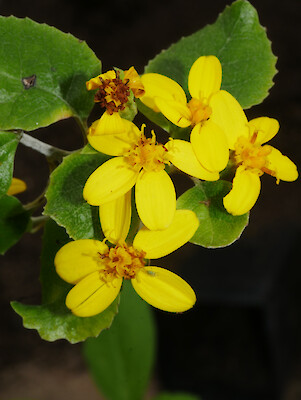
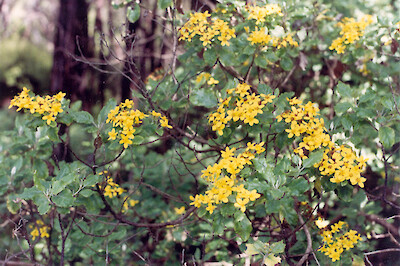
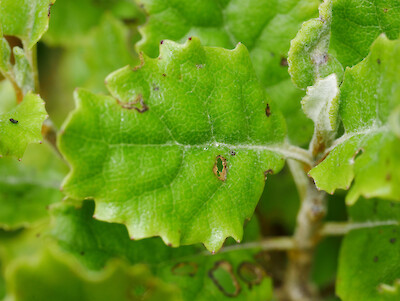
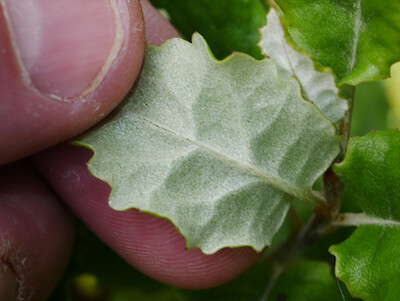
Rare wiry shrub inhabiting only Mt Percy in the Wairarapa. Leaves yellow-green, paler underneath, margin toothed and very wavy, on a grooved stalk. Flowers daisy-like with yellow, rounded, radiating petals, in loose clusters.
Flower colours
Orange, Yellow
Detailed description
Mildly aromatic flowering shrub 1-2 × 2.5 metres. Trunk stout, bark pale to dark grey, peeling in small flakes or shards. Branchlets numerous, spreading, slender and wiry, leaves terminally crowded. Leaf buds pubescent. Petioles slender, 8-15 mm long, grooved. Leaves leathery, slightly bullate, (31-)35-38(-43) × (-21)23-26(-29) mm, elliptic to broadly elliptic or occasionally broadly oblong-elliptic, margin upper 2/3 to 3/4 crenate to serrate, wavey (particularly when young), apex obtuse, dark green, to yellow-green with paler undersides, upper surface glabrescent except for pubescent veins, undersides usually covered in cotton-like tomentose. Inflorescences a dense terminal corymb. Capitula 4-25, turbinate, borne on pubescent pedicels. Ray florets 4-5, ligules elliptical, yellow, 4.6-5.0× 7.3-8.5 mm, apex minutely emarginate. Disc florets 7-9, corolla 5 lobes, translucent yellow, anther orange-yellow, stigma yellow. Phyllaries 6-8 linear, base truncate, pale grey green, abaxially pubescent, margins scarious, persistent after seed maturity becoming woody. Seed a cypsela, obovate-elliptic, 3 angled, 3.2-3.5 mm long, yellowish-brown, pappus-hairs stiff, 4-5.5 mm long.
Similar taxa
Differs from Brachyglottis perdicioides which has elliptic to broadly elliptic, rarely broadly oblong-elliptic leaves with undersides usually covered in sparse “cobb webbed” hairs. The capitula of B. perdicioides usually have 1–3 ray florets rather than the usual 5 ray florets on the capitula of B. pentacopa.
Distribution
Endemic. North Island, only known from Taraoneone | Mt Percy in the Eastern Wairarapa
Habitat
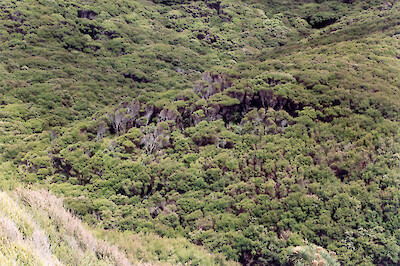
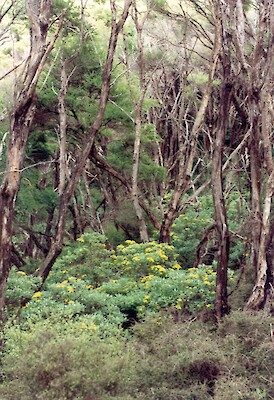
Lowland (300-450 m.a.s.l.), specialist of Kanuka understory. Thrives in well-drained high wind-flow regime, plants in damp situation suffer from leaf mould which eventually leads to the plant succumbing due to lack of ability to photosynthesize and die.
Threats
Ungulate browsing. Work is being undertaken to fence out the deer in the area to prevent further reduction in spread, and aid survival of the next generation and re-planted eco-sourced specimens.
Detailed taxonomy
Genus
Family
Synonyms
Senecio ‘Mt Percy’ G. Park: Senecio pentacopus D.G.Drury
Endemic taxon
Yes
Endemic genus
No
Endemic family
No
Ecology
Flowering
December-January
Fruiting
January-March
Propagation technique
Easy from semi-hardwood cuttings. Does best in full sun. Benefits from a hard prune after flowering.
In cultivation at the Otari-Wilton’s Wellington Botanical garden, it has been reported to be very difficult to grow and make happy enough to get to a flowering stage (Pers. comm. T. Belworthy, 2025).
Other information
Etymology
brachyglottis: Name comes from the Greek words brachus meaning “short” and glottis meaning “the vocal apparatus of the larynx”
NVS code
The National Vegetation Survey (NVS) Databank is a physical archive and electronic databank containing records of over 94,000 vegetation survey plots - including data from over 19,000 permanent plots. NVS maintains a standard set of species code abbreviations that correspond to standard scientific plant names from the Ngä Tipu o Aotearoa - New Zealand Plants database.
BRAPEN
Chromosome number
2n = 60
Previous conservation statuses
The conservation status of all known New Zealand vascular plant taxa at the rank of species and below were reassessed in 2022-2023 using the New Zealand Threat Classification System (NZTCS) – more information about this can be found on the NZTCS website. This report includes replaces all previous NZTCS lists for vascular plants. Previous assessments can be found here.
- Conservation status of vascular plants in Aotearoa New Zealand, 2023. 2024. Peter J. de Lange, Jane Gosden, Shannel P. Courtney, Alexander J. Fergus, John W. Barkla, Sarah M. Beadel, Paul D. Champion, Rowan Hindmarsh-Walls, Troy Makan and Pascale Michel Department of Conservation. Source: NZTCS and licensed by DOC for reuse under the Creative Commons Attribution 4.0 International licence.
2017 | Threatened – Nationally Critical | Qualifiers: DP, OL
2012 | At Risk – Naturally Uncommon | Qualifiers: RR
2009 | At Risk – Naturally Uncommon | Qualifiers: OL
2004 | Range Restricted
Referencing and citations
References and further reading
DG Drury. 1973. Annotated key to the New Zealand shrubby senecioneae-compositae and their wild and garden hybrids, New Zealand Journal of Botany, 11(4), pp. 731-784. DOI: 10.1080/0028825X.1973.10430309
Attribution
Fact sheet prepared by P.J. de Lange for NZPCN (1 June 2013). Fact sheet completed by M. Ward for NZPCN (9 December 2025)