
Melicytus drucei
Common names
Mount Egmont shrub māhoe, Druce’s māhoe
Biostatus
Native – Endemic taxon
Current conservation status
The conservation status of all known New Zealand vascular plant taxa at the rank of species and below were reassessed in 2022-2023 using the New Zealand Threat Classification System (NZTCS) – more information about this can be found on the NZTCS website. This report includes replaces all previous NZTCS lists for vascular plants. Previous assessments can be found here.
- Conservation status of vascular plants in Aotearoa New Zealand, 2023. 2024. Peter J. de Lange, Jane Gosden, Shannel P. Courtney, Alexander J. Fergus, John W. Barkla, Sarah M. Beadel, Paul D. Champion, Rowan Hindmarsh-Walls, Troy Makan and Pascale Michel Department of Conservation. Source: NZTCS and licensed by DOC for reuse under the Creative Commons Attribution 4.0 International licence.
2023 | Threatened – Nationally Endangered | Qualifiers: CD, DPT, RR
Category
Vascular
Structural class
Trees & Shrubs - Dicotyledons
Simplified description
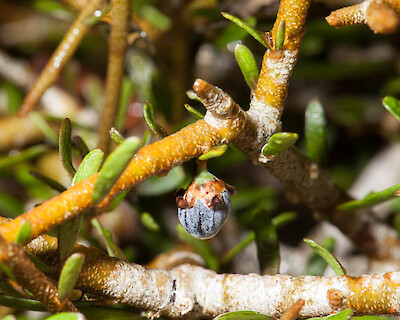
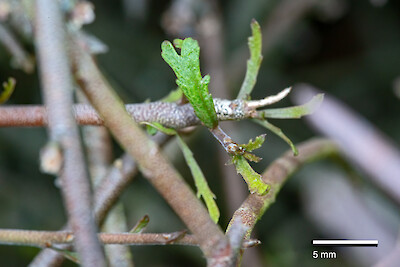
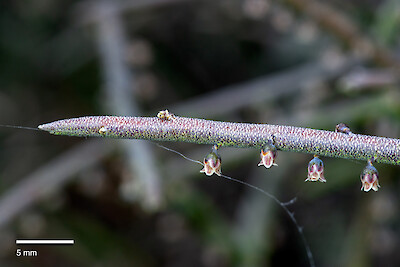
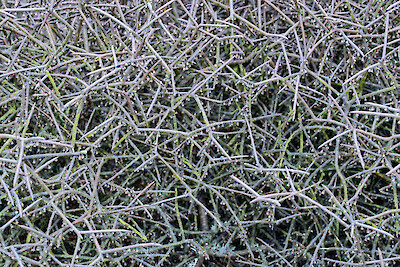
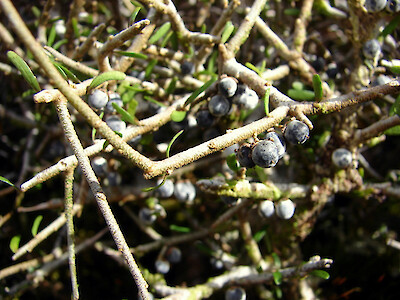
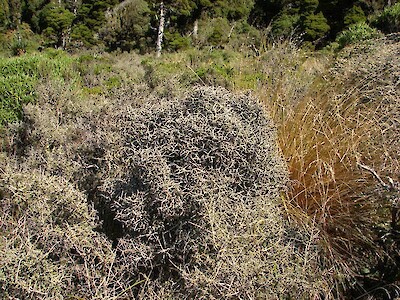
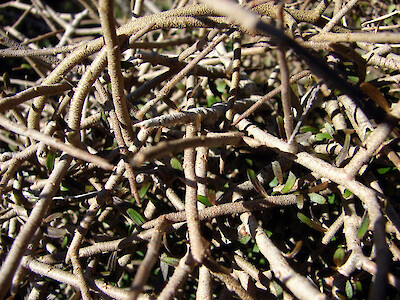
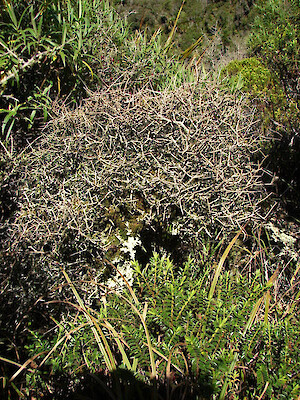
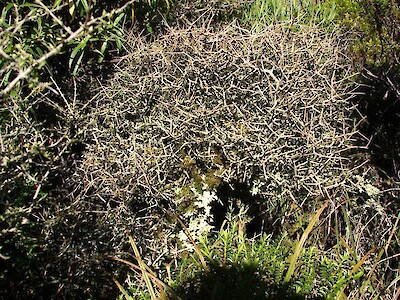
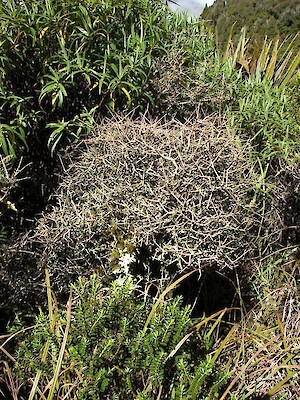
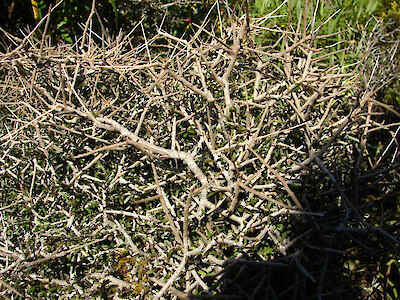
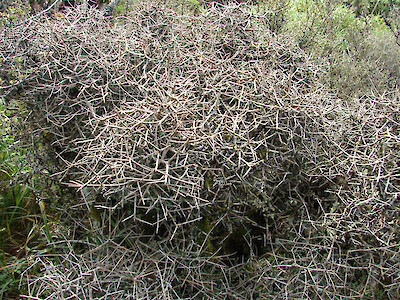
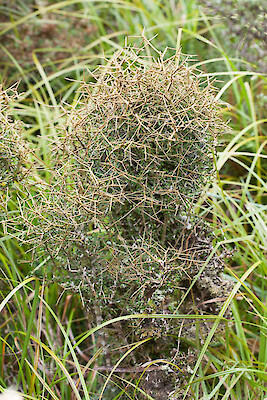
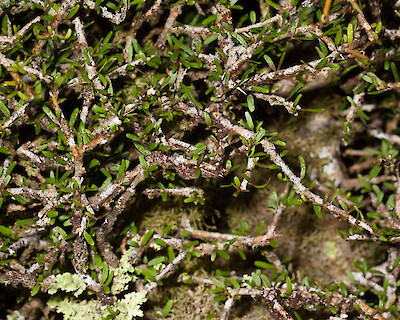
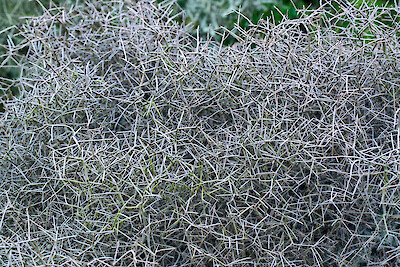
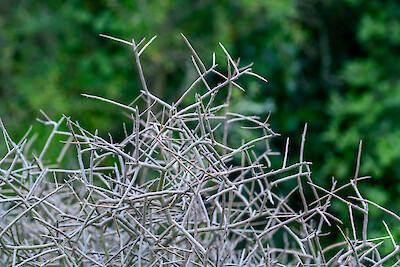
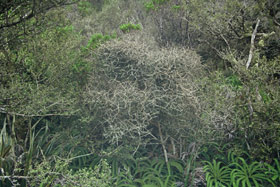
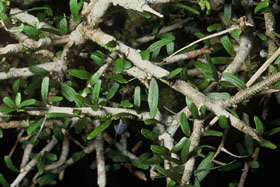
Greyish widely branched tangled shrub with speckled twigs inhabiting one small area in Mt Egmont National Park. Leaves not immediately obvious, 7-12mm long by 2mm wide, dark green. Flowers small, bell-shaped, under branches. Fruit small, purple.
Flower colours
Green, Red/Pink
Detailed description
Erect, ± evergreen shrubs 2 m or more tall. Exposed plants with compact, rigid, grey-brown crowns up to 1 m diameter, composed of tightly filiramulate-divaricate branches. Shaded plants with smaller, less filiramulate-divaricate, segmented crowns intermixed with those of other shrubs. Stems erect or suberect, 20-40 mm diameter, knobbly and crooked with regular coppice and epicormic shoots and occasional layered stems. Branchlets initially slender, later stout, curved or straight, green densely lenticellate, tapering to spinous tips; strongly interlaced on exposed plants with branch angles of 70-90°, less interlaced on shaded plants. Adult leaves alternate, 7-12 × 2 mm, solitary or in fascicles of 2-3, shortly petiolate or ± sessile, linear-oblong, often ± parallel-sided, entire or irregularly lobed, distinctly reflexed, thin, dark green above, paler beneath, glabrous when mature, minutely pubescent when young, margins finely revolute, apex retuse, often with a minute central apiculus. Flowers hermaphrodite, nectariferous, scented, solitary or more rarely paired, axillary, pendulous on lower side of branches. Peduncles slender, 0.5-2.0 mm long, decurved, green, with 2 minute, unequal, opposite, ovate, erose, orange bracteoles near the base, sometimes also at the middle. Flowers 2.5-3.5 mm diameter sepals unequal, ovate to deltoid, 1.0-1.5 mm long, green suffused with red, with paler, membranous, erosulate-ciliate margins; petals ± fleshy, broadly oblong to cuneate, 3-4 × 2 mm, cream or yellow, with reflexed slightly thickened tips and erosulate-ciliate margins; anthers sessile, oblong, 0.5 mm long, 2-loculed, creamy yellow, with an extended, toothed, membranous, orange connective. Erect nectary appendage attached basally to the dorsal surface of each stamen, 0.5 mm long, cuneate, green. Anthers fused to form an urceolate tube surrounding the gynoecium. Ovary 1 mm long, ovoid, green; style slender, 0.5 mm long, not reaching corolla rim, 2-fid, green; stigma lobes flared, erosulate-papillate. Fruit a globose berry 4-5 mm diameter, white with scattered purple to black spots or patches. Pyrenes (1-)2, 3-4 mm long, plano-convex, purplish-brown.
Similar taxa
Allied to Melicytus flexuosus Molloy et A.Druce from which it differs by its shorter stature, compact rigid crown of tightly divaricating branches and mostly leafy branchlets, hermaphrodite flowers, chromosome number (2n = 48) and geographic isolation.
Distribution
Endemic. New Zealand: North Island (Mt Egmont National Park (Ahukawakawa Swamp and Pouakai Range)
Habitat
Known from two sites. At the Ahukawakawa Swamp it grows along the colluvial toeslope, alluvial fan, and alluvial terrace, in the canopy layer or scrub margins of mixed scrub/shrubland (grey scrub) in places exposed to full sunlight. On the Pouakai Range it grows near or above tree-line on flat or gentle slopes with waterlogged peat soils or on steep sided, scrubby ridge lines.
Threats
Melicytus drucei is a naturally uncommon, range restricted endemic. However it is browsed avidly by introduced animals such as possums and hares. When these animals are controlled M. drucei plants thrive and set abundant seed. Seedlings and saplings have become common since possum numbers have been greatly reduced within the National Park following the use of 1080 by the New Zealand Department of Conservation in the late 1990’s.
Detailed taxonomy
Genus
Family
Synonyms
None (first described in 1996)
Endemic taxon
Yes
Endemic genus
No
Endemic family
No
Ecology
Flowering
October to December
Fruiting
March to May
Propagation technique
Slow from seed and cuttings. A very slow growing plant which has an attractive growth habit. It is rarely seen in cultivation.
Other information
New Zealand botanical history note
For a brief biography of AP (Tony) Druce, for whom this plant is named, see this article in Te Ara - The Encyclopedia of New Zealand. Hundreds of Tony’s famed plant lists can be found here and back-issues of regional Botanical Society Journals which he contributed can be accessed here.
Etymology
melicytus: From the Greek meli (honey) and kytos (hollow container), referring to the staminal nectaries of the flowers. Literally “honey-cave”
drucei: Named after Anthony (Tony) Peter Druce, one of New Zealand’s most respected field botanist (1920-1999).
Chromosome number
2n = 48
Previous conservation statuses
The conservation status of all known New Zealand vascular plant taxa at the rank of species and below were reassessed in 2022-2023 using the New Zealand Threat Classification System (NZTCS) – more information about this can be found on the NZTCS website. This report includes replaces all previous NZTCS lists for vascular plants. Previous assessments can be found here.
- Conservation status of vascular plants in Aotearoa New Zealand, 2023. 2024. Peter J. de Lange, Jane Gosden, Shannel P. Courtney, Alexander J. Fergus, John W. Barkla, Sarah M. Beadel, Paul D. Champion, Rowan Hindmarsh-Walls, Troy Makan and Pascale Michel Department of Conservation. Source: NZTCS and licensed by DOC for reuse under the Creative Commons Attribution 4.0 International licence.
2017 | Threatened – Nationally Endangered | Qualifiers: CD, RR
2012 | Threatened – Nationally Endangered | Qualifiers: CD, RR
2009 | At Risk – Naturally Uncommon | Qualifiers: CD, RC, OL
2004 | Range Restricted
Referencing and citations
References and further reading
Molloy, B.P.J.; Clarkson, B.D. 1996: A new, rare species of Melicytus (Violaceae) from New Zealand New Zealand Journal of Botany 34: 431-440.
Attribution
Fact sheet prepared for NZPCN by P.J. de Lange 2 July 2006. Description adapted from Molloy & Clarkson (1996).