
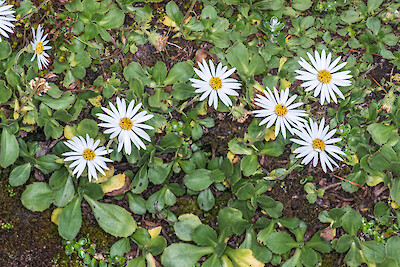
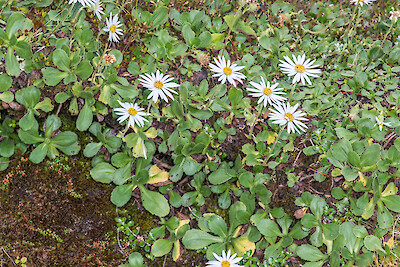
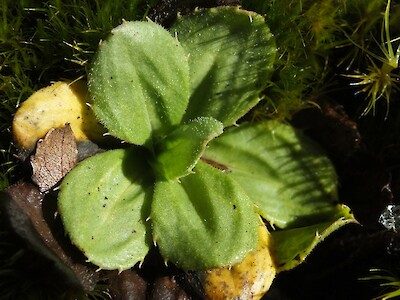
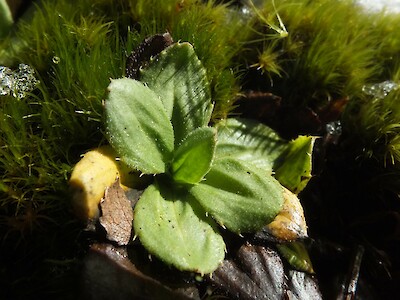
Celmisia glandulosa var. latifolia
Common names
Egmont bog mountain daisy
Biostatus
Native – Endemic taxon
Current conservation status
The conservation status of all known New Zealand vascular plant taxa at the rank of species and below were reassessed in 2022-2023 using the New Zealand Threat Classification System (NZTCS) – more information about this can be found on the NZTCS website. This report includes replaces all previous NZTCS lists for vascular plants. Previous assessments can be found here.
- Conservation status of vascular plants in Aotearoa New Zealand, 2023. 2024. Peter J. de Lange, Jane Gosden, Shannel P. Courtney, Alexander J. Fergus, John W. Barkla, Sarah M. Beadel, Paul D. Champion, Rowan Hindmarsh-Walls, Troy Makan and Pascale Michel Department of Conservation. Source: NZTCS and licensed by DOC for reuse under the Creative Commons Attribution 4.0 International licence.
2023 | At Risk – Naturally Uncommon | Qualifiers: OL
Category
Vascular
Structural class
Herbs - Dicotyledonous composites
Flower colours
White, Yellow
Detailed description
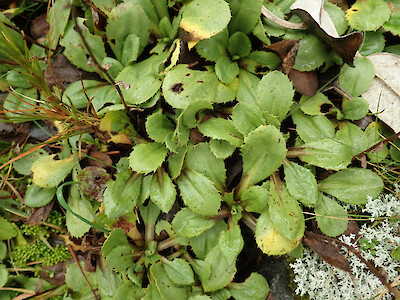
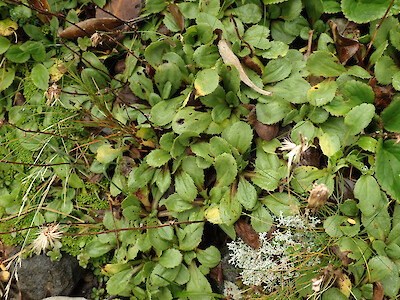
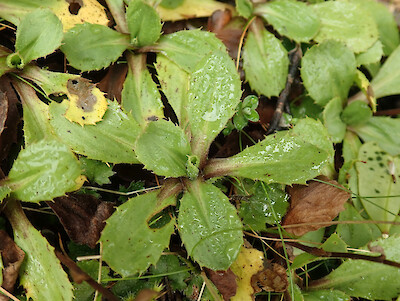
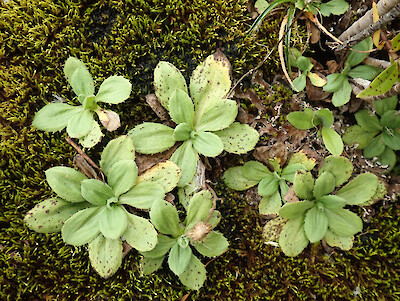
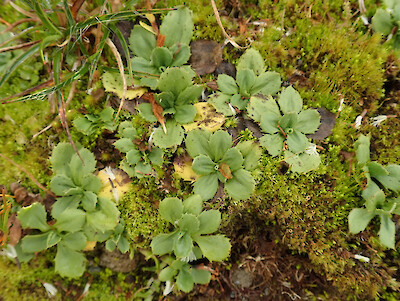
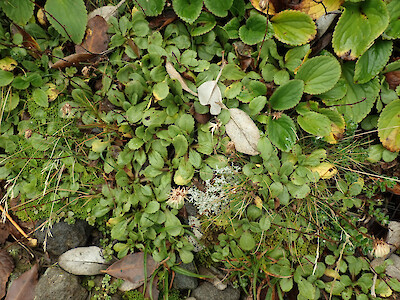
Stoloniferous herb with stout rather woody main stem, bearing rosulate leaves and emitting stolons up to c.250 mm long, rooting at nodes and there with rosulate leaves. Lamina coriaceous to submembranous, broadly oblong-spathulate to obovate, glandular-pubescent on both surfaces with evident reticulate veins and midrib, bright green above, paler below, 20-30 × 10-20 mm; apex obtuse apiculate; margins remotely to rather closely, coarsely serrate-dentate, teeth often apiculate; petiole 15 mm long, winged, parallel ribs distinct; sheath narrow, membranous, glabrous, ± 10 mm long. Scape slender, glandular-pubescent, 50-100 mm long, rather stiff; bracts numerous, linear-oblong, acute to acuminate, glandular, lower up to 15 mm long. Capitula 12-30 mm diameter; involucral bracts linear-subulate, acuminate, clad in soft hairs, especially marginally, up to 8-9 mm long. Ray florets conspicuous, spreading, up to c.15 mm long; limb obovate-oblong, up to c.4 mm wide, 3-toothed. Disk-florets funnelform, 6-8 mm long; teeth minute, ascending, narrow-triangular. Achenes narrow-cylindric, 2-3 mm long, ribs with fine ascending hairs. Pappus-hairs up to 8 mm long, very slender, very finely barbellate.
Similar taxa
Differs from C. glandulosa var. glandulosa by the larger and broader leaves (20-30 × 10-20 mm cf. 10-20 × 5-8 mm). It differs from C. glandulosa var. longiscapa, a south-western South Island endemic, by the shorter scapes (50-100 mm cf. 120-200 mm long) and its restriction to Egmont National Park, in the North Island.
Distribution
Endemic. North Island: Mount Egmont and Pouakai Range.
Habitat
Subalpine to alpine. Common in wet places in tussock-grassland or herbfield and in bogs.
Threats
A naturally uncommon plant that is abundant within the confines of Egmont National Park.
Detailed taxonomy
Genus
Family
Synonyms
None
Endemic taxon
Yes
Endemic genus
No
Endemic family
No
Ecology
Flowering
October - March
Fruiting
December - May
Propagation technique
Easy to grow from fresh seed and the division of established plants. Best in a pot or a rockery. Dislikes humidity and drying out.
Other information
Where To Buy
Not commercially available.
Plant of the Month
This plant has been featured as a Plant of the Month – see Trilepidea: NZPCN newsletter for April 2018 for the full story.
Etymology
celmisia: Apparently named after Kelmis, one of Idaean Dactyls, a group of skilled mythical beings associated with the Mother Goddess Rhea in Greek mythology. Kelmis, whose name means ‘casting’, was a blacksmith and childhood friend of Zeus, son of Rhea and later king of the gods. In Ovid’s ‘Metamorphoses’, Kelmis is described as offending Zeus who turned him into adamant so he was as hard as a tempered blade
glandulosa: Gland bearing
latifolia: From the Latin latus meaning broad, and folium meaning leaf, relating to the “broad-leaved” foliage of the plant.
Manaaki Whenua Online Interactive Key
NVS code
The National Vegetation Survey (NVS) Databank is a physical archive and electronic databank containing records of over 94,000 vegetation survey plots - including data from over 19,000 permanent plots. NVS maintains a standard set of species code abbreviations that correspond to standard scientific plant names from the Ngä Tipu o Aotearoa - New Zealand Plants database.
CELGVL
Chromosome number
2n = 108
Previous conservation statuses
The conservation status of all known New Zealand vascular plant taxa at the rank of species and below were reassessed in 2022-2023 using the New Zealand Threat Classification System (NZTCS) – more information about this can be found on the NZTCS website. This report includes replaces all previous NZTCS lists for vascular plants. Previous assessments can be found here.
- Conservation status of vascular plants in Aotearoa New Zealand, 2023. 2024. Peter J. de Lange, Jane Gosden, Shannel P. Courtney, Alexander J. Fergus, John W. Barkla, Sarah M. Beadel, Paul D. Champion, Rowan Hindmarsh-Walls, Troy Makan and Pascale Michel Department of Conservation. Source: NZTCS and licensed by DOC for reuse under the Creative Commons Attribution 4.0 International licence.
2017 | At Risk – Naturally Uncommon | Qualifiers: OL
2012 | At Risk – Naturally Uncommon | Qualifiers: RR
2009 | At Risk – Naturally Uncommon | Qualifiers: OL
2004 | Range Restricted
Referencing and citations
References and further reading
Allan, H.H. 1961: Flora of New Zealand. Vol. I, Government Printer, Wellington.
Attribution
Description adapted from Allan (1961).
Some of this factsheet information is derived from Flora of New Zealand Online and is used under a Creative Commons Attribution 3.0 New Zealand licence.