
Celmisia markii
Common names
Mark’s celmisia
Biostatus
Native – Endemic taxon
Current conservation status
The conservation status of all known New Zealand vascular plant taxa at the rank of species and below were reassessed in 2022-2023 using the New Zealand Threat Classification System (NZTCS) – more information about this can be found on the NZTCS website. This report includes replaces all previous NZTCS lists for vascular plants. Previous assessments can be found here.
- Conservation status of vascular plants in Aotearoa New Zealand, 2023. 2024. Peter J. de Lange, Jane Gosden, Shannel P. Courtney, Alexander J. Fergus, John W. Barkla, Sarah M. Beadel, Paul D. Champion, Rowan Hindmarsh-Walls, Troy Makan and Pascale Michel Department of Conservation. Source: NZTCS and licensed by DOC for reuse under the Creative Commons Attribution 4.0 International licence.
2023 | At Risk – Naturally Uncommon | Qualifiers: DPS, DPT, RR
Category
Vascular
Structural class
Herbs - Dicotyledonous composites
Flower colours
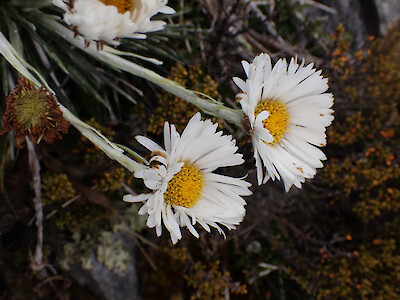
White
Detailed description
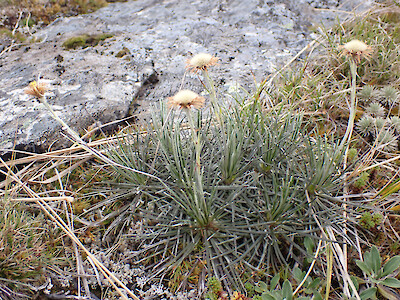
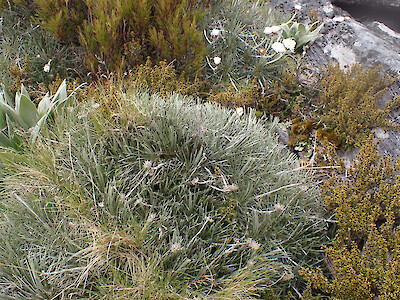
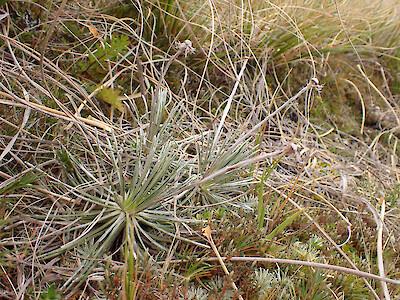
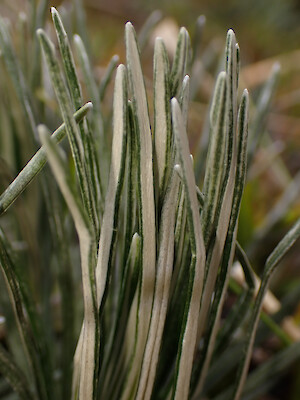
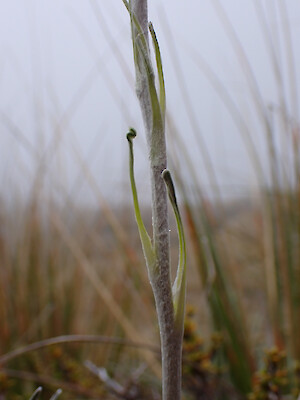
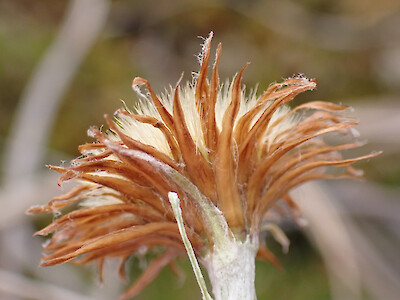
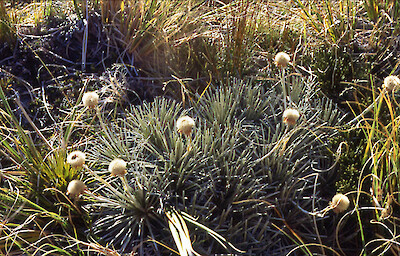
Woody-based perennial herb arising fom multicipital stock and forming somewhat flattened hemispherical cushions up to 80 cm diameter. Leaf lamina linear, rigid, straight; current seasons leaves erect, those of previous season becoming reflexed; 50.0-100.0 × 1.0—2.5 mm; upper surface with a median groove, yellowish green, clad in a persistent pellicle which becomes grey-green on older leaves; lower surface clad in white appressed tomentum; margins entire, strongly recurved to midrib; tip acute but not markedly acicular. Leaf sheath up to 50 mm long, membranous, purplish, covered with a thin pellicle. Scape 80-150 × 2-3 mm; bracts few, up to 25 mm long, glabrate, yellowish- green. Involucral bracts erect, linear-subulate, acute, up to 15 mm long, glabrate, tawny brown, venation simple. Receptacle obconic, surface alveolate. Ray florets up to 15 mm long, limb narrow, linear-lanceolate and glabrous, tube narrow and glabrous. In disc florets, corolla tube gradually narrowed from apex to base, glabrous; stamen tip acute, anther tails short; style bifid, arms differentiated into a lower parallel-sided papillose portion shorter than the triangular appendage which bears short collecting hairs. Pappus bristles unequal, c.25 in number, 3.5-5.0 mm long with closely spaced, short teeth. Achenes 3-3.5 mm long, fusiform, ribbed and clad in short bifid hairs.
Similar taxa
Could be confused with Celmisia spedenii which is an ultramafic species found on the Livingston Range and at West Dome. It differs from C. markii by its usually curved rather than straight leaves, with acicular rather than rounded leaf tips. The involucral bracts of C. markii are glabrate, tawny-brown while those of C. spedenii are silver-grey and tomentose
Distribution
Endemic. South Island south of Haast River to Mount Paulina, Caswell Sound. Also Mt Aspiring National Park.
Habitat
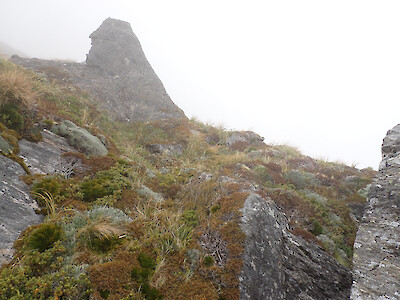
Alpine. On sparsely vegetated ground, fell field and in tussock grassland. Not known from ultramafic rocks.
Threats
A naturally uncommon species that does not appear to be actively threatened
Detailed taxonomy
Genus
Family
Synonyms
None
Endemic taxon
Yes
Endemic genus
No
Endemic family
No
Ecology
Flowering
December - February
Fruiting
December - February
Life cycle and dispersal
Pappate cypselae are dispersed by wind (Thorsen et al., 2009).
Propagation technique
Unknown.
Other information
Etymology
celmisia: Apparently named after Kelmis, one of Idaean Dactyls, a group of skilled mythical beings associated with the Mother Goddess Rhea in Greek mythology. Kelmis, whose name means ‘casting’, was a blacksmith and childhood friend of Zeus, son of Rhea and later king of the gods. In Ovid’s ‘Metamorphoses’, Kelmis is described as offending Zeus who turned him into adamant so he was as hard as a tempered blade
Manaaki Whenua Online Interactive Key
NVS code
The National Vegetation Survey (NVS) Databank is a physical archive and electronic databank containing records of over 94,000 vegetation survey plots - including data from over 19,000 permanent plots. NVS maintains a standard set of species code abbreviations that correspond to standard scientific plant names from the Ngä Tipu o Aotearoa - New Zealand Plants database.
CELMAR
Chromosome number
2n = 108
Previous conservation statuses
The conservation status of all known New Zealand vascular plant taxa at the rank of species and below were reassessed in 2022-2023 using the New Zealand Threat Classification System (NZTCS) – more information about this can be found on the NZTCS website. This report includes replaces all previous NZTCS lists for vascular plants. Previous assessments can be found here.
- Conservation status of vascular plants in Aotearoa New Zealand, 2023. 2024. Peter J. de Lange, Jane Gosden, Shannel P. Courtney, Alexander J. Fergus, John W. Barkla, Sarah M. Beadel, Paul D. Champion, Rowan Hindmarsh-Walls, Troy Makan and Pascale Michel Department of Conservation. Source: NZTCS and licensed by DOC for reuse under the Creative Commons Attribution 4.0 International licence.
2017 | At Risk – Naturally Uncommon | Qualifiers: DP, RR
2012 | At Risk – Naturally Uncommon | Qualifiers: RR
2009 | At Risk – Naturally Uncommon | Qualifiers: RR
2004 | Range Restricted
Referencing and citations
References and further reading
Lee, W.G.; Given, D.R. 1984: Celmisia spedenii G. Simpson, an ultramafic endemic, and Celmisia markii, sp. nov., from southern New Zealand. New Zealand Journal of Botany 22: 585–592.
Thorsen, M. J.; Dickinson, K. J. M.; Seddon, P. J. 2009. Seed dispersal systems in the New Zealand flora. Perspectives in Plant Ecology, Evolution and Systematics 2009 Vol. 11 No. 4 pp. 285-309
Attribution
Description from: Lee and Given (1984)