
Celmisia morganii

Common names
Ngakawau Gorge daisy
Biostatus
Native – Endemic taxon
Current conservation status
The conservation status of all known New Zealand vascular plant taxa at the rank of species and below were reassessed in 2022-2023 using the New Zealand Threat Classification System (NZTCS) – more information about this can be found on the NZTCS website. This report includes replaces all previous NZTCS lists for vascular plants. Previous assessments can be found here.
- Conservation status of vascular plants in Aotearoa New Zealand, 2023. 2024. Peter J. de Lange, Jane Gosden, Shannel P. Courtney, Alexander J. Fergus, John W. Barkla, Sarah M. Beadel, Paul D. Champion, Rowan Hindmarsh-Walls, Troy Makan and Pascale Michel Department of Conservation. Source: NZTCS and licensed by DOC for reuse under the Creative Commons Attribution 4.0 International licence.
2023 | At Risk – Naturally Uncommon | Qualifiers: DPS, DPT, RR
Category
Vascular
Structural class
Herbs - Dicotyledonous composites
Flower colours
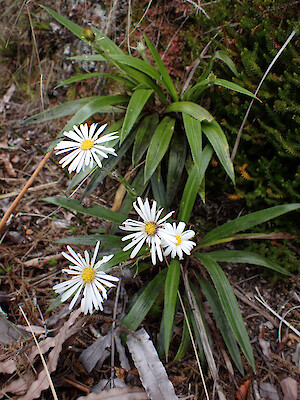
White, Yellow
Detailed description
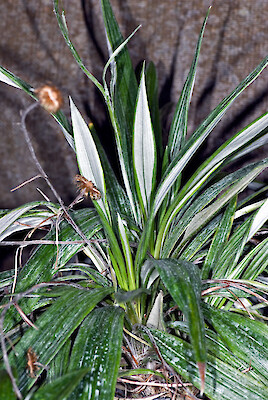
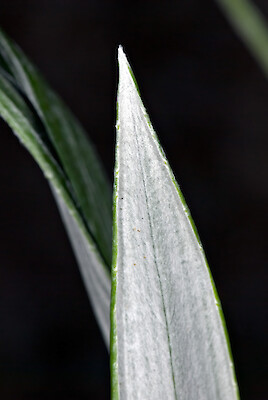
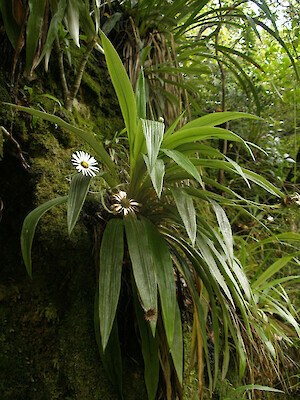
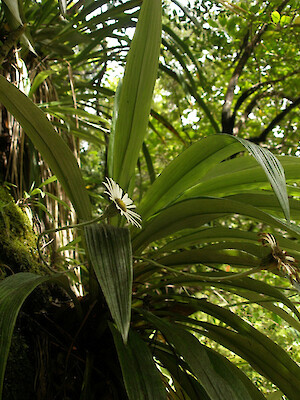
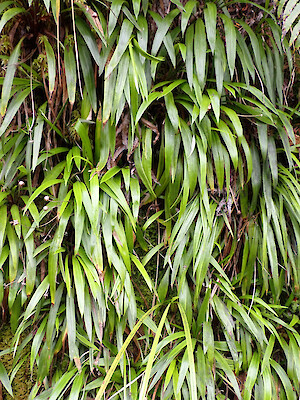
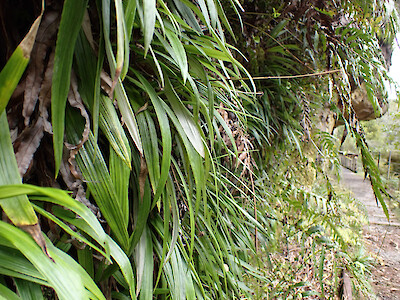
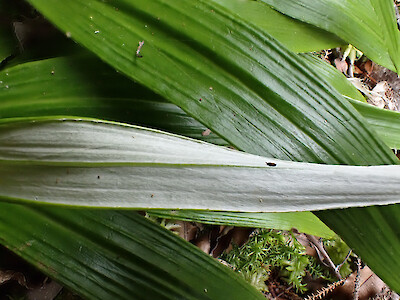
Woody-based herb with branchlets arising from a multicipital stock, usually close to soil surface; living leaves in large rosettes at the tips of branchlets, the whole plant forming irregular patches of numerous rosettes; leaf sheaths densely imbricate and compacted, forming a pseudo-stem. Leaf lamina 150-350 × 18-30 mm, subcoriaceous or flaccid, older leaves weakly patent, lanceolate to oblong; upper surface finely sulcate, concolorous, dark green, glabrate or with a thin, scurfy greenish pellicle; lower surface densely covered in glistening appressed tomentum, midrib prominent and sometimes purple; tip acute; margins entire, slightly revolute; base ± gradually narrowed to a purple, ribbed petiole up to 80 mm long. Sheath up to 60 × 25 mm, purple (rarely greenish), clad in floccose, white hairs or glabrate. Scape purple, thinly clad in floccose, white hairs, slender, up to 300 mm long; bracts several in upper ½, erect, linear; monocephalous. Ray florets c.40, ligulate, the limb narrow-linear, white. Disc florets c.50, 6 mm long, funneliform, yellow, tube with long eglandular biseriate hairs. Achene fusiform, grooved, 3.0-4.5 mm long, glabrous or slightly hairy; hairs short, appressed, bifid. Pappus unequal, c.6 mm long, of c.30 barbellate bristles.
Similar taxa
Celmisia morganii is allied to Celmisia dubia, C. monroi, and C. semicordata. From these species it is most likely to be confused with C. monroi from which it differs by the floppy rather than erect growth habit, leaves whose lamina is glabrate or with a scurfy, greenish rather than leaden pellicle.
Distribution
Endemic. South Island: Vicinity of Ngakawau (Ngakawau River Gorge, Haggard Creek, Blackwater River)
Habitat
Lowland to montane. Riparia, in damp seepages and wet spots in rock talus above rivers and creeks, and on shaded, wet cliff faces along river gorges
Threats
A Naturally Uncommon, narrow range endemic that is abundant within its few known locations. Although there are known major active threats the main population is located within a river system under investigation for a hydroelectric dam
Detailed taxonomy
Genus
Family
Synonyms
None
Taxonomic notes
Celmisia morganii is considered by some New Zealand botanists as indistinct being in their view simply a westerly outlier of C. monroi
Endemic taxon
Yes
Endemic genus
No
Endemic family
No
Ecology
Flowering
September - July
Fruiting
October - August
Propagation technique
Easily grown in a shaded site, planted within a permanently moist, free draining, soil. Dislikes humidity and will not tolerate drying out. Best grown from fresh seed which should be sown immediately or stratified in a fridge or freezer for 1-3 months
Other information
Cultivation
Occasionally available from specialist native plant nurseries.
Plant of the Month
This plant has been featured as a Plant of the Month – see Trilepidea: NZPCN newsletter for April 2012 for the full story.
Etymology
celmisia: Apparently named after Kelmis, one of Idaean Dactyls, a group of skilled mythical beings associated with the Mother Goddess Rhea in Greek mythology. Kelmis, whose name means ‘casting’, was a blacksmith and childhood friend of Zeus, son of Rhea and later king of the gods. In Ovid’s ‘Metamorphoses’, Kelmis is described as offending Zeus who turned him into adamant so he was as hard as a tempered blade
Manaaki Whenua Online Interactive Key
NVS code
The National Vegetation Survey (NVS) Databank is a physical archive and electronic databank containing records of over 94,000 vegetation survey plots - including data from over 19,000 permanent plots. NVS maintains a standard set of species code abbreviations that correspond to standard scientific plant names from the Ngä Tipu o Aotearoa - New Zealand Plants database.
CELMOR
Chromosome number
2n = 108
Previous conservation statuses
The conservation status of all known New Zealand vascular plant taxa at the rank of species and below were reassessed in 2022-2023 using the New Zealand Threat Classification System (NZTCS) – more information about this can be found on the NZTCS website. This report includes replaces all previous NZTCS lists for vascular plants. Previous assessments can be found here.
- Conservation status of vascular plants in Aotearoa New Zealand, 2023. 2024. Peter J. de Lange, Jane Gosden, Shannel P. Courtney, Alexander J. Fergus, John W. Barkla, Sarah M. Beadel, Paul D. Champion, Rowan Hindmarsh-Walls, Troy Makan and Pascale Michel Department of Conservation. Source: NZTCS and licensed by DOC for reuse under the Creative Commons Attribution 4.0 International licence.
2017 | At Risk – Naturally Uncommon | Qualifiers: DP, RR
2012 | At Risk – Naturally Uncommon | Qualifiers: RR
2009 | At Risk – Naturally Uncommon
2004 | Range Restricted
Referencing and citations
References and further reading
Given, D.R. 1980: A taxonomic revision of Celmisia coriacea (Forst.f.) Hook.f. and its immediate allies (Astereae-Compositae). New Zealand Journal of Botany 18: 127-140.
Attribution
Description from Given (1980)