
Lepidium castellanum

Common names
Kermadec Islands scurvy grass
Biostatus
Native – Endemic taxon
Current conservation status
The conservation status of all known New Zealand vascular plant taxa at the rank of species and below were reassessed in 2022-2023 using the New Zealand Threat Classification System (NZTCS) – more information about this can be found on the NZTCS website. This report includes replaces all previous NZTCS lists for vascular plants. Previous assessments can be found here.
- Conservation status of vascular plants in Aotearoa New Zealand, 2023. 2024. Peter J. de Lange, Jane Gosden, Shannel P. Courtney, Alexander J. Fergus, John W. Barkla, Sarah M. Beadel, Paul D. Champion, Rowan Hindmarsh-Walls, Troy Makan and Pascale Michel Department of Conservation. Source: NZTCS and licensed by DOC for reuse under the Creative Commons Attribution 4.0 International licence.
2023 | Threatened – Nationally Critical | Qualifiers: CD, DPS, DPT, EF, IE, RR
Category
Vascular
Structural class
Herbs - Dicotyledons other than Composites
Simplified description
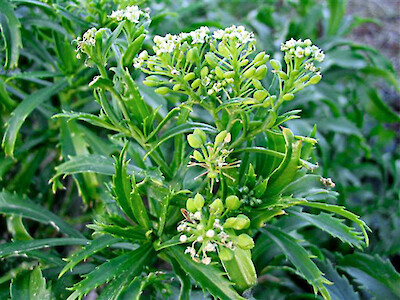
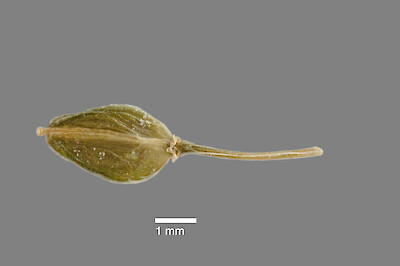
Perennial herb. Plants with numerous erect, leafy branches. Leaves dark green, narrow, with deeply toothed margins (teeth often needle-like) and smelling of cress when crushed. Inflorescences at branch tips, Flowers white with four stamens. Fruiting stalks minutely hairy. Fruits rhomboid with acute apices, splitting cleanly into two valves, seeds brown or orange-brown.
Detailed description
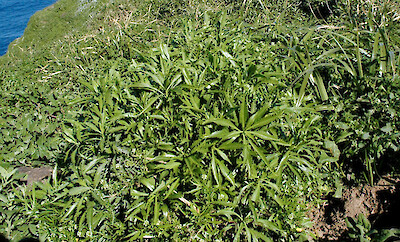
Tap-rooted, strongly pungent smelling, much branched, leafy perennial shrub, up to 1.8 × 2.0 m. Tap-root up to 800 mm long, ± napiform and/or scarcely branched. Rootstock 6–10 mm diameter, woody, exposed portion smooth. Stems persistent, arising from rootstock base and basal portion of main central stem, closely packed, woody, erect, weakly angled to ± terete, glabrous; mature stems 3.8–8.2 mm diameter, 0.3–1.8 m long; red-green to yellow-green, brittle, bases bearing numerous leaf abscission scars otherwise mostly leafy from mid-stem to apex at flowering; middle stems dark green to red-green, fleshy and pliant, initially ± square, prominently angled, becoming ± terete with age. Leaves coriaceous, fleshy, green to dark green, rosette-leaves absent, stem leaves withering with age; basal stem leaves 88.5–120.0 × 14.5–30.0 mm, lamina broadly lanceolate to lanceolate, margin ± deeply and ± evenly incised, teeth in 50–90 ± equal pairs, 0.5–2.9 mm long, protruding beyond leaf line, narrowly deltoid, to deltoid, leaf apex truncate, praemorse often deeply lacerate, teeth 3–5, cut 2.4–4.2 mm to lamina, narrowly deltoid, to deltoid, often bidentate, leaf base attenuate extending into a broad petiole wing; petiole distinct, 23.6–31.0 × 3.1–3.3 mm, decurrent, channelled, often with a broadly sheathing base; upper stem leaves 50.0–68.0 × 4.4–12.2 mm, decreasing in size toward inflorescences, lamina narrowly lanceolate to linear-lanceolate, margin ± deeply and ± evenly incised, teeth in 6–14 widely and evenly spaced ± pairs, 1.5–7.2 mm long, protruding beyond leaf line, narrowly deltoid, tapering, acerose, ± acicular to acicular-falcate; lamina apex acute (rarely truncate-praemorse), acuminate, acumen 5.8–11.0 mm long, margins of acumen toothed, teeth often bidentate, 8–10 mm long, acerose, often acicular, or acicular-falcate, leaf base attenuate extending into a narrow petiole wing; petiole distinct, 2.9–8.2 × 1.2–3.3 mm, decurrent, channelled, often with a broadly sheathing base. Inflorescences racemose, 50–100 mm long at fruiting; rachis 0.5–2.25 mm diam., terminal and lateral, leaf-opposed, often long-persistent, sparsely to densely covered in pale, patent, ± clavate hairs or rarely glabrous, hairs 0.1–0.14 mm long; pedicels 5.6–7.2 mm long at fruiting, erecto-patent, with sparse, pale, patent, clavate hairs on adaxial surface, hairs 0.1–0.12 mm long. Flowers 3.0–4.5 mm diameter, fragrant. Sepals 4, saccate, ± overlapping at base, lateral sepals broad, 0.5–1.5 mm diameter, orbicular, pale to dark green with a broad white, ± undulose margin, apex rounded to obtuse, abaxial surface often hairy, hairs 0.2–0.4 mm long, eglandular or with glandular tip, mostly shedding at anthesis except near base, median sepals 0.5–0.9 mm diameter, broadly elliptic, pale to dark green with a broad white, ± undulose margin, apex rounded to obtuse, abaxial surface glabrous. Petals white, 1.1–2.0 × 1.0–1.6 mm, spreading, claw 0.4–0.8 mm long; limb obovate, obovate-spathulate to orbicular, apex obtuse to rounded often slightly emarginate, margins smooth, sometimes weakly undulose. Stamens 4, filaments 1.2–2.0 mm long, white; anthers 0.3–0.5 mm long, yellow. Ovary 1.1–1.8 × 0.6–1.3 mm, ovate, broadly ovate to elliptic, green-brown, apex subacute; style 0.11–0.4 mm long, cylindrical; stigma 0.2–0.5 mm diameter. Nectaries 4, 0.2–0.3 × 0.1–0.15 mm, narrow-oblong to deltoid, pale translucent green. Silicles cartilaginous when fresh, coriaceous when dry, 2.4–3.6 × 1.8–2.5 mm, elliptic to rhomboid, apex acute and tapering, valves green maturing grey-white, glabrous, scarcely separating at apex at maturity, not winged; style 0.3–0.7 mm long, exserted. Seeds 2, 1.3–1.9 × 0.8–1.6 mm, narrowly to broadly ovoid, brown to orange-brown, not winged.
Similar taxa
Lepidium castellanum is recognised by its very robust, shrubby growth habit, sometimes up to 1.8 × 2.0 m, erect, often closely packed, usually leafy stems, narrowly lanceolate to linear-lanceolate upper stem leaves, and by the very long, needle-shaped teeth of the leaves which reach well beyond the leaf margin. In this species, the pedicels (and often the inflorescence rachises) are minutely hairy. On the Kermadec Islands this species grows with Lepidium oleraceum. It is not closely related to that species, DNA sequence data places it with a clade including L. aegrum, L. crassum and L. juvencum
Distribution
Endemic. Kermadec Islands (Southern Kermadec islands Group (Haszard Islet, Macauley, Curtis and Cheeseman Islands)
Habitat
Coastal. Lepidium castellanum grows along cliff tops in open or sparsely vegetated, petrel-burrowed ground
Threats
Lepidium castellanum is only known from four islands within the Southern Kermadec islands Group. On one of these, Macauley Island, it was known from only a few plants in 2006 and not seen again in 2011, and it has not been confirmed from Curtis Island since 1969. On Haszard Islet and Cheeseman Island between 29 and 59 mature plants have been recorded over the last decade. Although secure at these two locations, the species is obviously not common and on the basis of area of occupancy and number of adults plants readily qualifies for ‘Threatened / Nationally Critical’ status (see Townsend et al. 2008).
Detailed taxonomy
Genus
Family
Synonyms
None (first described in 2013)
Endemic taxon
Yes
Endemic genus
No
Endemic family
No
Ecology
Flowering
July - June
Fruiting
September - July
Propagation technique
Easy from fresh seed. However, plants are prone to diseases such as white rust (Albugo candida).
Other information
Etymology
lepidium: Scale-shaped (pods)
castellanum: The epithet ‘castellanum’ is from the Latin ‘associated with a fort, fortress or castle’
Previous conservation statuses
The conservation status of all known New Zealand vascular plant taxa at the rank of species and below were reassessed in 2022-2023 using the New Zealand Threat Classification System (NZTCS) – more information about this can be found on the NZTCS website. This report includes replaces all previous NZTCS lists for vascular plants. Previous assessments can be found here.
- Conservation status of vascular plants in Aotearoa New Zealand, 2023. 2024. Peter J. de Lange, Jane Gosden, Shannel P. Courtney, Alexander J. Fergus, John W. Barkla, Sarah M. Beadel, Paul D. Champion, Rowan Hindmarsh-Walls, Troy Makan and Pascale Michel Department of Conservation. Source: NZTCS and licensed by DOC for reuse under the Creative Commons Attribution 4.0 International licence.
2017 | Threatened – Nationally Critical | Qualifiers: CD, DP, EF, IE, RR
2012 | Threatened – Nationally Critical | Qualifiers: CD, DP, IE, RR
Referencing and citations
References and further reading
de Lange, P.J.; Heenan, P.B.; Houliston, G.; Rolfe, J.R.; Mitchell, A.D. 2013: New Lepidium (Brassicaceae) from New Zealand. Phytokeys 24:1-147pp, doi: 10.3897/phytokeys.24.4375.
Townsend AJ, de Lange PJ, Norton DA, Molloy J, Miskelly C, Duffy C (2008) The New Zealand Threat Classification System manual. Department of Conservation: Wellington. http://www.doc.govt.nz/publications/conservation/nz-threat-classification-system/nzthreat-classification-system-manual-2008/
Attribution
P.J. de Lange (19 August 2013). Description from de Lange et al. (2013) - see references for free download link for that paper.
NZPCN Fact Sheet citation
Please cite as: de Lange, P.J. (Year at time of access): Lepidium castellanum Fact Sheet (content continuously updated). New Zealand Plant Conservation Network. https://www.nzpcn.org.nz/flora/species/lepidium-castellanum/ (Date website was queried)