
Lepidium panniforme





Common names
Maung’Re | Mangere Island scurvy grass
Biostatus
Native – Endemic taxon
Current conservation status
The conservation status of all known New Zealand vascular plant taxa at the rank of species and below were reassessed in 2022-2023 using the New Zealand Threat Classification System (NZTCS) – more information about this can be found on the NZTCS website. This report includes replaces all previous NZTCS lists for vascular plants. Previous assessments can be found here.
- Conservation status of vascular plants in Aotearoa New Zealand, 2023. 2024. Peter J. de Lange, Jane Gosden, Shannel P. Courtney, Alexander J. Fergus, John W. Barkla, Sarah M. Beadel, Paul D. Champion, Rowan Hindmarsh-Walls, Troy Makan and Pascale Michel Department of Conservation. Source: NZTCS and licensed by DOC for reuse under the Creative Commons Attribution 4.0 International licence.
2023 | Threatened – Nationally Critical | Qualifiers: CD, DPT, IE, OL, RR
Category
Vascular
Structural class
Herbs - Dicotyledons other than Composites
Simplified description
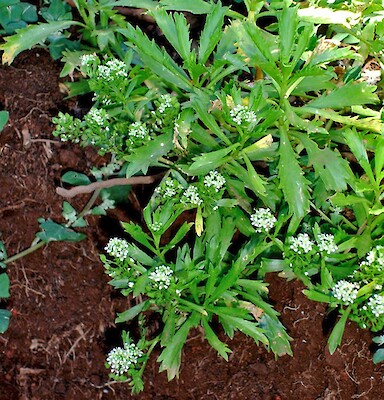
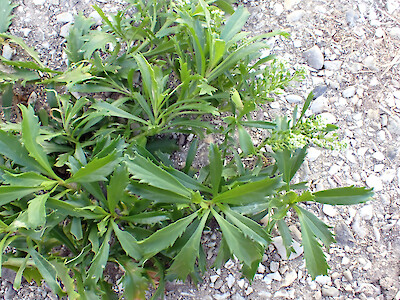
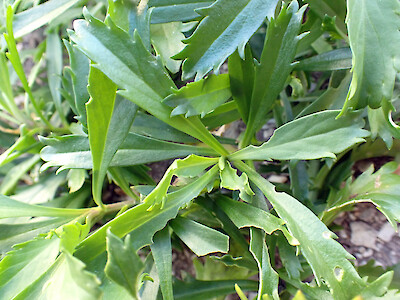
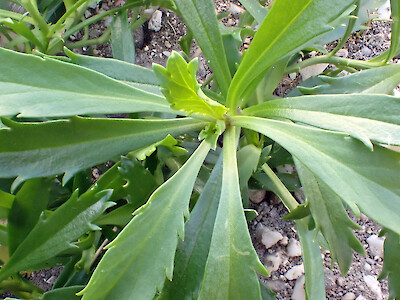
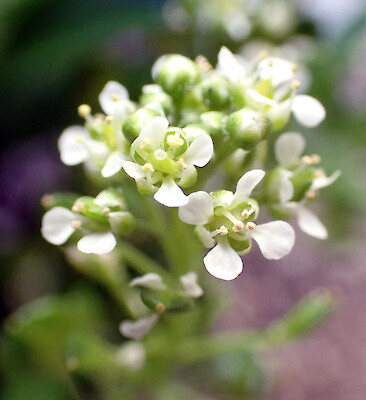
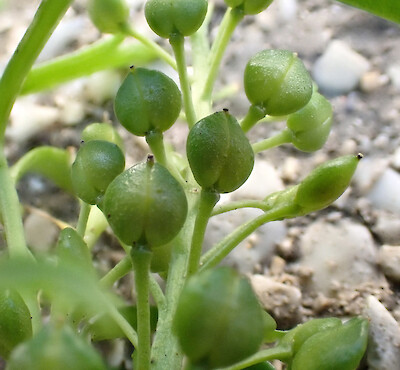
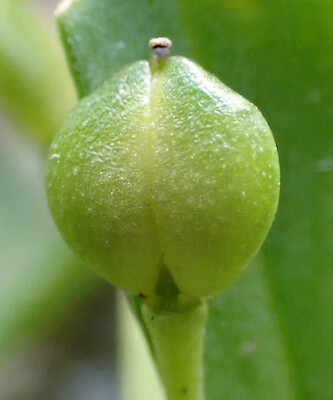
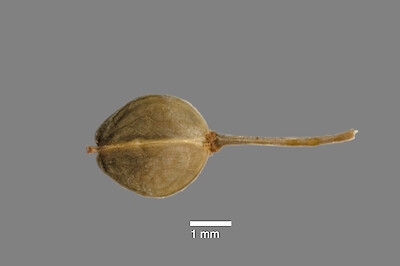
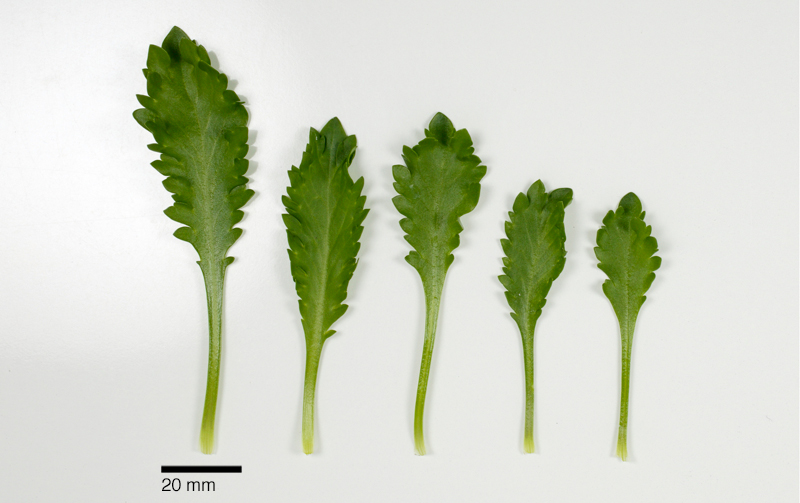
Leafy semi-erect to sprawling perennial herb. Leaves lanceolate to obovate, margins very deeply incised, jaggedly serrated (lacerate). Upper leaves less deeply incised than lower leaves. Inflorescences terminal, flowers white, with four petals and four stamens. Fruit a silicle, orbicular, apically notched.
Flower colours
White
Detailed description
Tap-rooted, pungent-smelling, summer-green, perennial herb arising from stock rootstock 7.3–8(–10) mm diam. Growth habit, erect to suberect, loose to densely branched plants up to 1 m across. Stems ± persistent, sometimes dying down to rootstock over winter or in times of adversity; upright to spreading, bases often very stout, ± spherical, somewhat woody when mature 10–15 × 10–12 mm, comprised of numerous old leaf and stem bases, sometimes producing roots, new seasons grow erect to suberect, glabrous, sometimes with very sparse, appressed, caducous, silky 0.5–1 mm long, hairs near stem apices; at fruiting stems often devoid of foliage for much of length. Leaves glabrous, firmly fleshy to succulent, usually dark green to green, sometimes yellow-green. Rosette and stem leaves usually withering at fruiting but sometimes with a few long persistent. Petiole distinct, 20–35(–40) × 2–9 mm. Lamina oblanceolate, lanceolate, narrowly lanceolate (rarely spathulate), 50–100 × 10–30 mm; either deeply toothed and/or lacerate or with distal ⅔ to ⅓ deeply toothed and/or deeply lacerate, teeth in 10–18(–20) pairs, blunt to sharp, running to and including apex and usually extending beyond leaf outline, base cuneate to narrowly cuneate. Middle stems leaves usually with indistinct petioles, these 10–30 mm long; lamina narrowly linear-lanceolate to linear, often recurved to falcate from or near ½ to ⅓ of leaf length, 50–80(–120) × 3–6 mm; margins deeply lacerate and/or toothed, teeth usually prominent, often confined to the upper ⅔, in 12–18(–30) pairs, these running to and including the apex; lamina base tapered, very narrowly cuneate. Upper stem leaves with or without a distinct petiole, petiole if present 40–60 mm, linear to linear-spathulate, occasionally narrowly lanceolate, usually toothed and/or lacerate, patent or recurved and/or falcate for upper ½ of leaf length, 30–50(–100) × 2.0–3.0(–30) mm. Racemes (5–)10–15 mm long, terminal and axillary; rachis glabrous; pedicels glabrous, erecto-patent, 2–5(–8) mm long at fruiting. Flowers c.0.4–0.8(–1.0) mm diam. Sepals glabrous or finely pubescent, or with both states within the one flower, green, broadly ovate to oval, c.0.6–1.0 × 0.6–1.2 mm, with pale-green to white thickened margin, apex broadly obtuse. Petals white, 1.5–2.0 × 0.3–0.8(–1) mm, erecto-patent to somewhat spreading, clawed; limb narrowly obovate, apex obtuse, occasionally emarginated. Stamens (2–)4, equal. Nectaries 2, subulate, 0.35 mm long. Silicles cartilaginous when fresh, coriaceous when dry, orbicular, orbicular-rhomboid (2.5–)3.0–3.5 × (1.5–)1.8–2.5(–3.3), slightly winged in upper ⅓, apex minutely notched, based obtuse to ± cordate, valves glabrous, dried surface often distinctly reticulate; style 0.1–0.2(–0.3) mm long, free from the narrow wing, exceeding the shallow notch; stigma 0.2–0.3 mm diam., capitate. Seeds 2, narrowly ovoid, brown, red-brown to orange-brown, not winged, 1.25–1.3 × 0.35–0.60 mm.
Similar taxa
Lepidium panniforme has an erect, suberect, or spreading growth habit which immediately separates it from the decumbent L. oligodontum, and L. rekohuense. It is further separated from these taxa by the long persistent, much larger, usually deeply toothed or lacerate and often rather tattered basal and lower stem leaves, and from L. oligodontum and L. rekohuense by the flowers which consistently have (2–)4 stamens. In growth habit, the species is most similar to L. oblitum and L. oleraceum. The deeply toothed and/or lacerate leaves of L. panniforme serve to readily distinguish it from L. oblitum. From L. oleraceum it is easily separated, especially when fruiting when the notched rather than acute silicle apex can be seen, but also when vegetative,
as the leaves of L. panniforme are diagnostically deeply toothed and/or lacerate.
Distribution
Endemic. Chatham Islands (Maung’Re | Mangere and probably Tapuaenuku | Little Mangere Islands)
Habitat
Lepidium panniforme is known only from a few sites where it grows in coastal herbfield along cliff tops, in rough pasture, shrubland, regenerating forest and sites kept artificially open, such as track sides. Few of these habitats are natural, and as such it is difficult to determine what the real habitat preferences of Lepidium panniforme are. In less modified parts of the island, plants are mainly confined to the steeper, often heavily seabird burrowed slopes and cliff margin sites which are probably indicative of its natural habitat preferences.
Threats
Lepidium panniforme may once have been on Rekohu | Wharekauri | Chatham Island - historical accounts of Lepidium sound very like this species and further in 1986 it seems to have been on Motuhinahina, a karst island in Te Whanga Lagoon. Here plants were seen by a Lands & Survey Ranger who when shown images of the Chatham Islands Lepidia immediately recognised L. panniforme as the one he had seen. on Maung’Re | Mangere Island some of the past records of this species we now know are examples of Lepidium oblitum, further hybrids between L. panniforme and L. oblitum have also been found. From 2018 Lepidium panniforme has only been confirmed from Maung’Re | Mangere Island from one site a track leading from the Mangere Hut to the isthmus ridge. Here plants are trampled from time to time by people, and the track sides are pedoturbated by burrowing seabirds. Disturbance seems necessary to maintain this species, so the track usage is actually keeping the species in the wild. The most recent census data for this species (March 2024) confirmed 50 plants remain in this site and that all the other known populations have gone as a consequence of forest regeneration. The records from Tapuaenuku | Little Mangere Island are on the basis of images, from these it is clear that Lepidium oblitum is also on that island. It is unclear how common L. panniforme is on that island, at best images indicate two plants. That island needs a proper survey for this species.
Detailed taxonomy
Genus
Family
Synonyms
None (first described in 2013)
Endemic taxon
Yes
Endemic genus
No
Endemic family
No
Other information
Etymology
lepidium: Scale-shaped (pods)
panniforme: Derived from ‘panniformus’ - as in a ‘shedded rag’ and used here to refer to the often tattered and torn, appearance of the basal leaves of this species (see de Lange et al. 2013)
NVS code
The National Vegetation Survey (NVS) Databank is a physical archive and electronic databank containing records of over 94,000 vegetation survey plots - including data from over 19,000 permanent plots. NVS maintains a standard set of species code abbreviations that correspond to standard scientific plant names from the Ngä Tipu o Aotearoa - New Zealand Plants database.
LEPPAN
Previous conservation statuses
The conservation status of all known New Zealand vascular plant taxa at the rank of species and below were reassessed in 2022-2023 using the New Zealand Threat Classification System (NZTCS) – more information about this can be found on the NZTCS website. This report includes replaces all previous NZTCS lists for vascular plants. Previous assessments can be found here.
- Conservation status of vascular plants in Aotearoa New Zealand, 2023. 2024. Peter J. de Lange, Jane Gosden, Shannel P. Courtney, Alexander J. Fergus, John W. Barkla, Sarah M. Beadel, Paul D. Champion, Rowan Hindmarsh-Walls, Troy Makan and Pascale Michel Department of Conservation. Source: NZTCS and licensed by DOC for reuse under the Creative Commons Attribution 4.0 International licence.
2017 | Threatened – Nationally Critical | Qualifiers: CD, DP, IE, OL, RR
2012 | Threatened – Nationally Critical | Qualifiers: CD, DP, IE, OL, RR
Referencing and citations
References and further reading
de Lange, P.J.; Heenan, P.B.; Houliston, G.; Rolfe, J.R.; Mitchell, A.D. 2013: New Lepidium (Brassicaceae) from New Zealand. Phytokeys 24:1-147pp. , doi: 10.3897/phytokeys.24.4375.
Attribution
Fact Sheet prepared for NZPCN by P.J. de Lange 1 March 20025. Description from de Lange et al. (2013)
NZPCN Fact Sheet citation
Please cite as: de Lange, P.J. (Year at time of access): Lepidium panniforme Fact Sheet (content continuously updated). New Zealand Plant Conservation Network. https://www.nzpcn.org.nz/flora/species/lepidium-panniforme/ (Date website was queried)