
Aciphylla kirkii


Biostatus
Native – Endemic taxon
Current conservation status
The conservation status of all known New Zealand vascular plant taxa at the rank of species and below were reassessed in 2022-2023 using the New Zealand Threat Classification System (NZTCS) – more information about this can be found on the NZTCS website. This report includes replaces all previous NZTCS lists for vascular plants. Previous assessments can be found here.
- Conservation status of vascular plants in Aotearoa New Zealand, 2023. 2024. Peter J. de Lange, Jane Gosden, Shannel P. Courtney, Alexander J. Fergus, John W. Barkla, Sarah M. Beadel, Paul D. Champion, Rowan Hindmarsh-Walls, Troy Makan and Pascale Michel Department of Conservation. Source: NZTCS and licensed by DOC for reuse under the Creative Commons Attribution 4.0 International licence.
2023 | Not Threatened | Qualifiers: DPS, DPT
Category
Vascular
Structural class
Herbs - Dicotyledons other than Composites
Simplified description
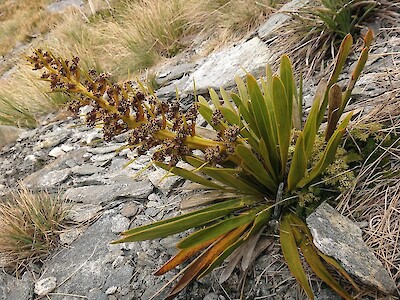
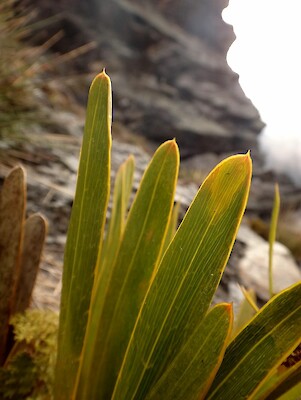
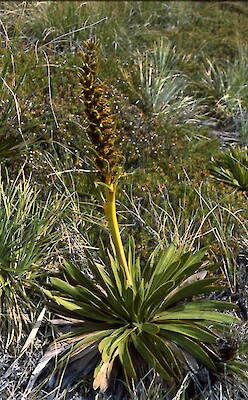
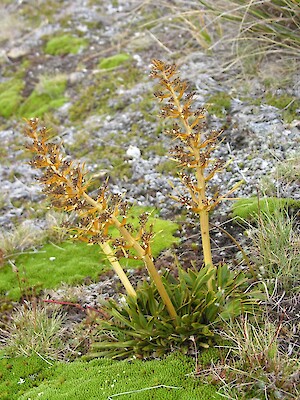
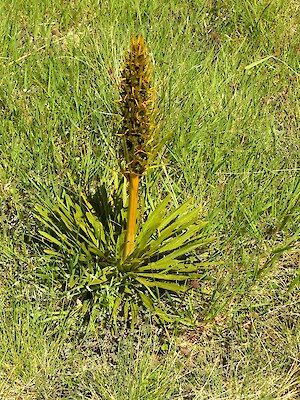
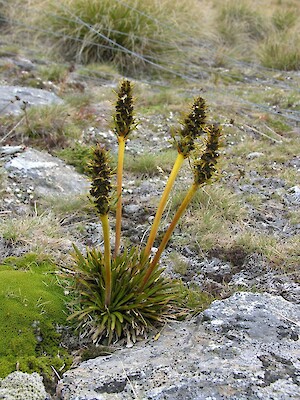
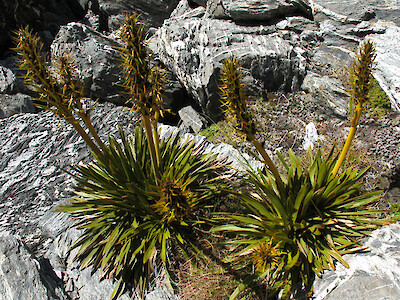
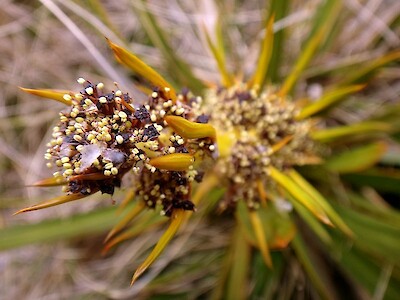
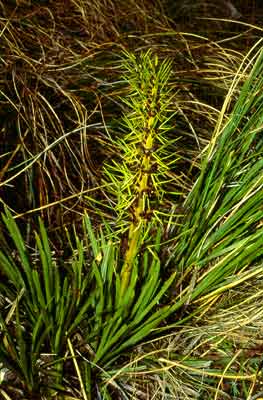
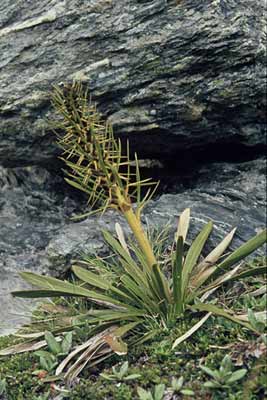
A spiky robust rosette forming herb up to 0.3 metres across. Leaves are sharp-pointed and rich green to yellow-green coloured, spikes of dark or cream coloured flowers are guarded by bright orange spiky bracts extend on elongated stems up to 300 mm long.
Flower colours
Cream, Brown
Detailed description
Plant forming rigid tufts up to about 0.3 metres tall including inflorescence. Leaves up to 200 × 20 mm; sheaths thin, about 50 × 10 mm; stipules leaflike, up to 50 × 5 mm, stiff, coriaceous, oblong, abruptly narrowed to pungent apex (rarely vestigial); petioles up to approximately 10 mm long; pinnae 1-(2) pairs, similar to stipules, very thick and coriaceous, margins much thickened, abruptly narrowed to pungent tips. Stems of male plants stout, strongly grooved, up to 400 × 8 mm including inflorescence up to 150 mm long. Bracts rigid, erect, lower stipuled, upper usually simple; sheaths very short, stipules spreading, generally about 20 mm long; lamina narrow-oblong, up to 40 × 2-3 mm, pungent. Umbels several, on very short rays. Stems of female flexuous, finely grooved; inflorescence 50-100 mm long; Umbels several, ± 5-10-fld, flowers sessile or nearly so. Fruit about 5mm long; mericarps 4-5-winged; vittae 1-2 per furrow, usually 4 commissural.
Similar taxa
Possible to mistake this species for Aciphylla hectorii which has an overlap in its distribution. Overall the plant is smaller, the pinnae are similar yet are smaller width, 5 mm, compared to 10-15 mm in A. kirkii pinnae.
Distribution
Endemic. Te Waipounamu | South Island, central and western Otago, east of the Southern Alps.
Habitat
Low to high alpine (1300 – 200 m.a.s.l.), snow tussock grassland, fellfield, herbfield, cushionfield.
Detailed taxonomy
Genus
Family
Endemic taxon
Yes
Endemic genus
No
Endemic family
No
Ecology
Flowering
December – February.
Fruiting
December – April.
Life cycle and dispersal
Winged schizocarps are dispersed primarily by wind (Thorsen et al., 2009).
Other information
Etymology
aciphylla: From the Latin acicula ‘needle’ and the Greek phyllum ‘leaf’, meaning needle-leaf.
kirkii: After Thomas Kirk (18 January 1828 - 8 March 1898), a NZ botanist and lecturer in natural sciences and regarded as a leader of botanical enquiry in NZ for over three decades. One of his most significant publications was Forest flora of NZ (1889) but he also contributed over 130 papers to the Transactions and Proceedings of the NZ Institute and other journals.
NVS code
The National Vegetation Survey (NVS) Databank is a physical archive and electronic databank containing records of over 94,000 vegetation survey plots - including data from over 19,000 permanent plots. NVS maintains a standard set of species code abbreviations that correspond to standard scientific plant names from the Ngä Tipu o Aotearoa - New Zealand Plants database.
ACIKIR
Previous conservation statuses
The conservation status of all known New Zealand vascular plant taxa at the rank of species and below were reassessed in 2022-2023 using the New Zealand Threat Classification System (NZTCS) – more information about this can be found on the NZTCS website. This report includes replaces all previous NZTCS lists for vascular plants. Previous assessments can be found here.
- Conservation status of vascular plants in Aotearoa New Zealand, 2023. 2024. Peter J. de Lange, Jane Gosden, Shannel P. Courtney, Alexander J. Fergus, John W. Barkla, Sarah M. Beadel, Paul D. Champion, Rowan Hindmarsh-Walls, Troy Makan and Pascale Michel Department of Conservation. Source: NZTCS and licensed by DOC for reuse under the Creative Commons Attribution 4.0 International licence.
2017 | Not Threatened | Qualifiers: DP
2012 | Not Threatened
2009 | Not Threatened
2004 | Not Threatened
Regional conservation statuses
Otago: 2025 | Regionally At Risk – Regionally Naturally Uncommon | Qualifiers: DPS, DPT, NS, NStr, Sp, TL
Current regional threat status assessments prepared according to Crisp et al. (2025) are displayed when available. The Otago conservation status information is sourced from the “Conservation Status of Indigenous Vascular Plants in Otago, 2025” Jarvie S et al. (2025) report.
Referencing and citations
References and further reading
Allan HH. 1961. Flora of New Zealand, Volume I. Indigenous Tracheophyta: Psilopsida, Lycopsida, Filicopsida, Gymnospermae, Dicotyledones. Government Printer, Wellington, NZ. 1085 p.
Mark AF. 2012. Above the Treeline: A Nature Guide to Alpine New Zealand. Craig Potton Publishing, Nelson. pg.144.
Thorsen, M. J.; Dickinson, K. J. M.; Seddon, P. J. 2009. Seed dispersal systems in the New Zealand flora. Perspectives in Plant Ecology, Evolution and Systematics 2009 Vol. 11 No. 4 pp. 285-309
Attribution
Fact sheet prepared for NZPCN by MD Ward (December 18th 2025). Description adapted from Allan (1961) & Mark (2012).
Some of this factsheet information is derived from Flora of New Zealand Online and is used under a Creative Commons Attribution 3.0 New Zealand licence.