
Aciphylla takahea
Biostatus
Native – Endemic taxon
Current conservation status
The conservation status of all known New Zealand vascular plant taxa at the rank of species and below were reassessed in 2022-2023 using the New Zealand Threat Classification System (NZTCS) – more information about this can be found on the NZTCS website. This report includes replaces all previous NZTCS lists for vascular plants. Previous assessments can be found here.
- Conservation status of vascular plants in Aotearoa New Zealand, 2023. 2024. Peter J. de Lange, Jane Gosden, Shannel P. Courtney, Alexander J. Fergus, John W. Barkla, Sarah M. Beadel, Paul D. Champion, Rowan Hindmarsh-Walls, Troy Makan and Pascale Michel Department of Conservation. Source: NZTCS and licensed by DOC for reuse under the Creative Commons Attribution 4.0 International licence.
2023 | At Risk – Declining | Qualifiers: Sp, DPS, DPT, RR
Category
Vascular
Structural class
Herbs - Dicotyledons other than Composites
Simplified description
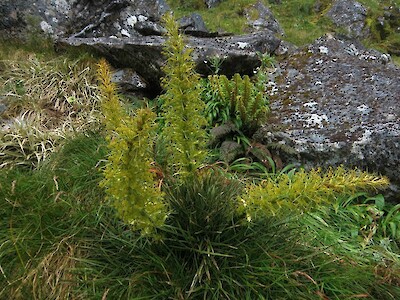
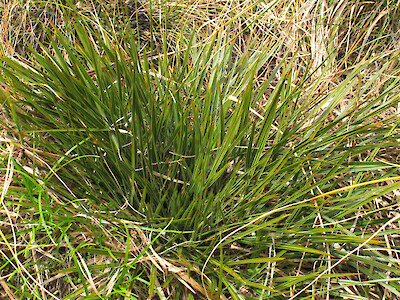
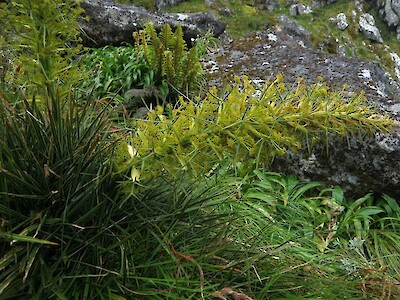
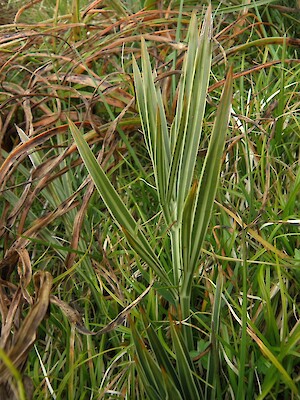
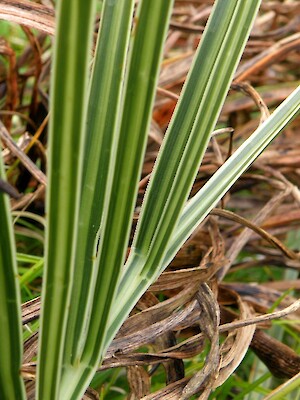
A tussock-forming spikey herb up to 0.6 metres across. Leaves are long narrow and sharp-pointed, multi-coloured dark green with lighter green midrib, spikes of pale coloured flowers protrude on elongated stems up to 1 metre high.
Flower colours
Cream, White
Detailed description
Medium-sized densely formed tussock. Leaves 2-pinnate, of male plants approximately 250 mm; of female plants approximately 400 mm long; margins and midribs serrulate-crenulate, tips pungent. Sheaths up to 50 × 30 mm, tapering to 15 mm; stipules 3-2-1-foliolate, on ligules up to 10 mm long; lowest central lamina up to 50 × 1.5 mm. Petioles approximately 50 mm long, concavo-convex, midrib stout; lower internodes approximately 40 mm long. Primary pinnae 2-5 pairs, the lower ones 3-foliolate, approximately 100 × 3-(5) mm. Secondary pinnae up to 50 mm long, flat, striate, pungent. Flowering stems of male plants approximately 600 × 5 mm, including inflorescence approximately 400 mm long. Lower bracts usually empty, up to 60 mm long; sheaths about 30 × 8 mm, submembranous; stipules unequal, to 15 mm long, pungent. Lamina approximately 30 mm long, more or less 3-foliolate. Male umbels approximately 30 mm diameter on slender rays; involucral bracts capillary; umbellules more or less 10-flowered, on very short capillary rays. Flowering stems of female plants approximately 1000 × 20 mm including inflorescence, approximately 500 mm long, oblong-lanceolate. Lower bracts usually empty, approximately 80 mm long; sheaths approximately 40 × 10 mm, coriaceous; stipules simple to trifoliolate, segments pungent, up to 40 mm long. Lamina more or less trifoliolate to simple in uppermost bracts. Female umbels about 50 mm diameter, on slender rays; involucral bracts capillary. Umbellules usually up to 10-flowered, on very short slender rays. Fruit approximately 8 mm long, broadly winged, with 3-4 narrowly winged ribs, vittae present.
Similar taxa
Resembling Aciphylla squarrosa structurally, however the foliage is glaucous colour, compared to dark green in A. takahea.
Distribution
Endemic. Te Waipounamu | South Island, Ben Lommond; Fiordland - Milford Sound, Wick Range to Murchison Range.
Habitat
Montane to sub-alpine (900-1300 m.a.s.l.), damp sites amongst tussock scrub and tussock-herbfield.
Detailed taxonomy
Genus
Family
Endemic taxon
Yes
Endemic genus
No
Endemic family
No
Ecology
Flowering
December – March.
Fruiting
January – April.
Other information
Etymology
aciphylla: From the Latin acicula ‘needle’ and the Greek phyllum ‘leaf’, meaning needle-leaf.
takahea: a reference to the Māori name of the South Island flightless endemic bird which the valley of this species’ typus is named after.
NVS code
The National Vegetation Survey (NVS) Databank is a physical archive and electronic databank containing records of over 94,000 vegetation survey plots - including data from over 19,000 permanent plots. NVS maintains a standard set of species code abbreviations that correspond to standard scientific plant names from the Ngä Tipu o Aotearoa - New Zealand Plants database.
ACITAK
Previous conservation statuses
The conservation status of all known New Zealand vascular plant taxa at the rank of species and below were reassessed in 2022-2023 using the New Zealand Threat Classification System (NZTCS) – more information about this can be found on the NZTCS website. This report includes replaces all previous NZTCS lists for vascular plants. Previous assessments can be found here.
- Conservation status of vascular plants in Aotearoa New Zealand, 2023. 2024. Peter J. de Lange, Jane Gosden, Shannel P. Courtney, Alexander J. Fergus, John W. Barkla, Sarah M. Beadel, Paul D. Champion, Rowan Hindmarsh-Walls, Troy Makan and Pascale Michel Department of Conservation. Source: NZTCS and licensed by DOC for reuse under the Creative Commons Attribution 4.0 International licence.
2017 | At Risk – Declining | Qualifiers: DP, RR, Sp
2012 | At Risk – Naturally Uncommon | Qualifiers: RR
2009 | At Risk – Naturally Uncommon
2004 | Range Restricted
Regional conservation statuses
Otago: 2025 | Regionally At Risk – Regionally Declining | Qualifiers: DPS, DPT, Sp
Current regional threat status assessments prepared according to Crisp et al. (2025) are displayed when available. The Otago conservation status information is sourced from the “Conservation Status of Indigenous Vascular Plants in Otago, 2025” Jarvie S et al. (2025) report.
Referencing and citations
References and further reading
Allan HH. 1961. Flora of New Zealand, Volume I. Indigenous Tracheophyta: Psilopsida, Lycopsida, Filicopsida, Gymnospermae, Dicotyledones. Government Printer, Wellington, NZ. pgs. 481-482.
Mark AF. 2012. Above the Treeline: A Nature Guide to Alpine New Zealand. Craig Potton Publishing, Nelson. pg.140.
Webb CJ & Simpson MJA. 2001. Seeds of NZ gymnosperms and dicotyledons. Manuka Press, Christchurch.
Attribution
Fact sheet prepared for NZPCN by MD Ward (December 18th 2025). Description adapted from Allan (1961) & Mark (2012).
Some of this factsheet information is derived from Flora of New Zealand Online and is used under a Creative Commons Attribution 3.0 New Zealand licence.