
Aciphylla traillii


Common names
Stewart Island speargrass
Biostatus
Native – Endemic taxon
Current conservation status
The conservation status of all known New Zealand vascular plant taxa at the rank of species and below were reassessed in 2022-2023 using the New Zealand Threat Classification System (NZTCS) – more information about this can be found on the NZTCS website. This report includes replaces all previous NZTCS lists for vascular plants. Previous assessments can be found here.
- Conservation status of vascular plants in Aotearoa New Zealand, 2023. 2024. Peter J. de Lange, Jane Gosden, Shannel P. Courtney, Alexander J. Fergus, John W. Barkla, Sarah M. Beadel, Paul D. Champion, Rowan Hindmarsh-Walls, Troy Makan and Pascale Michel Department of Conservation. Source: NZTCS and licensed by DOC for reuse under the Creative Commons Attribution 4.0 International licence.
2023 | At Risk – Naturally Uncommon | Qualifiers: RR
Category
Vascular
Structural class
Herbs - Dicotyledons other than Composites
Simplified description
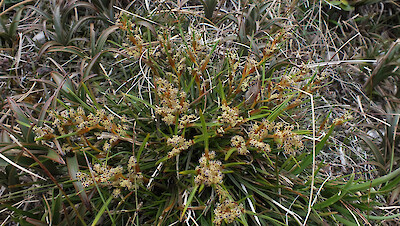
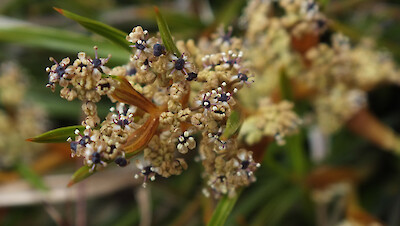
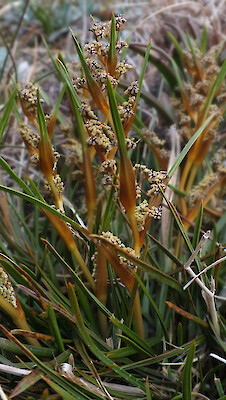
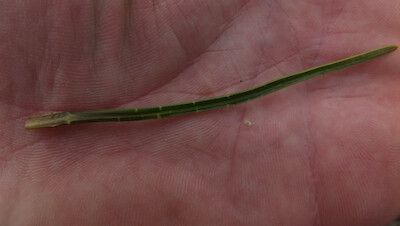
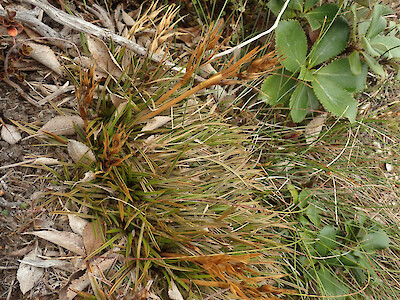
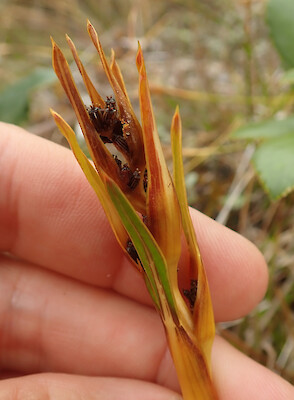
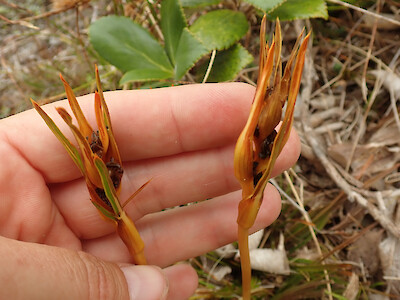
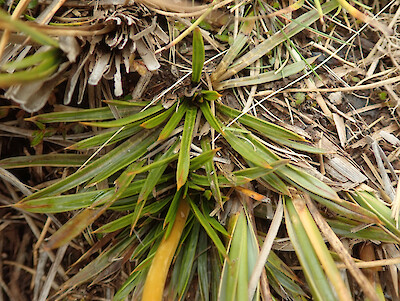
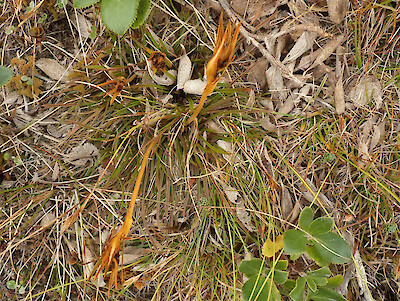
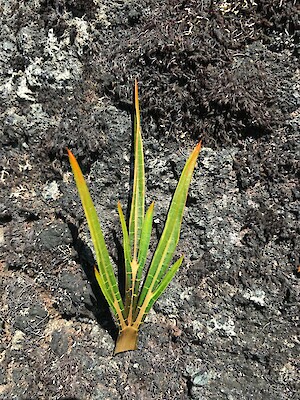
A clumping spikey herb up to 0.3 metres across. Leaves are sharp-pointed, multi-coloured olive-dark green and orange-yellow, spikes of dark coloured flowers protrude on elongated stems up to 200mm high.
Flower colours
Cream, Brown
Detailed description
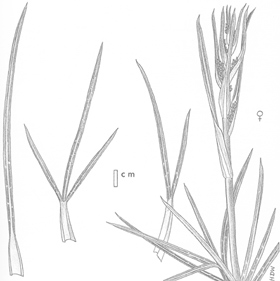
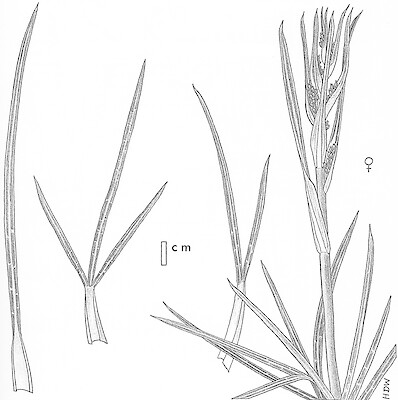
Rootstock rather slender, simple or branched, plants forming small tufts up to 20 cm tall including inflorescence; taproot rather stout. Leaves rather flaccid, becoming rather rigid when dry, up to approximately 150 mm long. Sheath narrow, thin, approximately 50 × 7 mm; stipules unequal, up to 30 × 2 mm. (rarely vestigial); petioles approximately 20 mm long; internodes obsolete or up to 10 mm long. Lamina of 1 pinna, or sometimes with 1 or 2 pairs of secondary pinnae. Primary lamina up to more or less 50 × 2-3 mm, coriaceous: midrib rather prominent, margins thickened, apex pungent. Secondary pinnae similar but shorter. Stems of male plants rather slender, up to approximately 80 mm long including inflorescence approximately 40 mm diameter. Bract-sheaths inflated, approximately 20 mm long; stipules about 10 mm long; lamina about 20 mm long. Umbels rather lax, forming an open panicle; rays short, slender. Secondary umbels few, approximately 5 mm diameter, approximately distant, on short capillary rays. Stems of female plants slender to rather stout, grooved, up to 100 mm long. Bract-sheaths broad, generally 20 × 5 mm; stipules short or absent, lamina short. Umbels nearly concealed by bract-sheaths; Secondary umbels very small, rays very short, filiform, Fruit approximately 3 mm long, mericarps with 5 winged ribs, vittae 1-(2) per furrow, 2-4 commissural.
Similar taxa
At a glance Aciphylla cartilaginea may be confused with this species as it too grows on Rakiura | Stewart Island and has similar colouring; it may be distinguished by its leaves being more divided including being once or twice pinnate compared to those of A. traillii being either simple or divided into two or three, not twice pinnate. The leaves of A. cartilaginea are also generally wider and more robust than those of A. traillii.
Distribution
Endemic. Rakiura | Stewart Island, Mt Anglem | Hananui, Little Mt Anglem and The Paps.
Habitat
Montane to low-alpine (600 – 970 m.a.s.l.), locally common in wet meadow grassland and herbmoor.
Detailed taxonomy
Genus
Family
Endemic taxon
Yes
Endemic genus
No
Endemic family
No
Ecology
Flowering
December – January.
Fruiting
January – March.
Other information
Where To Buy
Not commercially available.
Etymology
aciphylla: From the Latin acicula ‘needle’ and the Greek phyllum ‘leaf’, meaning needle-leaf.
traillii: After Charles Trail, Stewart Islander
NVS code
The National Vegetation Survey (NVS) Databank is a physical archive and electronic databank containing records of over 94,000 vegetation survey plots - including data from over 19,000 permanent plots. NVS maintains a standard set of species code abbreviations that correspond to standard scientific plant names from the Ngä Tipu o Aotearoa - New Zealand Plants database.
ACITRA
Previous conservation statuses
The conservation status of all known New Zealand vascular plant taxa at the rank of species and below were reassessed in 2022-2023 using the New Zealand Threat Classification System (NZTCS) – more information about this can be found on the NZTCS website. This report includes replaces all previous NZTCS lists for vascular plants. Previous assessments can be found here.
- Conservation status of vascular plants in Aotearoa New Zealand, 2023. 2024. Peter J. de Lange, Jane Gosden, Shannel P. Courtney, Alexander J. Fergus, John W. Barkla, Sarah M. Beadel, Paul D. Champion, Rowan Hindmarsh-Walls, Troy Makan and Pascale Michel Department of Conservation. Source: NZTCS and licensed by DOC for reuse under the Creative Commons Attribution 4.0 International licence.
2017 | At Risk – Naturally Uncommon | Qualifiers: RR, St
2012 | At Risk – Naturally Uncommon | Qualifiers: RR
2009 | At Risk – Naturally Uncommon
2004 | Range Restricted
Referencing and citations
References and further reading
Allan HH. 1961. Flora of New Zealand, Volume I. Indigenous Tracheophyta: Psilopsida, Lycopsida, Filicopsida, Gymnospermae, Dicotyledones. Government Printer, Wellington, NZ. pg. 471.
Mark AF. 2012. Above the Treeline: A Nature Guide to Alpine New Zealand. Craig Potton Publishing, Nelson. pg.146.
Wilson HD.1982. Stewart Island plants. Whitcoulls Ltd, Christchurch pgs. 187-188.
Attribution
Fact sheet prepared for NZPCN by MD Ward (December 18th 2025). Description adapted from Allan (1961), Mark (2012) and Wilson (1982).
Some of this factsheet information is derived from Flora of New Zealand Online and is used under a Creative Commons Attribution 3.0 New Zealand licence.