
Aciphylla spedenii
Biostatus
Native – Endemic taxon
Current conservation status
The conservation status of all known New Zealand vascular plant taxa at the rank of species and below were reassessed in 2022-2023 using the New Zealand Threat Classification System (NZTCS) – more information about this can be found on the NZTCS website. This report includes replaces all previous NZTCS lists for vascular plants. Previous assessments can be found here.
- Conservation status of vascular plants in Aotearoa New Zealand, 2023. 2024. Peter J. de Lange, Jane Gosden, Shannel P. Courtney, Alexander J. Fergus, John W. Barkla, Sarah M. Beadel, Paul D. Champion, Rowan Hindmarsh-Walls, Troy Makan and Pascale Michel Department of Conservation. Source: NZTCS and licensed by DOC for reuse under the Creative Commons Attribution 4.0 International licence.
2023 | At Risk – Naturally Uncommon | Qualifiers: Sp, DPT, RR
Category
Vascular
Structural class
Herbs - Dicotyledons other than Composites
Simplified description
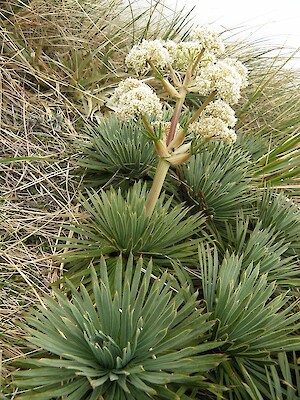
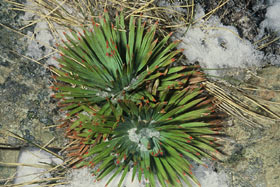
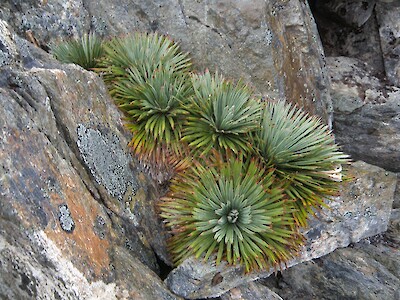
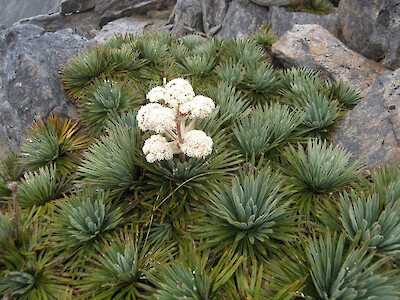
A tufted sprawling prickly cushion herb formed of multiple rosettes up to 0.5 metres across. Leaves have red-tinged sharp-points and grow in fans, glaucous to pale-green coloured, spikes of whiteish flowers protrude on elongated stems up to 250 mm long.
Flower colours
White
Detailed description
Rootstock stout, simple to multicipital, with solitary rosettes, or these forming clumps up to 30 cm diameter. Leaves rather soft, striate, with membranous sheaths approximately 80 × 15-20 mm, hyaline-margined. Stipules leaflike, 60-70 × 2-3 mm, pungent; petioles not more than 5 mm long; leaflets subflabellately pentafoliolate, with very short internodes. Pinnae up to 80 × 3 mm, subrigid, coriaceous, striate; margins and midribs thickened; apices pungent. Stems of male plants stout, up to 150 mm long excluding the somewhat globose inflorescence, up to 100 mm diameter. Bracts flaccid, with broad membranous sheaths, short linear stipules and lamina of 5-6 pinnules. Umbels several to unlimited on peduncles up to 25 mm long; umbellules without bracteoles. Calyx-teeth minute; petals white, clawed. (lacking information about female inflorescence) Fruit 4.2-5 mm long, 5 evenly winged ribs, elliptic, pale orange-yellow, vittae not very evident.
Similar taxa
Most similar to Aciphylla congesta which is slightly larger in some parts (compared to A. spedenii), flowering stem up to 300 mm (up to 150 mm), globe of flowers 120 mm diameter (100 mm diameter). A. congesta lacks the red-tipped leaves, more green coloured than glaucous.
Distribution
Endemic. Te Waipounamu | South Island, northern Southland, Eyre Mountains.
Habitat
High alpine (1700-1900 m.a.s.l.), fellfields.
Detailed taxonomy
Genus
Family
Endemic taxon
Yes
Endemic genus
No
Endemic family
No
Ecology
Flowering
December – January.
Fruiting
January – February.
Life cycle and dispersal
Winged schizocarps are dispersed primarily by wind (Thorsen et al., 2009).
Other information
Etymology
aciphylla: From the Latin acicula ‘needle’ and the Greek phyllum ‘leaf’, meaning needle-leaf.
spedenii: Named after James Speden who was a New Zealand explorer
NVS code
The National Vegetation Survey (NVS) Databank is a physical archive and electronic databank containing records of over 94,000 vegetation survey plots - including data from over 19,000 permanent plots. NVS maintains a standard set of species code abbreviations that correspond to standard scientific plant names from the Ngä Tipu o Aotearoa - New Zealand Plants database.
ACISPE
Previous conservation statuses
The conservation status of all known New Zealand vascular plant taxa at the rank of species and below were reassessed in 2022-2023 using the New Zealand Threat Classification System (NZTCS) – more information about this can be found on the NZTCS website. This report includes replaces all previous NZTCS lists for vascular plants. Previous assessments can be found here.
- Conservation status of vascular plants in Aotearoa New Zealand, 2023. 2024. Peter J. de Lange, Jane Gosden, Shannel P. Courtney, Alexander J. Fergus, John W. Barkla, Sarah M. Beadel, Paul D. Champion, Rowan Hindmarsh-Walls, Troy Makan and Pascale Michel Department of Conservation. Source: NZTCS and licensed by DOC for reuse under the Creative Commons Attribution 4.0 International licence.
2017 | At Risk – Naturally Uncommon | Qualifiers: RR
2012 | At Risk – Naturally Uncommon | Qualifiers: RR
2009 | At Risk – Naturally Uncommon
2004 | Range Restricted
Regional conservation statuses
Otago: 2025 | Regionally At Risk – Regionally Naturally Uncommon | Qualifiers: DPS, DPT, NR, NS, NStr, RR, Sp, St, TL
Current regional threat status assessments prepared according to Crisp et al. (2025) are displayed when available. The Otago conservation status information is sourced from the “Conservation Status of Indigenous Vascular Plants in Otago, 2025” Jarvie S et al. (2025) report.
Referencing and citations
References and further reading
Allan HH. 1961. Flora of New Zealand, Volume I. Indigenous Tracheophyta: Psilopsida, Lycopsida, Filicopsida, Gymnospermae, Dicotyledones. Government Printer, Wellington, NZ. pg. 470.
Mark AF. 2012. Above the Treeline: A Nature Guide to Alpine New Zealand. Craig Potton Publishing, Nelson. pg.150.
Thorsen MJ, Dickinson KJM, Seddon PJ. 2009. Seed dispersal systems in the New Zealand flora. Perspectives in Plant Ecology, Evolution and Systematics 11: 285–309. https://doi.org/10.1016/j.ppees.2009.06.001.
Webb CJ & Simpson MJA. 2001. Seeds of NZ gymnosperms and dicotyledons. Manuka Press, Christchurch.
Attribution
Fact sheet prepared for NZPCN by MD Ward (December 19th 2025). Description adapted from Allan (1961) & Mark (2012).
Some of this factsheet information is derived from Flora of New Zealand Online and is used under a Creative Commons Attribution 3.0 New Zealand licence.