
Cardamine dolichostyla

Common names
bittercress
Biostatus
Native – Endemic taxon
Current conservation status
The conservation status of all known New Zealand vascular plant taxa at the rank of species and below were reassessed in 2022-2023 using the New Zealand Threat Classification System (NZTCS) – more information about this can be found on the NZTCS website. This report includes replaces all previous NZTCS lists for vascular plants. Previous assessments can be found here.
- Conservation status of vascular plants in Aotearoa New Zealand, 2023. 2024. Peter J. de Lange, Jane Gosden, Shannel P. Courtney, Alexander J. Fergus, John W. Barkla, Sarah M. Beadel, Paul D. Champion, Rowan Hindmarsh-Walls, Troy Makan and Pascale Michel Department of Conservation. Source: NZTCS and licensed by DOC for reuse under the Creative Commons Attribution 4.0 International licence.
2023 | Not Threatened
Category
Vascular
Structural class
Herbs - Dicotyledons other than Composites
Simplified description
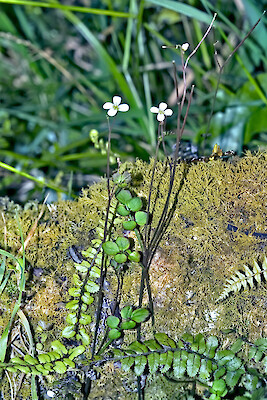
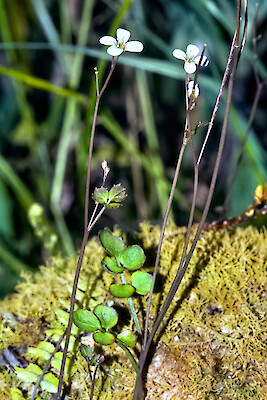
Perennial herb, a single rosette or with off-sets (short lateral branches). Leaves up to 130 mm long, deeply lobed; moderately hairy to hairless, somewhat glossy.
Inflorescence is a raceme, sometimes branched, each raceme 6–12-flowered; flowering stems to 400 mm or more tall. Mature flowers often turned horizontally rather than upright, flowering plants being relatively conspicuous in dark forest.
Flower colours
White
Similar taxa
Cardamine forsteri, which often grows with C. dolichostyla. The latter has larger flowers, which are often turned sideways, and the flowers have a longer style; leaves are somewhat more glossy than in C. forsteri.
Distribution
Endemic. New Zealand: North Island (south from South Auckland and west of the axial ranges), South Island (northern parts to Canterbury).
Habitat
Lowland to montane moist forest, sometimes disturbed sites.
Substrate details
Soil, litter, bases of tree roots.
Detailed taxonomy
Genus
Family
Synonyms
Once included in C. debilis, under the name Cardamine ‘Long Style’.
Endemic taxon
Yes
Endemic genus
No
Endemic family
No
Ecology
Wetland plant indicator status rating
Information derived from the revised national wetland plant list prepared to assist councils in delineating and monitoring wetlands (Clarkson et al., 2021 Manaaki Whenua – Landcare Research Contract Report LC3975 for Hawke’s Bay Regional Council). The national plant list categorises plants by the extent to which they are found in wetlands and not ‘drylands’. The indicator status ratings are OBL (obligate wetland), FACW (facultative wetland), FAC (facultative), FACU (facultative upland), and UPL (obligate upland). If you have suggestions for the Wetland Indicator Status Rating, please contact: [Enable JavaScript to view protected content]
FAC: Facultative
Commonly occurs as either a hydrophyte or non-hydrophyte (non-wetlands).
Other information
Etymology
cardamine: From the Greek name kárdamon, referring to an Indian spice
NVS code
The National Vegetation Survey (NVS) Databank is a physical archive and electronic databank containing records of over 94,000 vegetation survey plots - including data from over 19,000 permanent plots. NVS maintains a standard set of species code abbreviations that correspond to standard scientific plant names from the Ngä Tipu o Aotearoa - New Zealand Plants database.
CARDLC
Previous conservation status
The conservation status of all known New Zealand vascular plant taxa at the rank of species and below were reassessed in 2022-2023 using the New Zealand Threat Classification System (NZTCS) – more information about this can be found on the NZTCS website. This report includes replaces all previous NZTCS lists for vascular plants. Previous assessments can be found here.
- Conservation status of vascular plants in Aotearoa New Zealand, 2023. 2024. Peter J. de Lange, Jane Gosden, Shannel P. Courtney, Alexander J. Fergus, John W. Barkla, Sarah M. Beadel, Paul D. Champion, Rowan Hindmarsh-Walls, Troy Makan and Pascale Michel Department of Conservation. Source: NZTCS and licensed by DOC for reuse under the Creative Commons Attribution 4.0 International licence.
2017 | Not Threatened
Regional conservation statuses
Otago: 2025 | Regionally At Risk – Regionally Naturally Uncommon | Qualifiers: DPR, DPS, DPT, NR, Sp
Current regional threat status assessments prepared according to Crisp et al. (2025) are displayed when available. The Otago conservation status information is sourced from the “Conservation Status of Indigenous Vascular Plants in Otago, 2025” Jarvie S et al. (2025) report.
Wellington: 2025 | Regionally Not Threatened
Current regional threat status assessments prepared according to Crisp et al. (2025) are displayed when available. The Wellington conservation status information is sourced from the “Conservation status of indigenous vascular plants in the Wellington region” Enright P et al. 2025 report.