
Cardamine latior
Common names
Auckland Islands bitter cress
Biostatus
Native – Endemic taxon
Current conservation status
The conservation status of all known New Zealand vascular plant taxa at the rank of species and below were reassessed in 2022-2023 using the New Zealand Threat Classification System (NZTCS) – more information about this can be found on the NZTCS website. This report includes replaces all previous NZTCS lists for vascular plants. Previous assessments can be found here.
- Conservation status of vascular plants in Aotearoa New Zealand, 2023. 2024. Peter J. de Lange, Jane Gosden, Shannel P. Courtney, Alexander J. Fergus, John W. Barkla, Sarah M. Beadel, Paul D. Champion, Rowan Hindmarsh-Walls, Troy Makan and Pascale Michel Department of Conservation. Source: NZTCS and licensed by DOC for reuse under the Creative Commons Attribution 4.0 International licence.
2023 | At Risk – Naturally Uncommon | Qualifiers: IE, OL
Category
Vascular
Structural class
Herbs - Dicotyledons other than Composites
Flower colours
Red/Pink, White
Detailed description
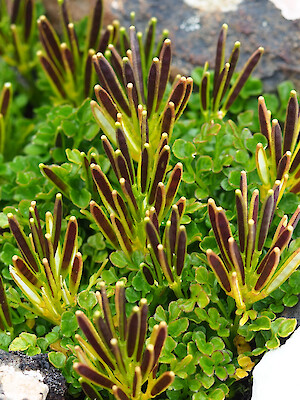
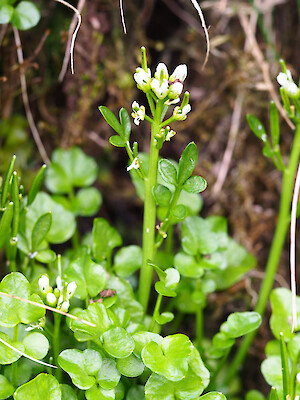
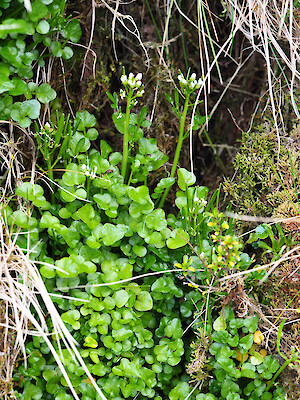
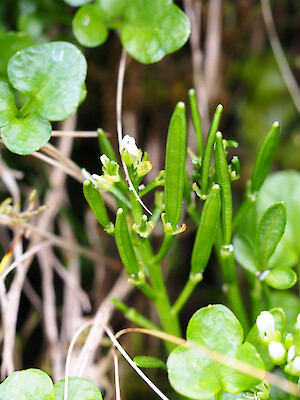
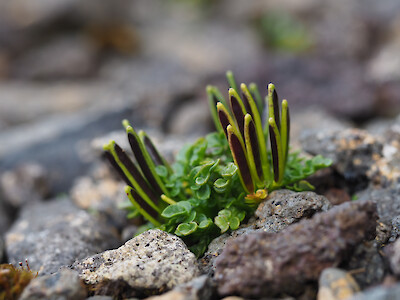
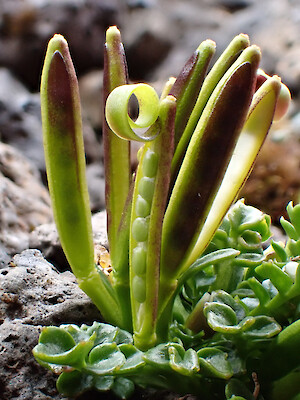
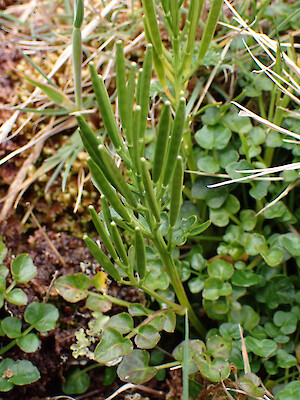
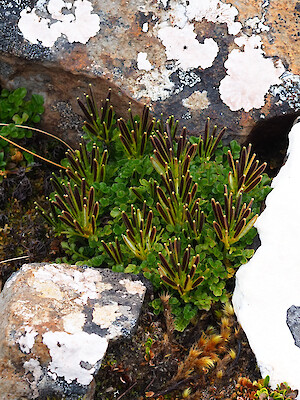
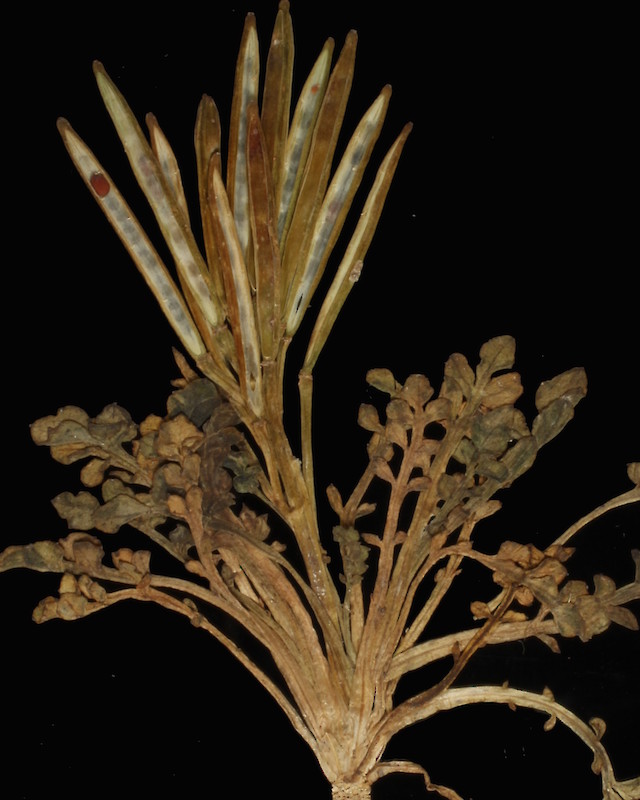
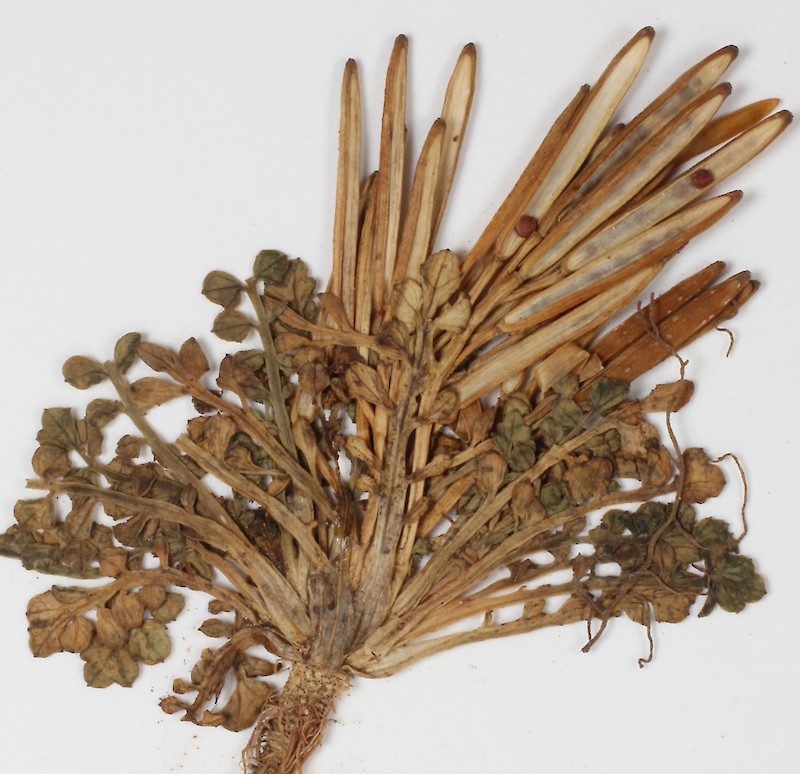
Perennial herb, caespitose, with many leaves forming a small, compact rosette. Leaves pinnate, up to 40–50 mm long, glabrous, green, ± coriaceous; petiole 8–12 mm long, 1.7–1.8 mm wide, winged and sheathing at base. Leaflets 11–15, in pairs and usually overlapping in distal part of leaf, alternate and distant in lower part of leaf, reniform, orbicular to broadly elliptic, hydathodes prominent on margin and in axil of petiolule, margin entire, base cordate, ± truncate to obtuse, apex obtuse to rounded; terminal leaflet lamina 3.5–4.7 × 3.5–4.1 mm, with 2 conspicuous lateral lobes; lateral leaflet lamina 1.5–2.5 × 0.7–2.2 mm; petiolules up to 0.5 mm long, often ± absent. Cauline leaves occasionally present subtending only the lower 1–2 flowers; similar to rosette leaves, but with fewer leaflets and smaller in all parts. Inflorescence usually up to 50 mm long, occasionally up to 145 mm in sheltered sites, 1.2–1.6 mm diameter at base, glabrous, compact and not elongating after flowering, fastigiate, racemose, flowers usually crowded in upper half. Pedicels 5–10–(17) mm long, 0.8–1.2 mm diameter, usually erect. Sepals 2.0–2.4 × 0.7–1.2 mm, oblong to elliptic, glabrous, margin white and membranous, apex obtuse to rounded, base truncate. Petals 3.2–4.0 × 1.2–1.5 mm, white, pale pink or purple, limb obovate; apex obtuse to rounded; base cuneate to attenuate, tapering to an indistinct claw. Filaments 6, 1.6–2.4 mm long; anthers 0.4–0.5 mm long. Ovary 1.5–2.6 mm long, 0.5–0.6 mm diameter, terete, glabrous; stigma 0.3–0.5 mm diameter. Siliques 12–23 × 1.7–2.2 mm, crowded, erect, beak 0.7–1.4 mm long; replum 0.9–1.1 mm wide; septum with a prominent central vein. Seeds 1.4–2.1 mm long, 1.1–1.5 mm wide, 0.4–0.5 mm thick, rounded or oblong, red-brown.
Similar taxa
Distinguished from the Campbell Island endemic Cardamine subcarnosa by shorter leaves with more leaflets, leaflets that overlap, more prominent leaf margin and axil hydathodes, short inflorescences, distinctly erect and broader siliques, and the septum with a distinct central vein.
Distribution
Endemic. New Zealand: Auckland Islands (Auckland Island, Adams Island).
Habitat
Recorded growing among boulders and fellfield, particularly at higher elevations on mountain-top screes.
Threats
Rated as Naturally Uncommon because this species is naturally confined to a restricted geographic area of <1000 km².
Detailed taxonomy
Genus
Family
Synonyms
None. First described in December 2008
Endemic taxon
Yes
Endemic genus
No
Endemic family
No
Ecology
Flowering
October–December
Fruiting
October–February
Life cycle and dispersal
Seeds are dispersed by ballistic projection, water and attachment (Thorsen et al., 2009).
Propagation technique
Not known from cultivation. Probably easy but likely to dislike high temperatures and humidity.
Other information
Etymology
cardamine: From the Greek name kárdamon, referring to an Indian spice
NVS code
The National Vegetation Survey (NVS) Databank is a physical archive and electronic databank containing records of over 94,000 vegetation survey plots - including data from over 19,000 permanent plots. NVS maintains a standard set of species code abbreviations that correspond to standard scientific plant names from the Ngä Tipu o Aotearoa - New Zealand Plants database.
CARLAT
Previous conservation statuses
The conservation status of all known New Zealand vascular plant taxa at the rank of species and below were reassessed in 2022-2023 using the New Zealand Threat Classification System (NZTCS) – more information about this can be found on the NZTCS website. This report includes replaces all previous NZTCS lists for vascular plants. Previous assessments can be found here.
- Conservation status of vascular plants in Aotearoa New Zealand, 2023. 2024. Peter J. de Lange, Jane Gosden, Shannel P. Courtney, Alexander J. Fergus, John W. Barkla, Sarah M. Beadel, Paul D. Champion, Rowan Hindmarsh-Walls, Troy Makan and Pascale Michel Department of Conservation. Source: NZTCS and licensed by DOC for reuse under the Creative Commons Attribution 4.0 International licence.
2017 | At Risk – Naturally Uncommon | Qualifiers: DP, IE, OL
2012 | At Risk – Naturally Uncommon | Qualifiers: IE, OL
2009 | At Risk – Naturally Uncommon | Qualifiers: RR, OL
2004 | Range Restricted
Referencing and citations
References and further reading
Heenan, P.B. 2008. Cardamine latior (Brassicaceae), a new species endemic to the subantarctic Auckland Islands, New Zealand. New Zealand Journal of Botany 46(4): 559–566. https://doi.org/10.1080/00288250809509785.
Thorsen MJ, Dickinson KJM, Seddon PJ. 2009. Seed dispersal systems in the New Zealand flora. Perspectives in Plant Ecology, Evolution and Systematics 11: 285–309. https://doi.org/10.1016/j.ppees.2009.06.001.
Attribution
Description from: Heenan (2008)