
Senecio banksii
Biostatus
Native – Endemic taxon
Current conservation status
The conservation status of all known New Zealand vascular plant taxa at the rank of species and below were reassessed in 2022-2023 using the New Zealand Threat Classification System (NZTCS) – more information about this can be found on the NZTCS website. This report includes replaces all previous NZTCS lists for vascular plants. Previous assessments can be found here.
- Conservation status of vascular plants in Aotearoa New Zealand, 2023. 2024. Peter J. de Lange, Jane Gosden, Shannel P. Courtney, Alexander J. Fergus, John W. Barkla, Sarah M. Beadel, Paul D. Champion, Rowan Hindmarsh-Walls, Troy Makan and Pascale Michel Department of Conservation. Source: NZTCS and licensed by DOC for reuse under the Creative Commons Attribution 4.0 International licence.
2023 | At Risk – Naturally Uncommon | Qualifiers: Sp, DPS, DPT, RR
Category
Vascular
Structural class
Herbs - Dicotyledonous composites
Simplified description
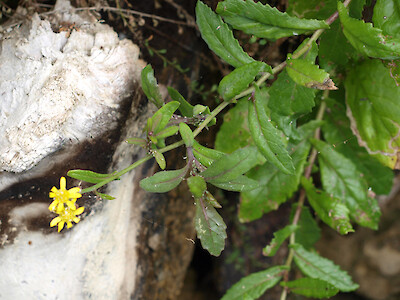
An attractive sometimes somewhat gangly daisy, with toothed leaves which clasp the stem. The yellow flowers are up to 2.5 cm across and are found in terminal bunches of up to 40. The plants are generally sparsely hairy and the green leaves often have undersides which have purple veins or are completely purple.
Flower colours
Yellow
Detailed description
Hardy, perennial herb. Stems angled to erect up to 1.5 metres. Leaves elliptic, or elliptic-oblong to obovate, (20-)40-120(-200) × (10-)20–50 mm; irregularly dentate to 1–2-serrate, lyrate-pinnatifid or 1-pinnatifid with oblong, few-toothed segments, or rarely crenately lobed, teeth or segments (3-)7–20 or more on each side. apetiolate and often cuneate to clasping at base, glabrous or moderately to densely lanate especially on lower surface, under side green to purple to blotchy combination of green and purple. Uppermost leaves smaller, narrower, often more or less oblong or lanceolate, less divided and more conspicuously clasping at base. Inflorescences terminal, of up to 40 capitula arranged corymbosely, overtopping leaves. Supplementary bracts 3-16(-20), 1.5–5 mm long. Involucral bracts 12-16(-19), glabrous, 2-5 mm long. Ray florets usually 7–13, very rarely as many as 22; ligules yellow, 3-8 mm long. Achenes with 1–3 rows of hairs in narrow grooves between broad ribs, not or scarcely narrowed to apex, 2-2.8 mm long.
Similar taxa
Senecio colensoi differs from S. banksii mainly by the leaves which are densely covered with silvery-white lanate hairs. It is also a smaller, less heavily branched plant.
Distribution
Endemic. Te Ika-a-Māui | North Island, East of ranges mostly coastal from Mokohinau Islands in the North, to Castlepoint, Eastern Wairarapa, in the South, extending inland to the Central plateau.
Habitat
Coastal to montane (0-1100 m.a.s.l.). Well drained sites such as limestone and mudstone cliffs, boulders and outcrops.
Detailed taxonomy
Genus
Family
Synonyms
Senecio banksii Hook.f. var. banksii, Senecio banksii var. velleia Hook.f., Senecio banksii var. scabrosus Hook.f., Senecio pumiceus Colenso
Taxonomic notes
Some botanists now include Senecio colensoi within S. banksii but the published evidence for this is wanting, i.e. no formal study of this species pair has been presented, just an opinion based on a brief examination of herbarium specimens (Webb et al. 1988).
As such until a proper, critical study of the two species is undertaken it seems prudent to retain them as distinct, especially as in the field both species are easily distinguished and have been found growing sympatrically.
Endemic taxon
Yes
Endemic genus
No
Endemic family
No
Ecology
Flowering
October – February(-June).
Fruiting
December - July.
Other information
Cultivation
Occasionally available from specialist native plant nurseries
Etymology
senecio: From the Latin senex ‘old man’ (probably referring to the bearded seeds)
banksii: Named after Sir Joseph Banks, 1st Baronet, GCB, PRS (24 February 1743 - 19 June 1820) was an English naturalist, botanist and patron of the natural sciences.
NVS code
The National Vegetation Survey (NVS) Databank is a physical archive and electronic databank containing records of over 94,000 vegetation survey plots - including data from over 19,000 permanent plots. NVS maintains a standard set of species code abbreviations that correspond to standard scientific plant names from the Ngä Tipu o Aotearoa - New Zealand Plants database.
SENBAN
Chromosome number
2n = 60
Previous conservation statuses
The conservation status of all known New Zealand vascular plant taxa at the rank of species and below were reassessed in 2022-2023 using the New Zealand Threat Classification System (NZTCS) – more information about this can be found on the NZTCS website. This report includes replaces all previous NZTCS lists for vascular plants. Previous assessments can be found here.
- Conservation status of vascular plants in Aotearoa New Zealand, 2023. 2024. Peter J. de Lange, Jane Gosden, Shannel P. Courtney, Alexander J. Fergus, John W. Barkla, Sarah M. Beadel, Paul D. Champion, Rowan Hindmarsh-Walls, Troy Makan and Pascale Michel Department of Conservation. Source: NZTCS and licensed by DOC for reuse under the Creative Commons Attribution 4.0 International licence.
2017 | At Risk – Naturally Uncommon | Qualifiers: DP, RR, Sp
2012 | At Risk – Naturally Uncommon | Qualifiers: DP, RR, Sp
2009 | Not Threatened
2004 | Not Threatened
Regional conservation statuses
Wellington: 2025 | Regionally Data Deficient
Current regional threat status assessments prepared according to Crisp et al. (2025) are displayed when available. The Wellington conservation status information is sourced from the “Conservation status of indigenous vascular plants in the Wellington region” Enright P et al. 2025 report.
Referencing and citations
References and further reading
Allan HH. 1961. Flora of New Zealand, Volume I. Indigenous Tracheophyta: Psilopsida, Lycopsida, Filicopsida, Gymnospermae, Dicotyledones. Government Printer, Wellington, NZ. 1085 p.
Webb CJ, Sykes WR, Garnock-Jones PJ. 1988. Flora of New Zealand, Volume IV. Naturalised Pteridophytes, Gymnosperms, Dicotyledons. Botany Division, Department of Scientific and Industrial Research, Christchurch, NZ. 1365 p.
Attribution
Fact sheet prepared for NZPCN by MD Ward (May 18th 2026). Description adapted from Allan (1961).
Some of this factsheet information is derived from Flora of New Zealand Online and is used under a Creative Commons Attribution 3.0 New Zealand licence.