
Senecio kermadecensis
Common names
Kermadec fireweed
Biostatus
Native – Endemic taxon
Current conservation status
The conservation status of all known New Zealand vascular plant taxa at the rank of species and below were reassessed in 2022-2023 using the New Zealand Threat Classification System (NZTCS) – more information about this can be found on the NZTCS website. This report includes replaces all previous NZTCS lists for vascular plants. Previous assessments can be found here.
- Conservation status of vascular plants in Aotearoa New Zealand, 2023. 2024. Peter J. de Lange, Jane Gosden, Shannel P. Courtney, Alexander J. Fergus, John W. Barkla, Sarah M. Beadel, Paul D. Champion, Rowan Hindmarsh-Walls, Troy Makan and Pascale Michel Department of Conservation. Source: NZTCS and licensed by DOC for reuse under the Creative Commons Attribution 4.0 International licence.
2023 | Threatened – Nationally Critical | Qualifiers: EF, IE, RR
Category
Vascular
Structural class
Herbs - Dicotyledonous composites
Flower colours
Green, Yellow
Detailed description
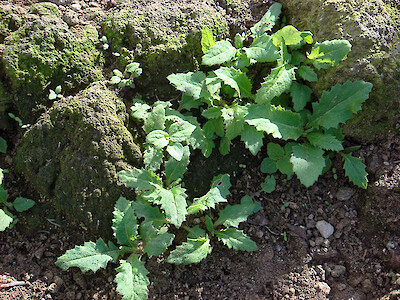
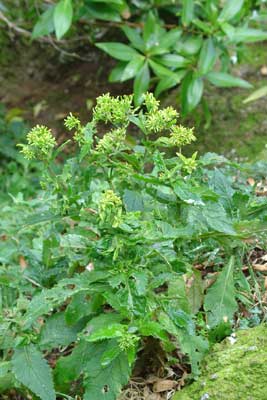
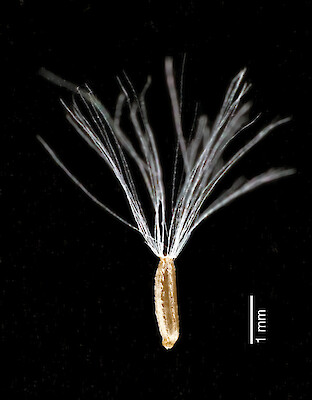
Erect annual or short-lived perennial herb. Stems usually dark maroon-purple, sometimes green. Basal leaves usually withering at flowering, apetiolate or shortly petiolate, 40–100 × 10–40mm, broadly elliptic, grey-green to bright green, sparsely to densely hispid especially on lower surface, evenly and finely dentate with dentitions increasing in depth toward leaf base; mid-cauline leaves similar, apetiolate, 30–80 × 5–30mm, broadly elliptic to elliptic, uppermost leaves smaller and narrower with few remote teeth. Inflorescence corymbose. Supplementary bracts of involucre 0–3, 1–2mm long. Involucral bracts 5–8, glabrous, 4.5–5.5mm long. Ray florets 0. Disc greenish-yellow, c. 1.5mm diameter. Cypsela subcylindric, 2.0–2.5mm long, greyish-black, scarcely narrowed or constricted at apex, with 1–3 rows of hairs in grooves between broad ribs.
Similar taxa
Only known from the Kermadec Islands where it is the only erechtioid senecio species present. Young plants are hard to distinguish from Ageratum houstonianum, and reliable identification can only be made with flowering specimens. The flowers of Ageratum houstonianum are blue those of S. kermadecensis are yellow-green.
Distribution
Endemic to the Kermadec Islands where it has been reported only from Raoul and the nearby Meyer Islets. A specimen provisionally referred to S. kermadecensis from the Poor Knights Islands is best placed with S. minimus, which in New Zealand exists in two forms, a narrow-leaved form akin to the typical species, and a broad-leaved form, which is close to S. kermadecensis and appears to be a recent arrival to New Zealand from Australia. It is actively spreading in Northland. The Poor Knights collection is of that form.
Habitat
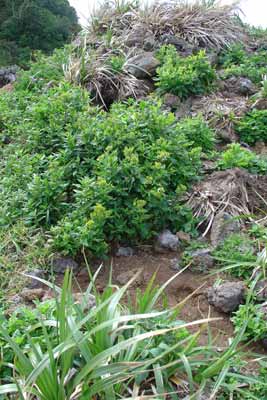
A species of disturbed sites, requiring open or clear ground such as that created by active sea bird nesting grounds to flourish.
Threats
Recent field surveys suggest this species is now confined to the Meyer Islets, where it is very common over a small area. Otherwise it seems to have gone extinct from Raoul Island over the last 30 years. The most likely cause of this decline seems to be the spread of the aggressive daisy Ageratum houstonianum Miller, which colonises the same open habitats the Senecio requires, is faster growing and seems to have displaced it from former and potential habitats on Raoul. Ageratum has now spread to the Meyer Islets, and eradication of this aggressive weed is unlikely due to the extreme vulnerability of the bird nesting grounds and burrows of those islands to collapse from human traffic.
Detailed taxonomy
Genus
Family
Synonyms
Erechtites kermadecensis (Belcher) Allan
Endemic taxon
Yes
Endemic genus
No
Endemic family
No
Ecology
Flowering
August to January
Fruiting
October to April
Propagation technique
Easy from fresh seed but very cold sensitive.
Other information
Etymology
senecio: From the Latin senex ‘old man’ (probably referring to the bearded seeds)
kermadecensis: From the Kermadec Islands
Chromosome number
2n = 60
Previous conservation statuses
The conservation status of all known New Zealand vascular plant taxa at the rank of species and below were reassessed in 2022-2023 using the New Zealand Threat Classification System (NZTCS) – more information about this can be found on the NZTCS website. This report includes replaces all previous NZTCS lists for vascular plants. Previous assessments can be found here.
- Conservation status of vascular plants in Aotearoa New Zealand, 2023. 2024. Peter J. de Lange, Jane Gosden, Shannel P. Courtney, Alexander J. Fergus, John W. Barkla, Sarah M. Beadel, Paul D. Champion, Rowan Hindmarsh-Walls, Troy Makan and Pascale Michel Department of Conservation. Source: NZTCS and licensed by DOC for reuse under the Creative Commons Attribution 4.0 International licence.
2017 | Threatened – Nationally Critical | Qualifiers: CD, EF, IE, RR
2012 | Threatened – Nationally Critical | Qualifiers: CD, EF, IE, RR
2009 | Threatened – Nationally Critical | Qualifiers: De, DP, EF, IE, OL
2004 | Threatened – Nationally Endangered
Referencing and citations
References and further reading
Webb CJ, Sykes WR, Garnock-Jones PJ. 1988. Flora of New Zealand, Volume IV. Naturalised Pteridophytes, Gymnosperms, Dicotyledons. Botany Division, Department of Scientific and Industrial Research, Christchurch, NZ. 1365 p.
Attribution
Fact Sheet prepared for NZPCN by P.J. de Lange 11 November 2008. Description based on Webb et al. (1988) supplemented with information obtained from fresh specimens and herbarium material.
Some of this factsheet information is derived from Flora of New Zealand Online and is used under a Creative Commons Attribution 3.0 New Zealand licence.
NZPCN Fact Sheet citation
Please cite as: de Lange, P.J. (Year at time of access): Senecio kermadecensis Fact Sheet (content continuously updated). New Zealand Plant Conservation Network. https://www.nzpcn.org.nz/flora/species/senecio-kermadecensis/ (Date website was queried)