
Coprosma macrocarpa subsp. minor
Biostatus
Native – Endemic taxon
Current conservation status
The conservation status of all known New Zealand vascular plant taxa at the rank of species and below were reassessed in 2022-2023 using the New Zealand Threat Classification System (NZTCS) – more information about this can be found on the NZTCS website. This report includes replaces all previous NZTCS lists for vascular plants. Previous assessments can be found here.
- Conservation status of vascular plants in Aotearoa New Zealand, 2023. 2024. Peter J. de Lange, Jane Gosden, Shannel P. Courtney, Alexander J. Fergus, John W. Barkla, Sarah M. Beadel, Paul D. Champion, Rowan Hindmarsh-Walls, Troy Makan and Pascale Michel Department of Conservation. Source: NZTCS and licensed by DOC for reuse under the Creative Commons Attribution 4.0 International licence.
2023 | Not Threatened
Category
Vascular
Structural class
Trees & Shrubs - Dicotyledons
Simplified description
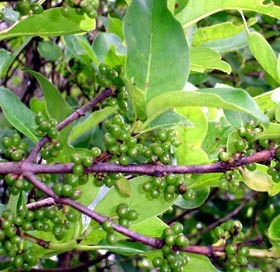
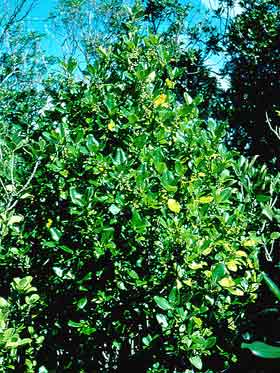
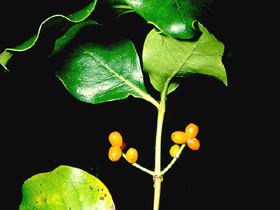
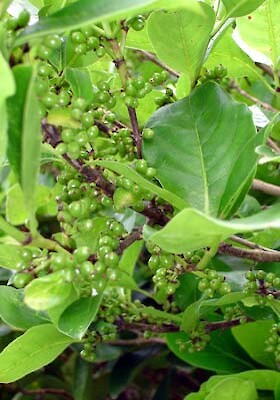
Shrub with pairs of dark green glossy pointed leaves inhabiting coastal forests of the northern half of the North Island. Leaves to 10cm long, widest at middle, paler underneath. Small papery sheath on stem between the base of the pairs of leaves. Fruit orange, clustered on short stems.
Flower colours
Green
Detailed description
Dioecious. Shrub or small tree up to 6(-9) metres tall. Trunk 10(-25) cm diameter. Bark thin, initially smooth and cream-coloured, becoming grey-brown and flaky. Branches and branchlets stout, glabrous, somewhat shiny. Petioles stout, approximately 10-18 mm long. Stipules approximately 4-7 mm long, membranous, triangular in face view, sheathing for about half the length, face slightly keeled, tipped with a single broadly conical gland-denticle approximately 1 mm long, stipule soon drying and abscising. Leaves 45-90(-140) × 35-50(-100) mm, chartaceous, mid-green, glabrous except when young distal margin lined with minute hairs, broad-ovate, apex subobtuse with short broad acumen, midrib prominent, secondary veins and reticulations evident, domatia present on lower surface. Male flowers peduncle 10-20 × 2 mm, flattened, decurved, approximate 5 flowers per primary fascicle, secondary-central fascicle of 7-15 flowers, calyx a dentate rim approximately 0.5 mm tall, with obscure cilia, corolla 9 × 2.5 mm, lobed to about halfway, lobes usually 5, anther 6.5 mm long. Female flowers peduncle .05-2(-3) × 2.5 mm, flattened, erect to antrorsely curved, (1-)2(-3) flowers per primary fascicle, secondary-central fascicle of (3-)7 flowers, calyx a dentate rim approximately 0.5 mm tall, with obscure cilia, corolla 8 × 1.5 mm, lobed to about halfway, lobes 4-5, stigma 15 mm long. Drupe yellowish to orange, 5-10 × 4-8 mm, broad-oblong. Seeds 2, pyrene, oblong, 5-6.5(-7.5) × 3-4 mm, in cross-section semilunar sometimes with pair of longitudinal ridges.
Similar taxa
Most similar to Coprosma macrocarpa ssp. macrocarpa, in which the leaves are very similar but are leathery(coriaceous) versus papery (chartaceous). The female flowers if present may be differentiated (from C. macrocarpa ssp. minor) as they have several differences ovary 1.3 mm diameter (3 mm), corolla lobe 1.3 mm (3 mm), if present the fruit can also be used 17 × 12 mm (7 × 6 mm), pyrene 9 × 6 mm (6.5 × 3.5 mm). C. macrocarpa ssp. macrocarpa is naturally only found on the Manawatāwhi | Three Kings Islands.
C. robusta is also similar, however this species leaves have a minutely toothed margin which C. macrocarpa ssp. minor does not. To a trained eye the leaf venation of C. macrocarpa ssp. minor is also more prominent than that of C. robusta.
Distribution
Endemic. Confined to the Te Ika-a-Māui | North Island and near off-shore islands (except the Three Kings Islands) from North Cape south to Kawhia Harbour and Hicks Bay.
Habitat
Coastal to Montane, (0 – 560 m.a.s.l.). Mostly a coastal species including on off-shore islands, amongst the forest and scrub.
Detailed taxonomy
Genus
Family
Taxonomic notes
In Gardner & Heads(2003), it is suggested that there is good herbarium evidence of this species readily hybridising with C. propinqua, C. repens, and particularly C. robusta.
Endemic taxon
Yes
Endemic genus
No
Endemic family
No
Ecology
Flowering
June – October.
Fruiting
August - February.
Other information
Etymology
coprosma: From the Greek kopros ‘dung’ and osme ‘smell’, referring to the foul smell of the species, literally ‘dung smell’
macrocarpa: Large fruit
minor: Smaller
Manaaki Whenua Online Interactive Key
NVS code
The National Vegetation Survey (NVS) Databank is a physical archive and electronic databank containing records of over 94,000 vegetation survey plots - including data from over 19,000 permanent plots. NVS maintains a standard set of species code abbreviations that correspond to standard scientific plant names from the Ngä Tipu o Aotearoa - New Zealand Plants database.
COPMSM
Chromosome number
2n = 44
Previous conservation statuses
The conservation status of all known New Zealand vascular plant taxa at the rank of species and below were reassessed in 2022-2023 using the New Zealand Threat Classification System (NZTCS) – more information about this can be found on the NZTCS website. This report includes replaces all previous NZTCS lists for vascular plants. Previous assessments can be found here.
- Conservation status of vascular plants in Aotearoa New Zealand, 2023. 2024. Peter J. de Lange, Jane Gosden, Shannel P. Courtney, Alexander J. Fergus, John W. Barkla, Sarah M. Beadel, Paul D. Champion, Rowan Hindmarsh-Walls, Troy Makan and Pascale Michel Department of Conservation. Source: NZTCS and licensed by DOC for reuse under the Creative Commons Attribution 4.0 International licence.
2017 | Not Threatened
2012 | Not Threatened
2009 | Not Threatened
2004 | Not Threatened
Regional conservation statuses
Northland: 2026 | Regionally Not Threatened
Current regional threat status assessments prepared according to Crisp et al. (2025) are displayed when available. The Northland conservation status information is sourced from the “Conservation status of indigenous vascular plants in Northland | Taitokerau” Ford et al. 2026 report.
Auckland: 2025 | Regionally Not Threatened | Qualifiers: DPS, DPT
Current regional threat status assessments prepared according to Crisp et al. (2025) are displayed when available. The Auckland conservation status information is sourced from the “Conservation status of vascular plant species in Tāmaki Makaurau / Auckland” Simpkins E et al. 2025 report.
Referencing and citations
References and further reading
Gardner R. 2006. Flowering time in Coprosma macrocarpa subsp. minor (Rubiaceae). Auckland Botanical Society Journal, Volume 61: 122-123.
Gardner R. & Heads M. 2003. Coprosma macrocarpa subsp. minor (Rubiaceae), a new subspecies from northern New Zealand. New Zealand Natural Sciences Journal, 28:67-80. http://dx.doi.org/10.26021/617
Attribution
Fact sheet prepared for NZPCN by MD Ward (December 17th 2025). Description adapted from Gardner 2003 Creative Commons Attribution 4.0 International licence.