
Coprosma perpusilla subsp. subantarctica

Biostatus
Native
Current conservation status
The conservation status of all known New Zealand vascular plant taxa at the rank of species and below were reassessed in 2022-2023 using the New Zealand Threat Classification System (NZTCS) – more information about this can be found on the NZTCS website. This report includes replaces all previous NZTCS lists for vascular plants. Previous assessments can be found here.
- Conservation status of vascular plants in Aotearoa New Zealand, 2023. 2024. Peter J. de Lange, Jane Gosden, Shannel P. Courtney, Alexander J. Fergus, John W. Barkla, Sarah M. Beadel, Paul D. Champion, Rowan Hindmarsh-Walls, Troy Makan and Pascale Michel Department of Conservation. Source: NZTCS and licensed by DOC for reuse under the Creative Commons Attribution 4.0 International licence.
2023 | At Risk – Naturally Uncommon | Qualifiers: RR, SO
Category
Vascular
Structural class
Trees & Shrubs - Dicotyledons
Simplified description
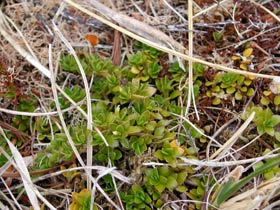
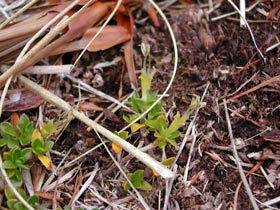
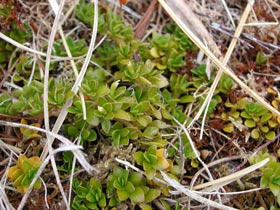
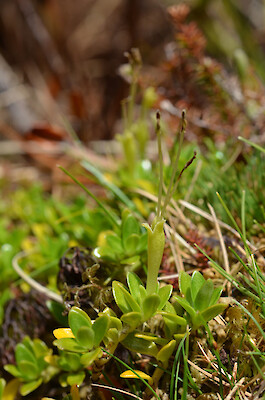
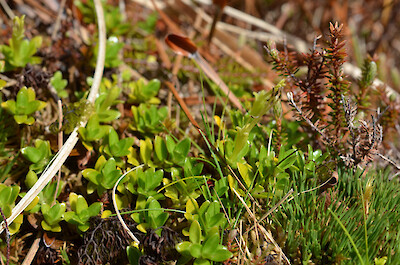
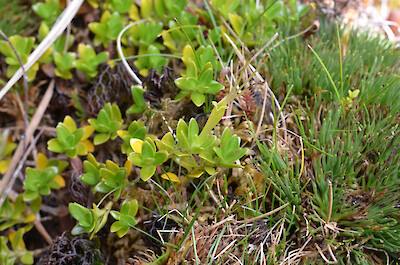
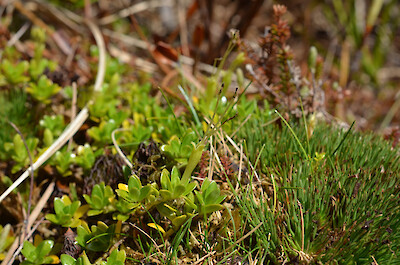
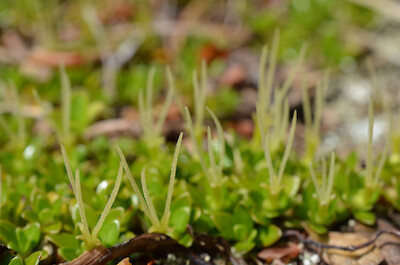
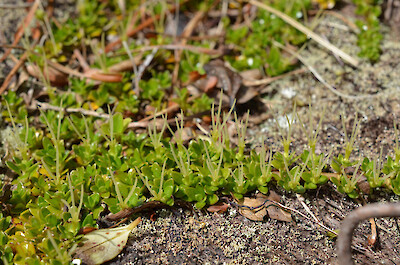
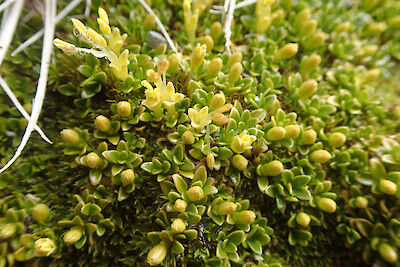
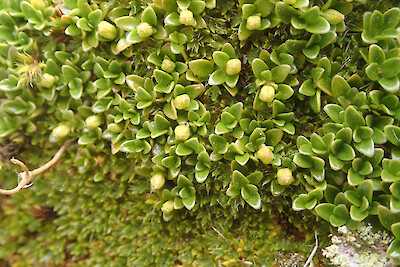
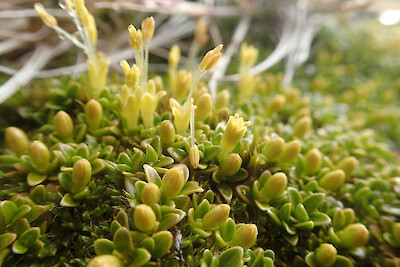
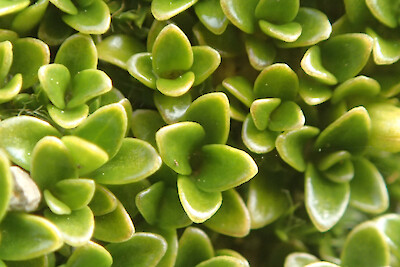
Dwarf low-growing sprawling shrub forming patches to 60cm in diameter with erect pairs of small glossy pale green hairless leaves inhabiting open areas on some Subantarctic Islands. Leaves 4-6mm long by 3-4mm wide, fleshy. Small group of hairs on stem between leaf bases.
Detailed description
Prostrate, mat-forming small shrub. Branches 300-400 × 2-3 mm, glabrous, rooting at nodes; branchlets upright, 10-20 mm long. Leaves crowded, usually 4.5–7 × 2-3.5 mm; stipules flat to flared, rounded-triangular, truncate at attachment, with up to 7 denticles, occasionally more, glabrous or slightly bearded on margin, hairs never concealing teeth; lamina bright glossy green, short petiole, glabrous, thick, fleshy, usually lanceolate to oblanceolate or ovate to obovate, apex bluntly acute, abscission zone of petiole well-developed. Flowers solitary, terminal on erect branchlets, unisexual; male flowers stalkless, calyx cupular, corolla greenish-white and flecked red; stamens 4, filaments (7-)12-27 mm long, anthers 3.8 mm long; female flowers stalkless, calyx cupular; corolla 3.4-6.7 mm long, yellow-green or pale orange, flecked red, styles 3 or 4. Drupe yellow-orange to orange-red, opaque to semi-translucent, ovoid, globular or depressed-globular, (3.5-)4.0-6.0(-11.0) mm long; Seeds 3-4 per fruit, elliptic, (2.2-)2.5-3.3 × (1.4-)1.5-1.8(-2.1) mm.
Similar taxa
Differs from Coprosma perpusilla subsp. perpusilla (compared to C. perpusilla subsp. subantarctica) in not having a well-defined abscission zone at the base of the petiole, and in its narrower stipules with fewer denticles 1-4 (up to 7), and obvious beard (few or no hairs).
Distribution
Indigenous. Subantarctic Islands, Motu Ihupuku | Campbell Island, Auckland Islands, and Moutere Mahue | Antipodes Islands , including Macquarie Island (all part of the New Zealand Botanical Region). However, Macquarie is geopolitically part of Australia.
Habitat
Lowland to upland (0-300 m.a.s.l.), in peaty soiled areas of tussocklands and cushionfields.
Detailed taxonomy
Genus
Family
Endemic taxon
No
Endemic genus
No
Endemic family
No
Ecology
Flowering
December - April.
Fruiting
January – November.
Wetland plant indicator status rating
Information derived from the revised national wetland plant list prepared to assist councils in delineating and monitoring wetlands (Clarkson et al., 2021 Manaaki Whenua – Landcare Research Contract Report LC3975 for Hawke’s Bay Regional Council). The national plant list categorises plants by the extent to which they are found in wetlands and not ‘drylands’. The indicator status ratings are OBL (obligate wetland), FACW (facultative wetland), FAC (facultative), FACU (facultative upland), and UPL (obligate upland). If you have suggestions for the Wetland Indicator Status Rating, please contact: [Enable JavaScript to view protected content]
FACW: Facultative Wetland
Usually is a hydrophyte but occasionally found in uplands (non-wetlands).
Other information
Etymology
coprosma: From the Greek kopros ‘dung’ and osme ‘smell’, referring to the foul smell of the species, literally ‘dung smell’
perpusilla: Tiny, very small
subantarctica: Referring to the plants distribution.
Manaaki Whenua Online Interactive Key
NVS code
The National Vegetation Survey (NVS) Databank is a physical archive and electronic databank containing records of over 94,000 vegetation survey plots - including data from over 19,000 permanent plots. NVS maintains a standard set of species code abbreviations that correspond to standard scientific plant names from the Ngä Tipu o Aotearoa - New Zealand Plants database.
COPPSS
Chromosome number
2n = c.154
Previous conservation statuses
The conservation status of all known New Zealand vascular plant taxa at the rank of species and below were reassessed in 2022-2023 using the New Zealand Threat Classification System (NZTCS) – more information about this can be found on the NZTCS website. This report includes replaces all previous NZTCS lists for vascular plants. Previous assessments can be found here.
- Conservation status of vascular plants in Aotearoa New Zealand, 2023. 2024. Peter J. de Lange, Jane Gosden, Shannel P. Courtney, Alexander J. Fergus, John W. Barkla, Sarah M. Beadel, Paul D. Champion, Rowan Hindmarsh-Walls, Troy Makan and Pascale Michel Department of Conservation. Source: NZTCS and licensed by DOC for reuse under the Creative Commons Attribution 4.0 International licence.
2017 | At Risk – Naturally Uncommon | Qualifiers: RR, Sp
2012 | At Risk – Naturally Uncommon | Qualifiers: RR, SO, Sp
2009 | At Risk – Naturally Uncommon
2004 | Not Threatened
Referencing and citations
References and further reading
Du Puy DJ, Telford IRH & Orchard AE. 1993. Rubiaceae, in George, A.S. et al. (eds), Flora of Australia 50: 392–404. Australian Government Publishing Service: Canberra, Australia.
Glenny D, Cruickshank J, Morse C and Rolfe J. 2010. Key to Coprosma species of New Zealand.
Accessed at https://www.landcareresearch.co.nz/tools-and-resources/identification/key-to-coprosma-species-of-new-zealand 24/12/25
Orchard AE 1987. A revision of the Coprosma pumila (Rubiaceae) complex in Australia, New Zealand and the subantarctic islands. Brunonia 9: 119–138.
Webb CJ, Simpson MJA. 2001. Seeds of New Zealand Gymnosperms and Dicotyledons. Manuka Press, Christchurch. 428 p.
Attribution
Fact sheet prepared for NZPCN by MD Ward (December 24th 2025). Description adapted from Glenny et. al. (2025)