
Corybas vitreus
Common names
spider orchid
Biostatus
Native – Endemic taxon
Current conservation status
The conservation status of all known New Zealand vascular plant taxa at the rank of species and below were reassessed in 2022-2023 using the New Zealand Threat Classification System (NZTCS) – more information about this can be found on the NZTCS website. This report includes replaces all previous NZTCS lists for vascular plants. Previous assessments can be found here.
- Conservation status of vascular plants in Aotearoa New Zealand, 2023. 2024. Peter J. de Lange, Jane Gosden, Shannel P. Courtney, Alexander J. Fergus, John W. Barkla, Sarah M. Beadel, Paul D. Champion, Rowan Hindmarsh-Walls, Troy Makan and Pascale Michel Department of Conservation. Source: NZTCS and licensed by DOC for reuse under the Creative Commons Attribution 4.0 International licence.
2023 | Not Threatened
Category
Vascular
Structural class
Orchids
Simplified description
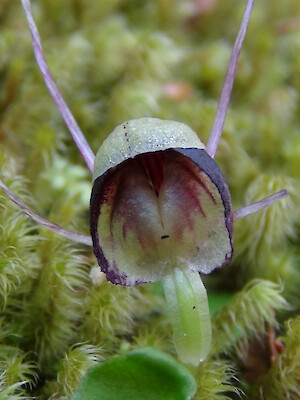
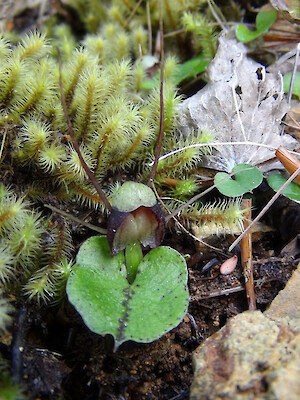
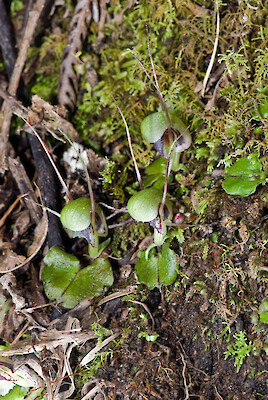
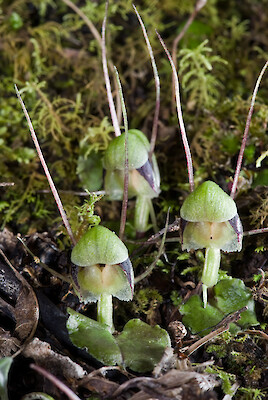
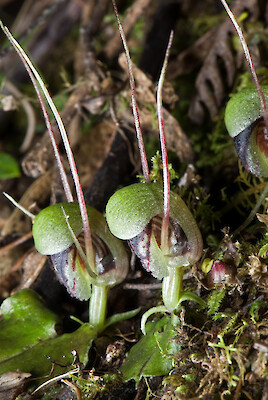
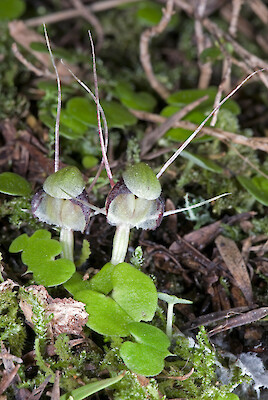
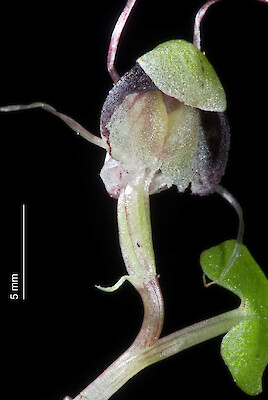
Terrestrial, seasonal orchid. Leaves solitary, heart-shaped, distinctly mucronate. Flowers solitary, central portion mostly translucent (‘glass-like’).
Flower colours
Green
Detailed description
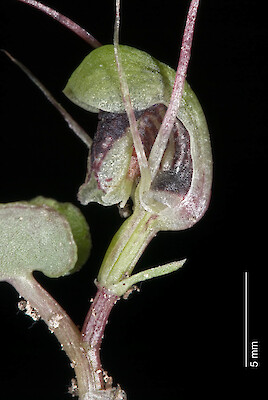
Terrestrial herbs, 14–30 mm tall at flowering. Leaf distinctly petiolate, petiole 3.3–24.7 mm long; lamina cordiform, 3.3–14.1 × 7.8–19.6 mm; margin entire; apex mucronate with mucro 0.2–2.8 mm long. Flower solitary, held erect on a peduncle 0.7–8.1 mm long; floral bract triangular to widely deltoid when flattened, 1.8–6.8 × 1.3–3.2 mm; dorsal sepal pale green and less often with a few maroon streaks, concave to cucullate, arching over the labellum, narrow at the base and widely spathulate towards the tip, apex retuse to emarginated; lateral sepals linear-filiform, whitish to pale maroon, 12.0–26.7 mm long; petals similar to the lateral sepals but longer, 21.3–56.5 mm long; labellum lamina mostly translucent, less often with a few streaks of maroon, covered with short trichomes, auriculate at base, aperture 1.2–2.6 mm in diameter; lamina deflexed, c. 7 mm wide, with a central groove formed by the inwards folding of the lamina, extending downwards half way the labellum and sunken pit formed at the point where the lamina bends; lateral margin of the labellum incurving, entire, with a non-isometric dark maroon to purple band, lower margin translucent, straight and erose. Ovary 4.5–8.4 mm long. Column 1.8 mm long, straight, round wings flanking the stigma. Senescent flowers with apex of the dorsal sepal pressing against the labellum blocking access to the column.
Similar taxa
Corybas vitreus is morphologically close to C. walliae both having a similar overall pale coloured flower but C. vitreus differs from C. walliae by its translucent labellum lamina with a non-isometric, dark maroon to purple band along the lateral margin and straight translucent lower margin. Corybas vitreus is distinguished from C. trilobus by its broadly ovate flower in frontal view and emarginate to retuse dorsal sepal.
Distribution
Endemic. New Zealand: North Island (southern), South Island.
Habitat
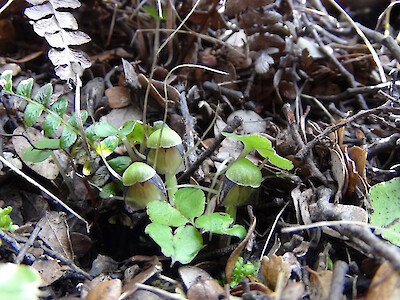
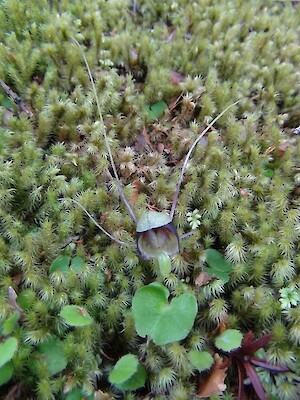
Locally common in beech forest (Fuscospora or Lophozonia (Nothofagaceae)) and Kunzea / Leptospermum schrubland / forest, usually growing in leaf litter at elevations between 600 to 1300 m.
Threats
Not Threatened.
Detailed taxonomy
Genus
Family
Synonyms
None - first described in 2016
Endemic taxon
Yes
Endemic genus
No
Endemic family
No
Ecology
Flowering
September–October
Fruiting
November – early January
Propagation technique
Difficult—should not be removed from the wild.
Other information
Etymology
corybas: Helmet flower
vitreus: Meaning ‘of glass or glassy’ as in transparent, glass-like and often green tinged
Manaaki Whenua Online Interactive Key
Previous conservation status
The conservation status of all known New Zealand vascular plant taxa at the rank of species and below were reassessed in 2022-2023 using the New Zealand Threat Classification System (NZTCS) – more information about this can be found on the NZTCS website. This report includes replaces all previous NZTCS lists for vascular plants. Previous assessments can be found here.
- Conservation status of vascular plants in Aotearoa New Zealand, 2023. 2024. Peter J. de Lange, Jane Gosden, Shannel P. Courtney, Alexander J. Fergus, John W. Barkla, Sarah M. Beadel, Paul D. Champion, Rowan Hindmarsh-Walls, Troy Makan and Pascale Michel Department of Conservation. Source: NZTCS and licensed by DOC for reuse under the Creative Commons Attribution 4.0 International licence.
2017 | Not Threatened
Regional conservation statuses
Otago: 2025 | Regionally Data Deficient
Current regional threat status assessments prepared according to Crisp et al. (2025) are displayed when available. The Otago conservation status information is sourced from the “Conservation Status of Indigenous Vascular Plants in Otago, 2025” Jarvie S et al. (2025) report.
Referencing and citations
References and further reading
Lehnebach CA, Zeller AJ, Frericks J, Ritchie P. 2016. Five new species of Corybas (Diurideae, Orchidaceae) endemic to New Zealand and phylogeny of the Nematoceras clade. Phytotaxa 270(1): 1–24. https://doi.org/10.11646/phytotaxa.270.1.1.
Attribution
Fact Sheet prepared for NZPCN by P.J. de Lange (13 August 2016). Description from Lehnebach et al. (2016)