
Myosotis chaffeyorum
Common names
forget-me-not
Biostatus
Native – Endemic taxon
Current conservation status
The conservation status of all known New Zealand vascular plant taxa at the rank of species and below were reassessed in 2022-2023 using the New Zealand Threat Classification System (NZTCS) – more information about this can be found on the NZTCS website. This report includes replaces all previous NZTCS lists for vascular plants. Previous assessments can be found here.
- Conservation status of vascular plants in Aotearoa New Zealand, 2023. 2024. Peter J. de Lange, Jane Gosden, Shannel P. Courtney, Alexander J. Fergus, John W. Barkla, Sarah M. Beadel, Paul D. Champion, Rowan Hindmarsh-Walls, Troy Makan and Pascale Michel Department of Conservation. Source: NZTCS and licensed by DOC for reuse under the Creative Commons Attribution 4.0 International licence.
2023 | Threatened – Nationally Vulnerable | Qualifiers: Sp, DPR, RR
Category
Vascular
Structural class
Herbs - Dicotyledons other than Composites
Detailed description
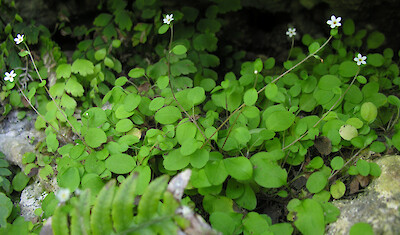
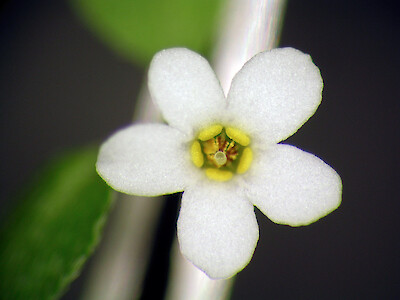
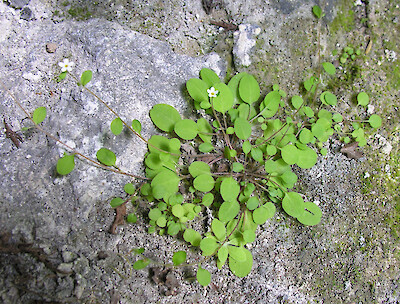
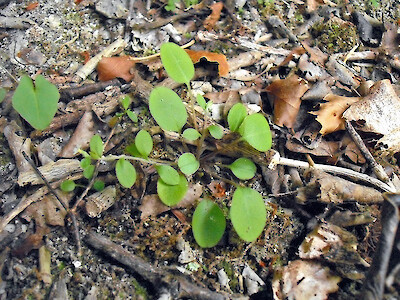
Plant perennial, 14–46 mm tall. Rosette leaves 6–9, lamina orbicular, 8.1–8.9 × 7.7–9.2 mm, apex mucronate, mucro c.1 mm long. Leaf indumentum strigose, hairs on upper and lower surface sparsely distributed, non overlapping, appressed and antrorse. Hairs on leaf margin appressed. Petiole well-defined, 11.9–13.5 × 0.2–0.3 mm; hairs appressed, antrorse, sparsely distributed. Stem light brown, decumbent, not rooting at nodes, 59–100 × 0.3–0.5 mm. Stem hairs appressed as for leaves, hairs 0.2–0.6 mm long. Stem leaves elliptic or orbicular, 7.2–8.8 × 4.4–6.2 mm, mucronulate, shortly petiolate or sessile towards distal end of stem. Indumentum as for rosette leaves. Calyx lobes lanceolate, 1.5–2.0 mm long, hairs in upper half of the lobe only. Fruiting calyx 2.3 – 3 mm long; hairs appressed, straight, overlapping, not uniform in size. Flowers borne along the trailing stem, each usually opposite to a leaf. Pedicel at fruiting 1.5–3.0 mm long. Corolla white with yellow scales, 3.7–4.0 mm across. Corolla lobes obovate, not overlapping, 1.4–1.8 × 1.2–1.6 mm, apex rounded or irregularly notched. Corolla tube 2 – 2.2 mm long. Stamens included in the corolla, anther appendage slightly above the scales. Filament attached below scales. Anther 0.5 × 0.2 mm. Style 1.8 mm long, stigma clavate. Nutlet smooth, light brown, ovoid to ellipsoid, 1.2 × 0.7–0.8 mm, ventral surface rounded.
Similar taxa
Myosotis chaffeyorum can be confused with M. matthewsii (a North Island (Northland)) endemic and M. spathulata. It differs from Myosotis spathulata differs from Myosotis by its well-defined, slender petiole; appressed, straight hairs on stem, petiole, leaf lamina and margin; and by its decumbent stem not rooting at nodes. From M. matthewsii it differs its strigose indumentum on leaf upper surface; smaller flowers (3.7– 4.0 mm across vs 5.0–8.0 mm across); stamens included in the corolla tube and by the fruiting calyx borne on a shorter pedicel (1.5–3.0 mm vs 4.6 – 8.4 mm)
Distribution
Endemic. South Island (North West Nelson (Kahurangi National Park))
Habitat
Montane in closed red beech (Nothofagus fusca) forest at the bases of limestone cliff faces
Threats
Myosotis chaffeyorum is currently known from five populations (four on protected land) and very few individuals (< 250) for this reason it has been listed as Nationally Critical by Lehnebach (2012)
Detailed taxonomy
Genus
Family
Synonyms
None - first described in 2012
Endemic taxon
Yes
Endemic genus
No
Endemic family
No
Ecology
Flowering
February
Fruiting
February
Propagation technique
Unknown
Other information
Etymology
myosotis: Mouse-eared
Previous conservation statuses
The conservation status of all known New Zealand vascular plant taxa at the rank of species and below were reassessed in 2022-2023 using the New Zealand Threat Classification System (NZTCS) – more information about this can be found on the NZTCS website. This report includes replaces all previous NZTCS lists for vascular plants. Previous assessments can be found here.
- Conservation status of vascular plants in Aotearoa New Zealand, 2023. 2024. Peter J. de Lange, Jane Gosden, Shannel P. Courtney, Alexander J. Fergus, John W. Barkla, Sarah M. Beadel, Paul D. Champion, Rowan Hindmarsh-Walls, Troy Makan and Pascale Michel Department of Conservation. Source: NZTCS and licensed by DOC for reuse under the Creative Commons Attribution 4.0 International licence.
2017 | Threatened – Nationally Critical | Qualifiers: RR, Sp
2012 | Threatened – Nationally Critical | Qualifiers: DP, RR, Sp
2009 | Threatened – Nationally Critical | Qualifiers: DP
Referencing and citations
References and further reading
Lehnebach, C.A. 2012: Two new species of forget-me-nots (Boraginaceae) from New Zealand. Phytokeys 16: 53-64. (doi: 10.3897/phytokeys.16.3602 www.phytokeys.com)
Attribution
Fact Sheet Prepared for NZPCN by: P.J. de Lange (5 September 2012). Description adapted from Lehnebach (2012)