
Myosotis ×cinerascens
Biostatus
Native – Endemic taxon
Current conservation status
The conservation status of all known New Zealand vascular plant taxa at the rank of species and below were reassessed in 2022-2023 using the New Zealand Threat Classification System (NZTCS) – more information about this can be found on the NZTCS website. This report includes replaces all previous NZTCS lists for vascular plants. Previous assessments can be found here.
- Conservation status of vascular plants in Aotearoa New Zealand, 2023. 2024. Peter J. de Lange, Jane Gosden, Shannel P. Courtney, Alexander J. Fergus, John W. Barkla, Sarah M. Beadel, Paul D. Champion, Rowan Hindmarsh-Walls, Troy Makan and Pascale Michel Department of Conservation. Source: NZTCS and licensed by DOC for reuse under the Creative Commons Attribution 4.0 International licence.
2023 | Not Assessed
Category
Vascular
Structural class
Herbs - Dicotyledons other than Composites
Flower colours
White, Yellow
Detailed description
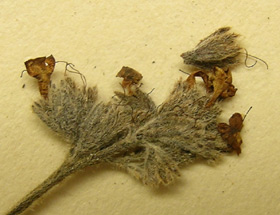
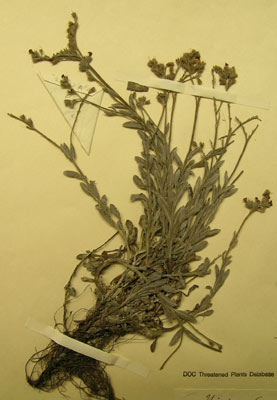
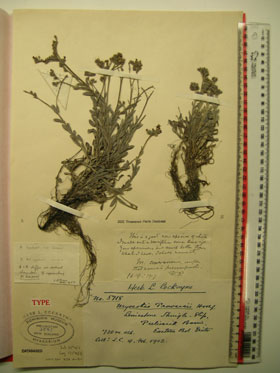
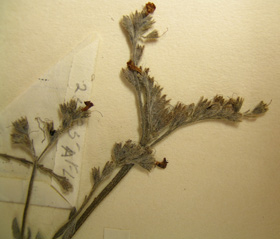
Tufted, greyish green, hairy, rosette forming herb. Rosette leaves numerous, spathulate, 20-70 x 40-90 mm, petiole broad, ill-defined, hairs numerous, on upper surface smoothly appressed, overlapping of varying lengths, hairs on undersides short, not retrorse. Lateral branches ascending to erect, up to 150 mm long, internodes < leaves. Upper stem leaves 12-20 mm, oblong, narrowing to subacute tip; hairs of upper surface appressed, short, those of undersides similar but shorter, interspersed with longer hooked hairs. Inflorescence a compact, many-flowered cyme, carried 10-20(-30) mm above leaves when fruiting, occasionally with a leafy bract above the lowest division. Flowers probably white or maybe pale lemon.
Similar taxa
The most recent treatment of New Zealand Myosotis, that offered by Meudt (2021) suggests that this plant which has long been known as M. cinerascens or M. traversii var. cinerascens (see de Lange et al. 2010; Meudt 2021) is an uncommon naturally occurring hybrid between M. colensoi and M. traversii subsp. cantabrica. From M. traversii subsp. traversii this hybrid is distinguished by the presence of many hooked hairs on the undersurface of the upper stem leaves. From M. traversii subsp. cantabrica it is distinguished by the short, smoothly appressed leaf hairs and elongated fruiting inflorescence.
Distribution
Endemic. South Island, Canterbury, Castle Hill Basin only.
Habitat
A very uncommon hybrid found on the limestone within the Castle Hill Basin. The most recent records of it have found it on talus slopes associated with the putative parents.
Threats
This plant is known from only a handful of collections made during the from much the same area fromt he 1800s to the early 2000s. The most recent observations found very few plants. It is not known if the hybrid is sterile. Unfortunately its limestone habitat is now at risk from severe modification following weed invasion.
Detailed taxonomy
Genus
Family
Synonyms
Myosotis cinerascens Petrie, Myosotis traversii var. cinerascens (Petrie) L.B.Moore
Taxonomic notes
Opinion as to the status of thus hybrid has varied from those who felt it was a species to others who considered it an unusual ‘sport’ or perhaps an uncommon hybrid. Meudt (2021) decided to treat this plant as a hybrid, providing a nothotaxon name for it. NZPCN retains Myosotis ×cinerascens, because a few other nothotaxon are also accepted on the website. Myosotis ×cinerascens has not received a threat listing by de Lange et al. (2024) because the New Zealand Threat Classification System does not allow for threat listing of hybrids.
Endemic taxon
Yes
Endemic genus
No
Endemic family
No
Ecology
Flowering
Unknown
Fruiting
February
Propagation technique
Unknown. As a relatively low-elevation plant of limestone outcrops it may have been reasonably easy to cultivate from rooted pieces and fresh seed.
Other information
Etymology
myosotis: Mouse-eared
cinerascens: Becoming ash-coloured
Previous conservation statuses
The conservation status of all known New Zealand vascular plant taxa at the rank of species and below were reassessed in 2022-2023 using the New Zealand Threat Classification System (NZTCS) – more information about this can be found on the NZTCS website. This report includes replaces all previous NZTCS lists for vascular plants. Previous assessments can be found here.
- Conservation status of vascular plants in Aotearoa New Zealand, 2023. 2024. Peter J. de Lange, Jane Gosden, Shannel P. Courtney, Alexander J. Fergus, John W. Barkla, Sarah M. Beadel, Paul D. Champion, Rowan Hindmarsh-Walls, Troy Makan and Pascale Michel Department of Conservation. Source: NZTCS and licensed by DOC for reuse under the Creative Commons Attribution 4.0 International licence.
2017 | Extinct
2012 | Extinct
2009 | Extinct
2004 | Extinct
Referencing and citations
References and further reading
de Lange, P.J.; Heenan, P.B.; Norton, D.A.; Rolfe, J.R.; Sawyer, J.W.D. 2010: Threatened Plants of New Zealand. Canterbury University Press, Christchurch.
Meudt, H.M. 2021: Taxonomic revision of five species groups of ebracteate-erect Myosotis (Boraginaceae) endemic to New Zealand, based on morphology, and description of new subspecies. Australian Systematic Botany 34: 252–304.
Attribution
Fact Sheet prepared by NZPCN by P.J. de Lange (1 February 2008). Description subsequently published in de Lange et al. (2010).
NZPCN Fact Sheet citation
Please cite as: de Lange, P.J. (Year at time of access): Myosotis ×cinerascens Fact Sheet (content continuously updated). New Zealand Plant Conservation Network. https://www.nzpcn.org.nz/flora/species/myosotis-cinerascens/ (Date website was queried)