
Myosotis uniflora

Common names
Riverbed forget-me-not
Biostatus
Native – Endemic taxon
Current conservation status
The conservation status of all known New Zealand vascular plant taxa at the rank of species and below were reassessed in 2022-2023 using the New Zealand Threat Classification System (NZTCS) – more information about this can be found on the NZTCS website. This report includes replaces all previous NZTCS lists for vascular plants. Previous assessments can be found here.
- Conservation status of vascular plants in Aotearoa New Zealand, 2023. 2024. Peter J. de Lange, Jane Gosden, Shannel P. Courtney, Alexander J. Fergus, John W. Barkla, Sarah M. Beadel, Paul D. Champion, Rowan Hindmarsh-Walls, Troy Makan and Pascale Michel Department of Conservation. Source: NZTCS and licensed by DOC for reuse under the Creative Commons Attribution 4.0 International licence.
2023 | Threatened – Nationally Vulnerable | Qualifiers: Sp, CI, DPS, DPT
Category
Vascular
Structural class
Herbs - Dicotyledons other than Composites
Flower colours
White, Yellow
Detailed description
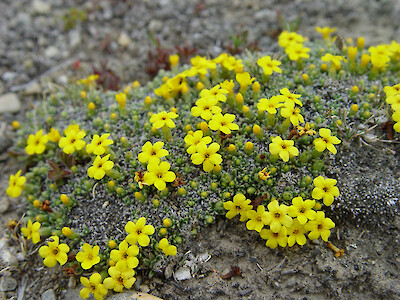
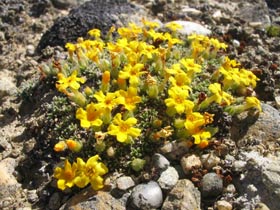
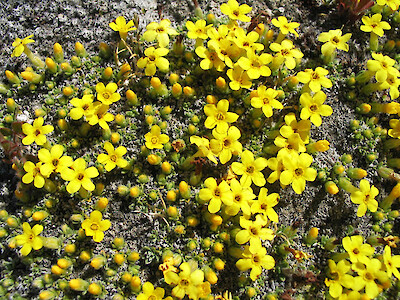
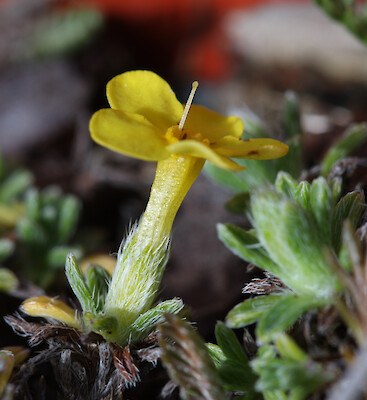
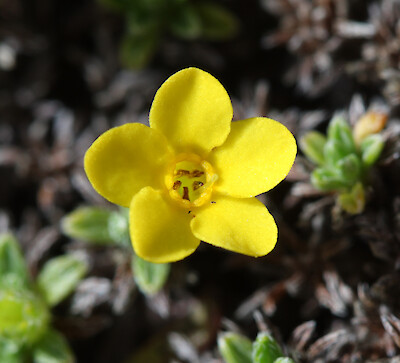
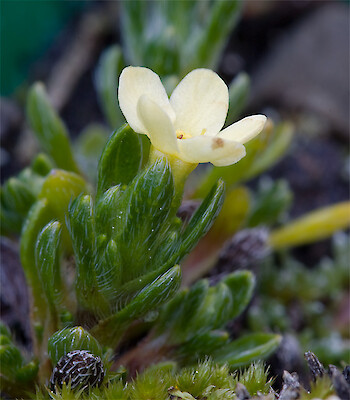
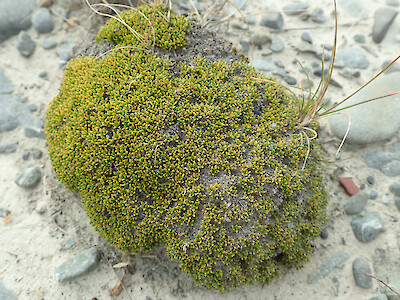
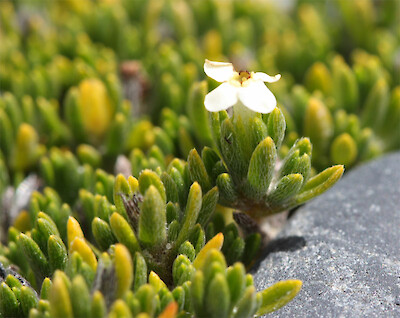
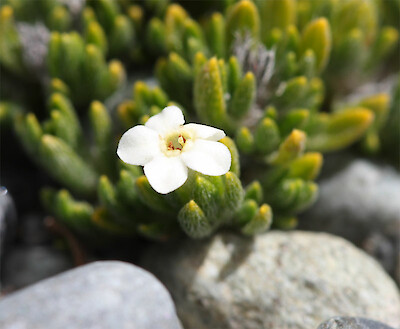
Much-branched tufted perennial herb arising from a long stout central woody taproot. Plants forming compact rounded cushion up to 100 mm diameter. Stems 10-50 mm long, c.5 mm diameter, crowded, ± erect, closely covered with imbricating leaves. Leaves c.5 mm long; base 1.5 mm. wide, membranous, sheathing, fringed with long hairs; lamina narrower, triangular to subulate, ± concave, apex subacute; hairs stiff, appressed, ± overlapping. Flowering branchlets short, not projecting above cushion, their leaves lacking the broad base but otherwise similar to lower leaves. Calyx c.3 mm long, lobes c. 1/2 length, rather broad, subacute, glabrous within, the whole calyx covered outside with uniform stiff appressed overlapping hairs. Corolla yellow fading to white with age, 4-5 mm diameter, tube 5 mm long, long-cylindric, lobes c.2 × 2 mm, rotund, flat; filaments short, anthers 1.5 mm long, tips protruding just above rather large scales; style 2-3× calyx, stigma capitate. Nutlets dark, up to 2.0 × 1.5 mm.
Similar taxa
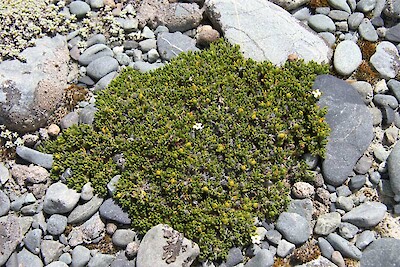
A very distinct species unlikely to be confused with any other Myosotis, and unique in its preference for stony river beds. In the field this species is easily recognised by the dark green cushions it forms, by the closely packed stems and narrow leaves, and when flowering by the conspicuous yellow flowers.
Distribution
Endemic. South Island. Eastern from Canterbury to Central Otago.
Habitat
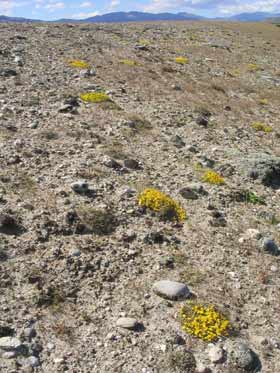
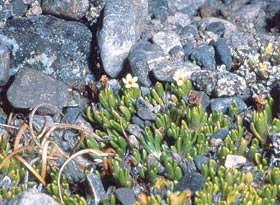
Montane to subalpine. Favouring stony and shingle river beds, flats and consolidated moraines.
Threats
Myosotis uniflora is an uncommon, mostly sparsely distributed species occupying habitats that are becoming increasingly vulnerable to weed invasion, or used for viticulture. If these trends continue then it is likely that M. uniflora will eventually be listed at some of level of threat.
Detailed taxonomy
Genus
Family
Synonyms
None
Endemic taxon
Yes
Endemic genus
No
Endemic family
No
Ecology
Flowering
September to November
Fruiting
November to January
Propagation technique
Difficult - should not be removed from the wild. This species can be grown in an alpine house but it is difficult to maintain.
Other information
Etymology
myosotis: Mouse-eared
uniflora: Single-flowered
NVS code
The National Vegetation Survey (NVS) Databank is a physical archive and electronic databank containing records of over 94,000 vegetation survey plots - including data from over 19,000 permanent plots. NVS maintains a standard set of species code abbreviations that correspond to standard scientific plant names from the Ngä Tipu o Aotearoa - New Zealand Plants database.
MYOUNI
Previous conservation statuses
The conservation status of all known New Zealand vascular plant taxa at the rank of species and below were reassessed in 2022-2023 using the New Zealand Threat Classification System (NZTCS) – more information about this can be found on the NZTCS website. This report includes replaces all previous NZTCS lists for vascular plants. Previous assessments can be found here.
- Conservation status of vascular plants in Aotearoa New Zealand, 2023. 2024. Peter J. de Lange, Jane Gosden, Shannel P. Courtney, Alexander J. Fergus, John W. Barkla, Sarah M. Beadel, Paul D. Champion, Rowan Hindmarsh-Walls, Troy Makan and Pascale Michel Department of Conservation. Source: NZTCS and licensed by DOC for reuse under the Creative Commons Attribution 4.0 International licence.
2017 | At Risk – Naturally Uncommon | Qualifiers: DP, Sp
2012 | At Risk – Naturally Uncommon | Qualifiers: DP, Sp
2009 | At Risk – Naturally Uncommon
2004 | Data Deficient
Regional conservation statuses
Otago: 2025 | Regionally Threatened – Regionally Endangered | Qualifiers: CD, DPT, OL
Current regional threat status assessments prepared according to Crisp et al. (2025) are displayed when available. The Otago conservation status information is sourced from the “Conservation Status of Indigenous Vascular Plants in Otago, 2025” Jarvie S et al. (2025) report.
Referencing and citations
References and further reading
Allan, H.H. 1961: Flora of New Zealand. Vol. I. Goverment Printer, Wellington.
Attribution
Fact Sheet prepared for NZPCN by P.J. de Lange (1 February 2008). Description based on Allan (1961).
Some of this factsheet information is derived from Flora of New Zealand Online and is used under a Creative Commons Attribution 3.0 New Zealand licence.
NZPCN Fact Sheet citation
Please cite as: de Lange, P.J. (Year at time of access): Myosotis uniflora Fact Sheet (content continuously updated). New Zealand Plant Conservation Network. https://www.nzpcn.org.nz/flora/species/myosotis-uniflora/ (Date website was queried)