
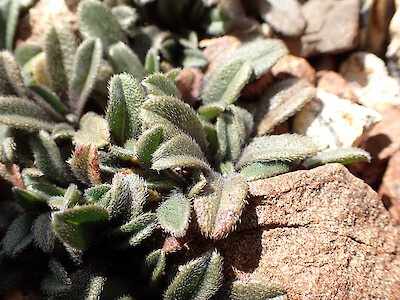
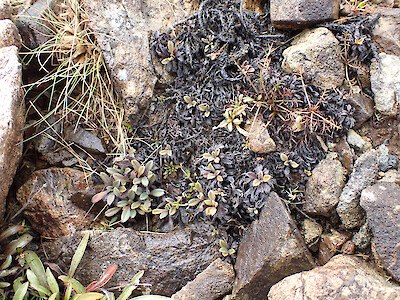
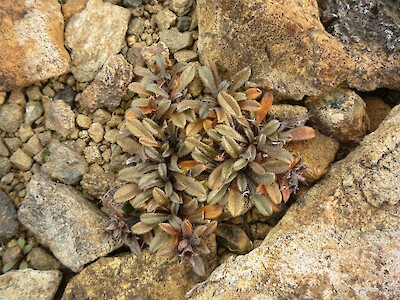
Myosotis ultramafica







Biostatus
Native – Endemic taxon
Current conservation status
The conservation status of all known New Zealand vascular plant taxa at the rank of species and below were reassessed in 2022-2023 using the New Zealand Threat Classification System (NZTCS) – more information about this can be found on the NZTCS website. This report includes replaces all previous NZTCS lists for vascular plants. Previous assessments can be found here.
- Conservation status of vascular plants in Aotearoa New Zealand, 2023. 2024. Peter J. de Lange, Jane Gosden, Shannel P. Courtney, Alexander J. Fergus, John W. Barkla, Sarah M. Beadel, Paul D. Champion, Rowan Hindmarsh-Walls, Troy Makan and Pascale Michel Department of Conservation. Source: NZTCS and licensed by DOC for reuse under the Creative Commons Attribution 4.0 International licence.
2023 | At Risk – Naturally Uncommon | Qualifiers: RR
Category
Vascular
Structural class
Herbs - Dicotyledons other than Composites
Distribution
New Zealand. South Island: Southland (West Dome, Bald Hill, Livingstone Mountains and Black Ridge).
Threats
Myosotis ultramafica was listed as At Risk – Naturally Uncommon, Range Restricted, Species by de Lange et al. (2013; as M. aff. lyallii (Mossburn, CHR 320240); Myosotis (a) (CHR 320240; Mossburn). It was not included in the 2017 threat assessment of de Lange et al. (2018) because it was considered synonymous with M. lyallii subsp. elderi on the basis of the results from Meudt and Prebble (2018). It the recent descripton of this species it was recommended the status Threatened - Nationally Vulnerable B(1) with the qualifiers ‘Data Poor Trend’ (DPT) and ‘Range Restricted’ (RR). Because EOO is very low (estimated to be ~32 km2 ) and this species is restricted to ultramafic substrates from only four nearby locations, all in close proximity, RR is recommended as a qualifier (Meudt & Prebble, 2022).
It is estimated that there are in excess of 1000 plants on each of Bald Hill and West Dome (i.e. several to many hundred plants), whereas Black Ridge has a population of a few hundred plants and Livingstone Mountains has a population estimated at less than 100 plants (B. Rance, pers. comm.). However, the qualifier DPT is relevant because it is currently unknown how the population sizes change over time. The major threats to the ultramafic habitat of M. ultramafica are fire and weeds (particularly gorse, broom and wilding conifers) (B. Rance, pers. comm., 2021).
More surveys are needed of this species to allow determination of the extent of its geographic range, and collection of additional specimens (particularly of flowering individuals).
Detailed taxonomy
Genus
Family
Synonyms
Previously specimens of Myosotis ultramafica have been annotated with the tag names Myosotis sp. “West Dome”, M. aff. lyallii or M. sp. “Mossburn”.
Endemic taxon
Yes
Endemic genus
No
Endemic family
No
Ecology
Flowering
Flowering December–February, fruiting January–February.
Other information
Etymology
myosotis: Mouse-eared
ultramafica: The epithet ultramafica comes from the Latin word ‘ultra’, meaning ‘beyond’, and the composite word ‘mafic’, which was coined for modal ferromagnesian minerals.
NVS code
The National Vegetation Survey (NVS) Databank is a physical archive and electronic databank containing records of over 94,000 vegetation survey plots - including data from over 19,000 permanent plots. NVS maintains a standard set of species code abbreviations that correspond to standard scientific plant names from the Ngä Tipu o Aotearoa - New Zealand Plants database.
MYOult
Chromosome number
Unknown
Previous conservation statuses
The conservation status of all known New Zealand vascular plant taxa at the rank of species and below were reassessed in 2022-2023 using the New Zealand Threat Classification System (NZTCS) – more information about this can be found on the NZTCS website. This report includes replaces all previous NZTCS lists for vascular plants. Previous assessments can be found here.
- Conservation status of vascular plants in Aotearoa New Zealand, 2023. 2024. Peter J. de Lange, Jane Gosden, Shannel P. Courtney, Alexander J. Fergus, John W. Barkla, Sarah M. Beadel, Paul D. Champion, Rowan Hindmarsh-Walls, Troy Makan and Pascale Michel Department of Conservation. Source: NZTCS and licensed by DOC for reuse under the Creative Commons Attribution 4.0 International licence.
2017 | Not Evaluated
2012 | At Risk – Naturally Uncommon | Qualifiers: Range Restricted
Referencing and citations
References and further reading
de Lange P. J., Rolfe J. R., Champion P. D., Courtney S. P., Heenan P. B., Barkla J. W., Cameron E. K., Norton D. A., Hitchmough R. A. 2013. Conservation status of New Zealand indigenous vascular plants, 2012. New Zealand Threat Classification Series 3, 1–70.
de Lange P. J., Rolfe J. R., Barkla J. W., Courtney S. P., Champion P. D., Perrie L. R., Beadel S.M., Ford K. A., Breitwieser I., Schönberger I., Hindmarsh Walls R., Heenan P. B., Ladley K 2018. Conservation status of New Zealand indigenous vascular plants, 2017. (Department of Conservation: Wellington, New Zealand).
Meudt H. M., Prebble J. M. 2018. Species limits and taxonomic revision of the bracteate–prostrate group of southern hemisphere forget-me-nots (Myosotis, Boraginaceae), including description of three new species endemic to New Zealand. Australian Systematic Botany 31, 48–105. doi:10.1071/SB17045
Meudt, H. M., & Prebble, J. M. 2022. Morphological analyses support recognition of three new threatened species of bracteate–prostrate Myosotis (Boraginaceae) endemic to the South Island of Aotearoa New Zealand. Australian Systematic Botany, 35(5), 364-394.
Attribution
Fact sheet prepared by Marley Ford (23 March 2023).