
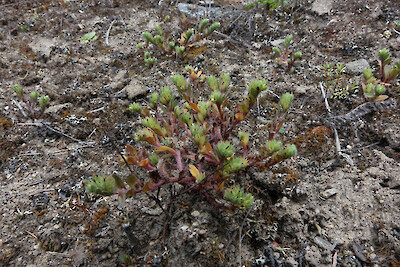
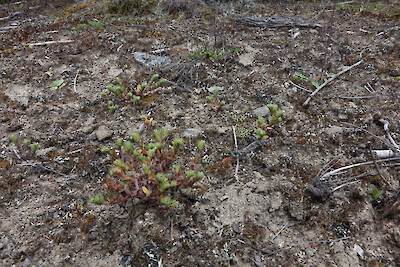
Myosotis hikuwai

Biostatus
Native – Endemic taxon
Current conservation status
The conservation status of all known New Zealand vascular plant taxa at the rank of species and below were reassessed in 2022-2023 using the New Zealand Threat Classification System (NZTCS) – more information about this can be found on the NZTCS website. This report includes replaces all previous NZTCS lists for vascular plants. Previous assessments can be found here.
- Conservation status of vascular plants in Aotearoa New Zealand, 2023. 2024. Peter J. de Lange, Jane Gosden, Shannel P. Courtney, Alexander J. Fergus, John W. Barkla, Sarah M. Beadel, Paul D. Champion, Rowan Hindmarsh-Walls, Troy Makan and Pascale Michel Department of Conservation. Source: NZTCS and licensed by DOC for reuse under the Creative Commons Attribution 4.0 International licence.
2023 | Threatened – Nationally Endangered | Qualifiers: DPS, DPT, OL
Category
Vascular
Structural class
Herbs - Dicotyledons other than Composites
Distribution
South Island: Otago.
Detailed taxonomy
Genus
Family
Taxonomic notes
It was first collected in 2013 and has been previously referred to as ‘Myosotis sp. morphologically similar to M. glauca’ (Prebble et al. 2018), M. aff. glauca (a) (WELT SP104520; “Mata-Au”) (de Lange et al. 2018; Prebble et al. 2022), or M. “Mata-Au” (Prebble et al. 2019).
Endemic taxon
Yes
Endemic genus
No
Endemic family
No
Ecology
Flowering
Spring annual; flowering mid-September–late November, fruiting November.
Other information
Etymology
myosotis: Mouse-eared
hikuwai: The epithet hikuwai refers to the Hikuwai Conservation Area where the only known population of this plant is from. In te reo Māori, hikuwai means ‘source of a stream' and may refer to the source of the Clutha River / Mata-Au.
Chromosome number
Unknown
Previous conservation status
The conservation status of all known New Zealand vascular plant taxa at the rank of species and below were reassessed in 2022-2023 using the New Zealand Threat Classification System (NZTCS) – more information about this can be found on the NZTCS website. This report includes replaces all previous NZTCS lists for vascular plants. Previous assessments can be found here.
- Conservation status of vascular plants in Aotearoa New Zealand, 2023. 2024. Peter J. de Lange, Jane Gosden, Shannel P. Courtney, Alexander J. Fergus, John W. Barkla, Sarah M. Beadel, Paul D. Champion, Rowan Hindmarsh-Walls, Troy Makan and Pascale Michel Department of Conservation. Source: NZTCS and licensed by DOC for reuse under the Creative Commons Attribution 4.0 International licence.
2017 | Threatened – Nationally Critical | Qualifiers: DP, OL
Regional conservation statuses
Otago: 2025 | Regionally Threatened – Regionally Endangered | Qualifiers: DPT, EF, NStr, OL, RE, TL
Current regional threat status assessments prepared according to Crisp et al. (2025) are displayed when available. The Otago conservation status information is sourced from the “Conservation Status of Indigenous Vascular Plants in Otago, 2025” Jarvie S et al. (2025) report.
Referencing and citations
References and further reading
e Lange P. J., Rolfe J. R., Barkla J. W., Courtney S. P., Champion P. D., Perrie L. R., Beadel S.M., Ford K. A., Breitwieser I., Schönberger I., Hindmarsh Walls R., Heenan P. B., & Ladley K 2018. Conservation status of New Zealand indigenous vascular plants, 2017. (Department of Conservation: Wellington, New Zealand).
Meudt H. M., & Prebble J. M. 2018. Species limits and taxonomic revision of the bracteate–prostrate group of southern hemisphere forget-me-nots (Myosotis, Boraginaceae), including description of three new species endemic to New Zealand. Australian Systematic Botany 31, 48–105. doi:10.1071/SB17045
Meudt, H. M., & Prebble, J. M. 2022. Morphological analyses support recognition of three new threatened species of bracteate–prostrate Myosotis (Boraginaceae) endemic to the South Island of Aotearoa New Zealand. Australian Systematic Botany, 35(5), 364-394.
Prebble J. M., Meudt H. M., & Tate J. A., & Symonds V. V. (2018) Bolstering species delimitation in difficult species complexes by analyzing herbarium www.publish.csiro.au/sb Australian Systematic Botany 393 and common garden morphological data: a case study using the New Zealand native Myosotis pygmaea species group (Boraginaceae) and common garden morphological data: a case study using the New Zealand native Myosotis pygmaea species group (Boraginaceae). Systematic Botany 43, 266–289. doi:10.1600/036364418X697058
Prebble J. M., Meudt H. M., Tate J. A., & Symonds V. V. 2019. Comparing and co-analysing microsatellite and morphological data for species delimitation in the New Zealand native Myosotis pygmaea species group (Boraginaceae). Taxon 68, 731–750. doi:10.1002/tax. 12096
Prebble J. M., Symonds V. V., Tate J. A., & Meudt H. M. (2022) Taxonomic revision of the southern hemisphere pygmy forget-me-not group (Myosotis; Boraginaceae) based on morphological, population genetic and climate-edaphic niche modelling data. Australian Systematic Botany 35(1), 63–94. doi:10.1071/SB21031