
Gentianella antipoda

Common names
Antipodes Islands gentian
Biostatus
Native – Endemic taxon
Current conservation status
The conservation status of all known New Zealand vascular plant taxa at the rank of species and below were reassessed in 2022-2023 using the New Zealand Threat Classification System (NZTCS) – more information about this can be found on the NZTCS website. This report includes replaces all previous NZTCS lists for vascular plants. Previous assessments can be found here.
- Conservation status of vascular plants in Aotearoa New Zealand, 2023. 2024. Peter J. de Lange, Jane Gosden, Shannel P. Courtney, Alexander J. Fergus, John W. Barkla, Sarah M. Beadel, Paul D. Champion, Rowan Hindmarsh-Walls, Troy Makan and Pascale Michel Department of Conservation. Source: NZTCS and licensed by DOC for reuse under the Creative Commons Attribution 4.0 International licence.
2023 | At Risk – Naturally Uncommon | Qualifiers: IE, Sp
Category
Vascular
Structural class
Herbs - Dicotyledons other than Composites
Flower colours
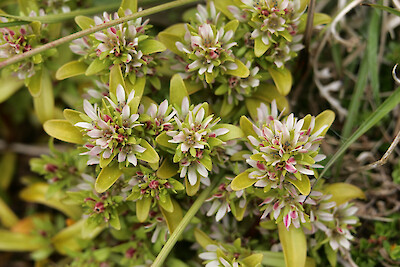
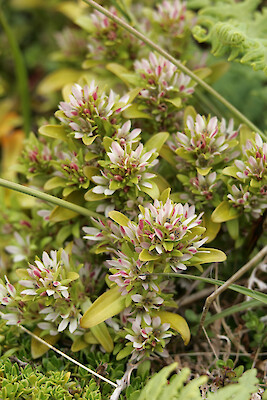
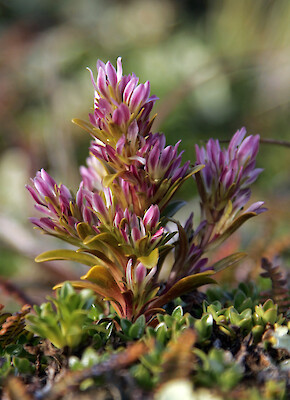
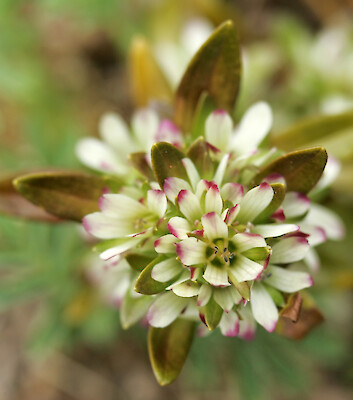
Violet/Purple, White
Detailed description
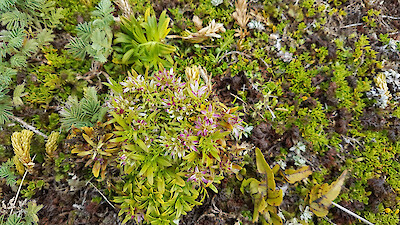
Plants biennial, monocarpic, height in flower 35–240 mm. Caudex unbranched or branched (depending on the size of plant), up to 100 mm long. Flowering stems terminal and lateral, 2–20 per plant, 1.5–2.5 mm diameter when dry, yellow or tinted crimson, lateral flowering stems decumbent, flowering stem leaves 5–6 pairs per stem, lowest pedicels from halfway up flowering stem. Rosette of leaves present but not very distinct from flowering stem leaves, leaves narrowly elliptic, 34–39 × 4.8–6.2 mm wide, tinted crimson below or yellow, flat, not recurved, apex acute or rounded; margin thickened; petiole distinct, 3.2–3.5 mm wide. Flowering stem leaves similar to rosette leaves but smaller. Pedicels 1 per leaf axil, 0.8–2.0 × 0.6–0.9 mm. Flowers 73–83 per plant, 5.5–10.5 mm long. Calyx 4.7–8.0 mm long, hairs at calyx–corolla fusion line present; lobes 3.9–6.7 mm long, 0.9–1.3 mm wide at base, green or crimson, plane, apices narrowly acute, margins minutely denticulate, sinus hairs sparse. Corolla 5.5–10.5 mm long, white to purple, with veins uncoloured to purple; tube 1.6–2.9 mm long; lobes 3.9–7.6 mm long, 1.3–2.7 mm wide; hairs below sinus absent; nectary 1.0–1.4 mm from corolla base. Filaments 2.8–6.3 mm long from corolla base, 0.3–0.55 mm wide. Anthers 0.75–1.0 mm long, anther wall blue-black, mouth yellow, extrorse at anthesis. Stigma colour unknown. Ovules 3–9 per ovary. Capsule 2.9–7.2 mm long.
Similar taxa
Gentianella antipoda is the only species present on the Antipodes Islands. Closest to G. antarctica from which it is distinguished by Plants having 2–20 lateral flowering stems; rosette leaf petioles 3.2–3.5 mm long (cf. 1.6-2.6 mm long); corolla tubes 1.6–2.9 mm long (3.6-2.4 mm long); nectaries 1.0–1.4 mm cf. 1.6-3.4 mm from corolla base; fewer ovules 3–9 per ovary (cf. 7-27); capsules 2.9–7.2 cf. 8.0-13.2 mm long
Distribution
Endemic. New Zealand: Antipodes Islands (Antipodes and Bollons Islands)
Habitat
Coastal to montane in Poa litorosa tussock grassland and Carex ternaria–Anisotome antipoda bogs
Threats
A Naturally Uncommon, range-restricted, island endemic. Abundant on the islands it is under no obvious threat. The Antipodes Islands are administered as a Nature Reserve and are part of a World Heritage Park with access strictly controlled by the New Zealand Department of Conservation.
Detailed taxonomy
Genus
Family
Synonyms
Gentiana antipoda Kirk, Gentiana antipoda f. pallida Kirk, Gentiana antipoda f. rubra Kirk, Chionogentias antipoda (Kirk) L.G.Adams
Endemic taxon
Yes
Endemic genus
No
Endemic family
No
Ecology
Flowering
December – April
Fruiting
January - May
Life cycle and dispersal
Seeds dispersed by ballistic projection, wind and water (Thorsen et al., 2009)
Propagation technique
Difficult. Should not be removed from the wild.
Other information
Where To Buy
Not Commercially Available
Etymology
gentianella: Little Gentiana (named after Gentius, 6th century king of Illyria, who found the roots of the yellow gentian to have a healing effect on his malaria-stricken troops)
antipoda: Named after the Antipodes i.e. Australia or New Zealand which are on the opposite side of the world from Europe
Chromosome number
2n = 36
Previous conservation statuses
The conservation status of all known New Zealand vascular plant taxa at the rank of species and below were reassessed in 2022-2023 using the New Zealand Threat Classification System (NZTCS) – more information about this can be found on the NZTCS website. This report includes replaces all previous NZTCS lists for vascular plants. Previous assessments can be found here.
- Conservation status of vascular plants in Aotearoa New Zealand, 2023. 2024. Peter J. de Lange, Jane Gosden, Shannel P. Courtney, Alexander J. Fergus, John W. Barkla, Sarah M. Beadel, Paul D. Champion, Rowan Hindmarsh-Walls, Troy Makan and Pascale Michel Department of Conservation. Source: NZTCS and licensed by DOC for reuse under the Creative Commons Attribution 4.0 International licence.
2017 | At Risk – Naturally Uncommon | Qualifiers: IE, Sp
2012 | At Risk – Naturally Uncommon | Qualifiers: IE, OL, Sp
2009 | At Risk – Naturally Uncommon | Qualifiers: OL IE
2004 | Range Restricted
Referencing and citations
References and further reading
Glenny, D. 2004: A revision of the genus Gentianella in New Zealand. New Zealand Journal of Botany 42: 361-530.
Thorsen, M. J.; Dickinson, K. J. M.; Seddon, P. J. 2009. Seed dispersal systems in the New Zealand flora. Perspectives in Plant Ecology, Evolution and Systematics 11: 285-309
Attribution
Fact sheet prepared for NZPCN by P.J. de Lange (October 2004). Description modified from Glenny (2004)