
Gentianella corymbifera subsp. gracilis
Common names
grassland gentian, tall gentian
Biostatus
Native – Endemic taxon
Current conservation status
The conservation status of all known New Zealand vascular plant taxa at the rank of species and below were reassessed in 2022-2023 using the New Zealand Threat Classification System (NZTCS) – more information about this can be found on the NZTCS website. This report includes replaces all previous NZTCS lists for vascular plants. Previous assessments can be found here.
- Conservation status of vascular plants in Aotearoa New Zealand, 2023. 2024. Peter J. de Lange, Jane Gosden, Shannel P. Courtney, Alexander J. Fergus, John W. Barkla, Sarah M. Beadel, Paul D. Champion, Rowan Hindmarsh-Walls, Troy Makan and Pascale Michel Department of Conservation. Source: NZTCS and licensed by DOC for reuse under the Creative Commons Attribution 4.0 International licence.
2023 | Not Threatened
Category
Vascular
Structural class
Herbs - Dicotyledons other than Composites
Flower colours
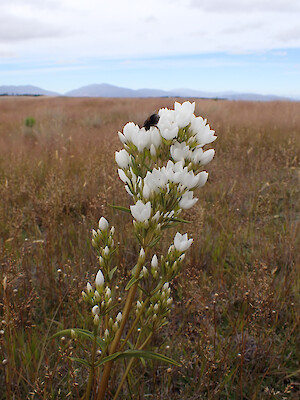
Violet/Purple, White
Detailed description
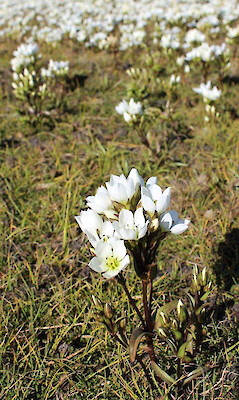
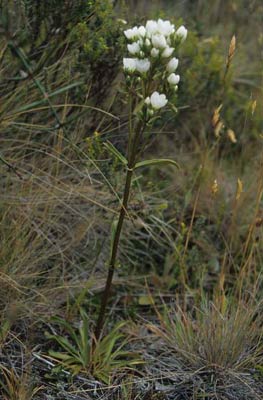
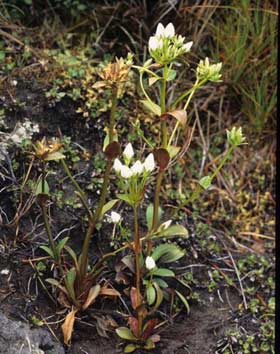
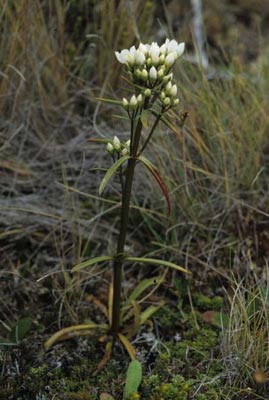
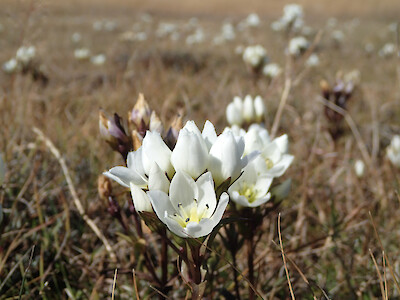
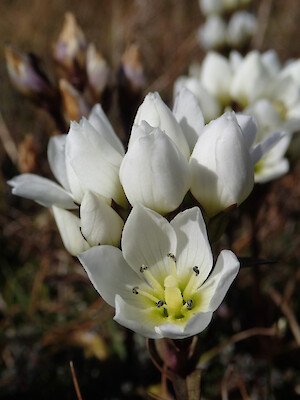
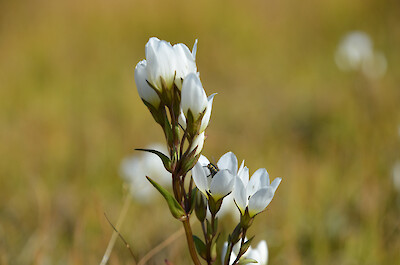
Plants biennial, rarely perennial, height in flower 90–370 mm. Caudex unbranched, 15–70 mm long. Root branched or unbranched, 1.3–11.3 mm diameter at stem base. Flowering stems terminal only or terminal and lateral with more slender lateral branches from among the rosette leaves, 1–7 per plant, terminal flowering stem 1.3–7.0 mm diameter at base, green, tinted crimson or purple-black, lateral flowering stems erect, internodes 2–6 pairs per stem, lowest pedicels from near base of flowering stem, halfway up flowering stem, or near apex of flowering stem. Rosette of leaves present and distinct from flowering stem leaves, leaves narrowly elliptic to elliptic or ovate, leaf apex acute to rounded, 15.0–127.0 × 5.0–11.3 mm, sometimes tinted crimson or purple-black below or on the petiole, usually flat, sometimes V-shaped or channelled at the petiole, petiole 10–40 mm long, 1.5–5.2 mm wide at leaf base. Flowering stem leaves ovate, apex acute, sessile. Flowers 7–110 per plant, 11–23 mm long, rarely female. Pedicels 1–2 per leaf axil, 10–30 mm long, 0.64–1.1 mm diameter. Calyx 5.2–8.5 mm long, green or tinted purple-black, crimson, or bronze; lobes 2.9–4.4 × 1.7–2.8 mm, plane, apices acute, margins smooth or minutely denticulate, hairs at sinuses present or absent. Corolla 11.0–15.3 mm long, white, rarely pale violet or with veins violet; tube 2.5–12 mm long; lobes 7.5–15.5 × 5.1–10.2 mm, hairs below sinus present; nectary 0.7–1.5 mm from corolla base. Filaments 6.4–9.2 mm long from corolla base, 1.5–2.7 mm wide. Anthers 1.5–3.2 mm long, anther wall yellow or blue-black, mouth yellow, extrorse, rarely introrse at anthesis. Stigma colourless. Ovules 36–68 per ovary. Capsules 12–19 mm long.
Similar taxa
Distinguished from subsp. corymbifera by its usually biennial life form; by the terminal flowering stem 1.3–7.0 mm cf. 3.0–11.3 mm diameter when fresh; leaves 15–127 × 5.0–11.3 mm cf. 41–168 × 6.5–31 mm wide; calyx lobes 1.7–2.8 mm cf. 2.7–4.0 mm wide; corolla 11.0–15.3 mm cf. 14.0–21.1 mm long; and by the filaments 0.6–1.2 mm cf. 1.1–1.6 mm wide.
Distribution
Endemic. New Zealand: South Island (East of the Main Divide from mid Canterbury to Southland)
Habitat
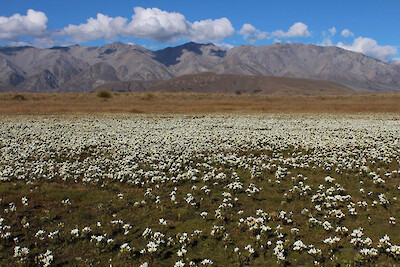
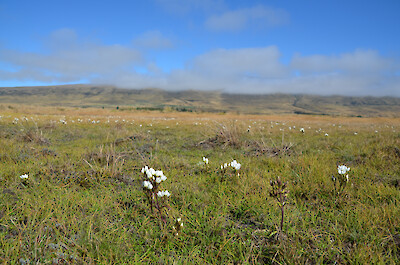
Montane to alpine. In modified short-tussock and tall-tussock grasslands, within intermontane basins, on moraine downs, outwash terraces, and lower hillslopes. Also on schist and limestone rock outcrops near creeks
Detailed taxonomy
Genus
Family
Synonyms
None (described in 2004)
Endemic taxon
Yes
Endemic genus
No
Endemic family
No
Ecology
Flowering
December – April
Fruiting
February – June
Propagation technique
Difficult. Should not be removed from the wild
Other information
Etymology
gentianella: Little Gentiana (named after Gentius, 6th century king of Illyria, who found the roots of the yellow gentian to have a healing effect on his malaria-stricken troops)
corymbifera: Corymb-bearing
gracilis: Slender
NVS code
The National Vegetation Survey (NVS) Databank is a physical archive and electronic databank containing records of over 94,000 vegetation survey plots - including data from over 19,000 permanent plots. NVS maintains a standard set of species code abbreviations that correspond to standard scientific plant names from the Ngä Tipu o Aotearoa - New Zealand Plants database.
GENCSG
Previous conservation statuses
The conservation status of all known New Zealand vascular plant taxa at the rank of species and below were reassessed in 2022-2023 using the New Zealand Threat Classification System (NZTCS) – more information about this can be found on the NZTCS website. This report includes replaces all previous NZTCS lists for vascular plants. Previous assessments can be found here.
- Conservation status of vascular plants in Aotearoa New Zealand, 2023. 2024. Peter J. de Lange, Jane Gosden, Shannel P. Courtney, Alexander J. Fergus, John W. Barkla, Sarah M. Beadel, Paul D. Champion, Rowan Hindmarsh-Walls, Troy Makan and Pascale Michel Department of Conservation. Source: NZTCS and licensed by DOC for reuse under the Creative Commons Attribution 4.0 International licence.
2017 | Not Threatened
2012 | Not Threatened
2009 | Not Threatened
2004 | Not Threatened
Regional conservation statuses
Otago: 2025 | Regionally Not Threatened
Current regional threat status assessments prepared according to Crisp et al. (2025) are displayed when available. The Otago conservation status information is sourced from the “Conservation Status of Indigenous Vascular Plants in Otago, 2025” Jarvie S et al. (2025) report.
Referencing and citations
References and further reading
Glenny, D. 2004: A revision of the genus Gentianella in New Zealand. New Zealand Journal of Botany 42: 361-530.
Attribution
Description modified from Glenny (2004)