
Gentianella calcis subsp. calcis
Common names
Awahokomo gentian
Biostatus
Native – Endemic taxon
Current conservation status
The conservation status of all known New Zealand vascular plant taxa at the rank of species and below were reassessed in 2022-2023 using the New Zealand Threat Classification System (NZTCS) – more information about this can be found on the NZTCS website. This report includes replaces all previous NZTCS lists for vascular plants. Previous assessments can be found here.
- Conservation status of vascular plants in Aotearoa New Zealand, 2023. 2024. Peter J. de Lange, Jane Gosden, Shannel P. Courtney, Alexander J. Fergus, John W. Barkla, Sarah M. Beadel, Paul D. Champion, Rowan Hindmarsh-Walls, Troy Makan and Pascale Michel Department of Conservation. Source: NZTCS and licensed by DOC for reuse under the Creative Commons Attribution 4.0 International licence.
2023 | Threatened – Nationally Critical | Qualifiers: CD, OL
Category
Vascular
Structural class
Herbs - Dicotyledons other than Composites
Flower colours
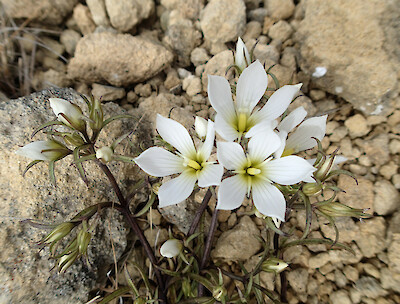
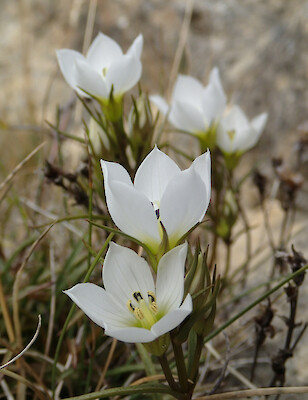
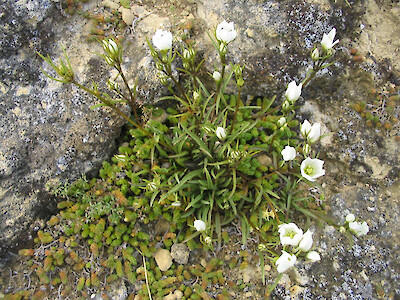
White, Yellow
Detailed description
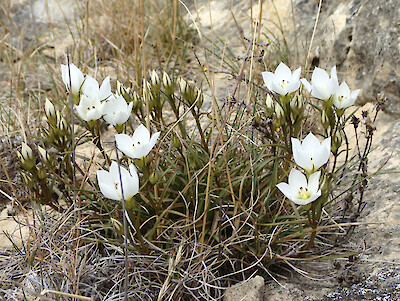
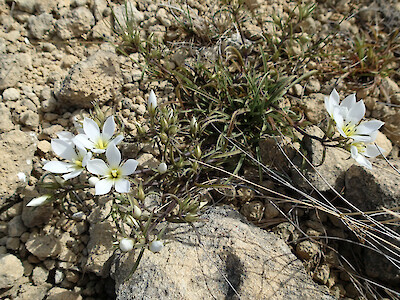
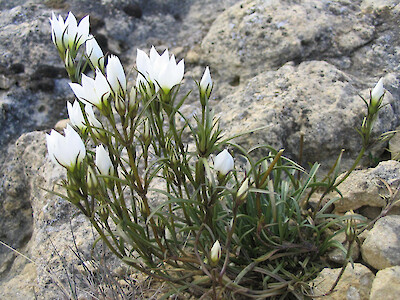
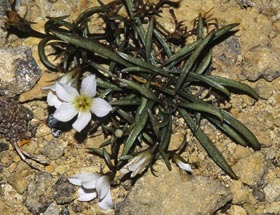
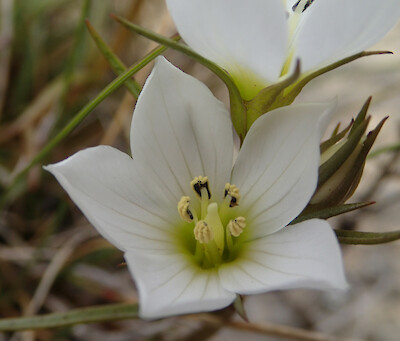
Perennial tufted herb partially dying back to root-stock in winter. Rosette leaves without obvious petiole; linear 68-83 mm long, 2.6-4.1 mm wide, green to purple-green, strongly V-shaped in cross-section, apex acute, recurved; margins minutely toothed or smooth. Cauline leaves, linear, somewhat recurved, usually smaller than rosette leaves. Flowering stems, purple-black, 1-5 per plant. Pedicels 3.5-14 mm long, 0.8-1 mm diam. Flowers 9-28(-78) per plant, 15-18 mm long. Calyx green, tinted purple black, 7.5-14 mm long; lobes 4.6-10 mm long, 1.9-2.5 mm wide at base. Corolla 13.5-17 mm long, veins colourless; tube 3.4-5 mm long; lobes 10-12 mm long, 6.2-9 mm wide, margins toothed; nectary 0.9-1.6 mm from corolla base, V-shaped to pocket-like. Filaments 6.5-8.5 mm long from corolla base, 0.6-0.9 mm wide. Anthers 1.9-3.1 mm long, extrorse at anthesis. Ovules 9-35 per ovary. Ovary becoming bluish-purple after flowering. Capsules 13-17.5 mm.
Similar taxa
Closely allied to G. calcis subsp. manahune Glenny et Molloy, G. calcis subsp. waipara Glenny et Molloy, and G. calcis subsp. taiko Glenny et Molloy, from all of which it differs by the longer and wider rosette leaves, while it it differs from G. calcis subsp. manahune by its colourless rather than purple corolla veins.
Distribution
Endemic. South Island, two sites in the Waitaki Valley.
Habitat
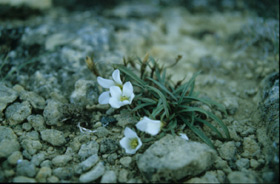
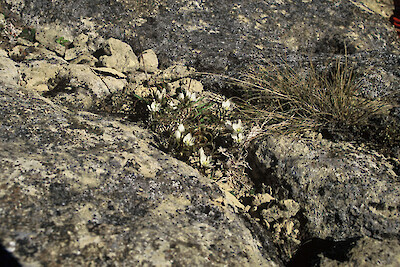
A limestone endemic confined to limestone bluffs, where it grows in rock joints, crevices, associated rendzina soils, limestone talus and associated colluvium. Usually in bare or sparsely vegetated sites.
Threats
At serious risk of extinction from the spread of weeds such as Festuca rubra, Pilosella officinarum L., Dactylis glomerata L. and Sedum acre L., and because the population is so small natural disturbances caused by storms, slumping, rock and boulder fall. Previously regarded (as Gentiana aff. astonii (c) (CHR 519113; Awahokomo)) as Range Restricted in de Lange et al. (2004).
Detailed taxonomy
Genus
Family
Synonyms
None
Taxonomic notes
Gentianella calcis is closely related to G. astonii (Petrie) T.N.Ho et S.W.Liu, from which it differs by the consistently longer (30-83 mm cf. 9-32 mm) leaves, which are usually folded, and by the recurved leaf apex.
Endemic taxon
Yes
Endemic genus
No
Endemic family
No
Ecology
Flowering
(March-) April (-June)
Fruiting
(April-) August (-November)
Life cycle and dispersal
Seeds dispersed by ballistic projection, wind and water (Thorsen et al. 2009)
Propagation technique
Difficult. Should not be removed from the wild.
Other information
Etymology
gentianella: Little Gentiana (named after Gentius, 6th century king of Illyria, who found the roots of the yellow gentian to have a healing effect on his malaria-stricken troops)
NVS code
The National Vegetation Survey (NVS) Databank is a physical archive and electronic databank containing records of over 94,000 vegetation survey plots - including data from over 19,000 permanent plots. NVS maintains a standard set of species code abbreviations that correspond to standard scientific plant names from the Ngä Tipu o Aotearoa - New Zealand Plants database.
GENCSL
Chromosome number
2n = 36
Previous conservation statuses
The conservation status of all known New Zealand vascular plant taxa at the rank of species and below were reassessed in 2022-2023 using the New Zealand Threat Classification System (NZTCS) – more information about this can be found on the NZTCS website. This report includes replaces all previous NZTCS lists for vascular plants. Previous assessments can be found here.
- Conservation status of vascular plants in Aotearoa New Zealand, 2023. 2024. Peter J. de Lange, Jane Gosden, Shannel P. Courtney, Alexander J. Fergus, John W. Barkla, Sarah M. Beadel, Paul D. Champion, Rowan Hindmarsh-Walls, Troy Makan and Pascale Michel Department of Conservation. Source: NZTCS and licensed by DOC for reuse under the Creative Commons Attribution 4.0 International licence.
2017 | Threatened – Nationally Critical | Qualifiers: CD, OL
2012 | Threatened – Nationally Critical | Qualifiers: CD, EF, OL
2009 | Threatened – Nationally Critical | Qualifiers: CD, EF, OL
2004 | Range Restricted
Referencing and citations
References and further reading
de Lange P. et al. 2004: Threatened and uncommon plants on New Zealand. New Zealand Journal of Botany 42: 45-76.
Glenny, D. 2004: A revision of the genus Gentianella in New Zealand. New Zealand Journal of Botany 42: 361-530.
Thorsen, M. J.; Dickinson, K. J. M.; Seddon, P.J. 2009: Seed dispersal systems in the New Zealand flora. Perspectives in Plant Ecology, Evolution and Systematics 11: 285-309
Attribution
Fact sheet prepared for NZPCN by P.J. de Lange (October 2004). Description modified from Glenny (2004).