
Carex kermadecensis
Common names
Kermadec sedge
Biostatus
Native – Endemic taxon
Current conservation status
The conservation status of all known New Zealand vascular plant taxa at the rank of species and below were reassessed in 2022-2023 using the New Zealand Threat Classification System (NZTCS) – more information about this can be found on the NZTCS website. This report includes replaces all previous NZTCS lists for vascular plants. Previous assessments can be found here.
- Conservation status of vascular plants in Aotearoa New Zealand, 2023. 2024. Peter J. de Lange, Jane Gosden, Shannel P. Courtney, Alexander J. Fergus, John W. Barkla, Sarah M. Beadel, Paul D. Champion, Rowan Hindmarsh-Walls, Troy Makan and Pascale Michel Department of Conservation. Source: NZTCS and licensed by DOC for reuse under the Creative Commons Attribution 4.0 International licence.
2023 | At Risk – Naturally Uncommon | Qualifiers: CD, IE
Category
Vascular
Structural class
Sedges
Detailed description
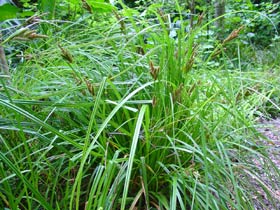
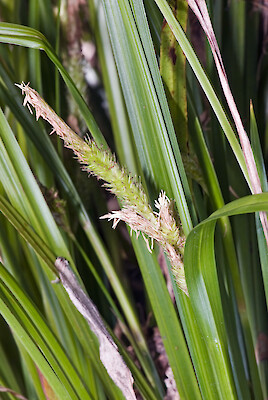
Rather robust tufted, light yellow-green to green tussock forming sedge usually of shaded forested slopes. Culms up to 450 mm tall, 2 mm diameter, triquetrous, finely and faintly scabrid just below inflorescence; basal sheaths light brown. Leaves much > culms, 7–10 mm wide, double-folded, margins scabrid. Inflorescence of 5–10 usually compound spikes. Spikes 20–55 × 5–7 mm, approximate or with the lower 2–4 more distant, erect on stiff peduncles; the terminal spike wholly or mostly male, or completely female; remaining spikes female with occasional male flowers at the base; lower subtending bracts leaf-like, much > inflorescence. Glumes (excluding awn) < utricles, ovate-oblong, emarginated or acute, margins fimbriate towards apex, light brown or with minute dark brown flecks, chartaceous to membranous, awns up to 3 mm long, pale green to straw-coloured, scabrid,. Utricles 3–4 × 1.5 mm, trigonous, ellipsoid or more or less ovoid, nerves distinct, membranous, grey-brown with red-brown flecks, beck 1–2 mm long, deeply and acutely bifid, orifice and margins of beak and of upper part of utricles usually scabrid. Stigmas 3. Nut 2 mm long, dark brown, trigonous, oblong-obovoid.
Similar taxa
As the only carex on the Kermadecs field identification is not usually a problem. However, herbarium material could be confused with C. elingamita Hamlin of the Three Kings Islands group. From that species C. kermadecensis differs consistently by the lowermost spikes predominantly female rather than largely male toward the top, by the utricles 3–4 mm rather than 4–4.5 mm long and by the nut coloured dark brown rather than red brown. That they are closely allied is inferred from nrDNA ITS sequences which position both species as sister taxa.
Distribution
Endemic. Kermadec Islands group where it is known only from Raoul and Macauley Islands.
Habitat
Coastal forest where it is usually found amongst boulders, rubble and near sea bird nesting sites. Sometimes found in open exposed places but generally prefers shaded situations.
Threats
A naturally uncommon , range restricted species. However, it has not been seen on Macauley Island since 1989.
Detailed taxonomy
Genus
Family
Synonyms
Carex forsteri Wahl. subsp. insularis W.R.B.Oliver
Endemic taxon
Yes
Endemic genus
No
Endemic family
No
Ecology
Flowering
October–January
Fruiting
October–May
Life cycle and dispersal
Nuts surrounded by inflated utricles are dispersed by granivory and wind (Thorsen et al., 2009).
Propagation technique
Easily grown in a warm sheltered site, prefers semi-shade. Very cold sensitive.
Other information
Etymology
carex: Latin name for a species of sedge, now applied to the whole group.
kermadecensis: From the Kermadec Islands
Manaaki Whenua Online Interactive Key
NVS code
The National Vegetation Survey (NVS) Databank is a physical archive and electronic databank containing records of over 94,000 vegetation survey plots - including data from over 19,000 permanent plots. NVS maintains a standard set of species code abbreviations that correspond to standard scientific plant names from the Ngä Tipu o Aotearoa - New Zealand Plants database.
CARKER
Chromosome number
2n = c.60
Previous conservation statuses
The conservation status of all known New Zealand vascular plant taxa at the rank of species and below were reassessed in 2022-2023 using the New Zealand Threat Classification System (NZTCS) – more information about this can be found on the NZTCS website. This report includes replaces all previous NZTCS lists for vascular plants. Previous assessments can be found here.
- Conservation status of vascular plants in Aotearoa New Zealand, 2023. 2024. Peter J. de Lange, Jane Gosden, Shannel P. Courtney, Alexander J. Fergus, John W. Barkla, Sarah M. Beadel, Paul D. Champion, Rowan Hindmarsh-Walls, Troy Makan and Pascale Michel Department of Conservation. Source: NZTCS and licensed by DOC for reuse under the Creative Commons Attribution 4.0 International licence.
2017 | At Risk – Naturally Uncommon | Qualifiers: CD, IE
2012 | At Risk – Naturally Uncommon | Qualifiers: CD, IE
2009 | At Risk – Naturally Uncommon | Qualifiers: IE
2004 | Range Restricted
Referencing and citations
References and further reading
Moore LB, Edgar E. 1970. Flora of New Zealand, Volume II. Indigenous Tracheophyta: Monocotyledones except Gramineae. Government Printer, Wellington, NZ. 354 p.
Thorsen MJ, Dickinson KJM, Seddon PJ. 2009. Seed dispersal systems in the New Zealand flora. Perspectives in Plant Ecology, Evolution and Systematics 11: 285–309.
Attribution
Description adapted from Moore and Edgar (1970)
Some of this factsheet information is derived from Flora of New Zealand Online and is used under a Creative Commons Attribution 3.0 New Zealand licence.