
Carex potens
Common names
bastard grass, hook sedge
Biostatus
Native – Endemic taxon
Current conservation status
The conservation status of all known New Zealand vascular plant taxa at the rank of species and below were reassessed in 2022-2023 using the New Zealand Threat Classification System (NZTCS) – more information about this can be found on the NZTCS website. This report includes replaces all previous NZTCS lists for vascular plants. Previous assessments can be found here.
- Conservation status of vascular plants in Aotearoa New Zealand, 2023. 2024. Peter J. de Lange, Jane Gosden, Shannel P. Courtney, Alexander J. Fergus, John W. Barkla, Sarah M. Beadel, Paul D. Champion, Rowan Hindmarsh-Walls, Troy Makan and Pascale Michel Department of Conservation. Source: NZTCS and licensed by DOC for reuse under the Creative Commons Attribution 4.0 International licence.
2023 | Not Threatened
Category
Vascular
Structural class
Sedges
Detailed description
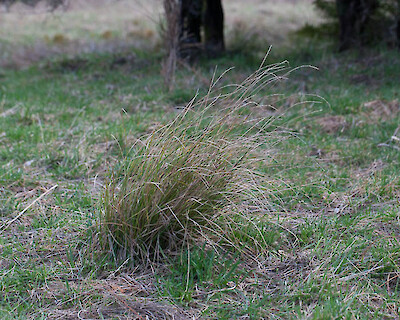
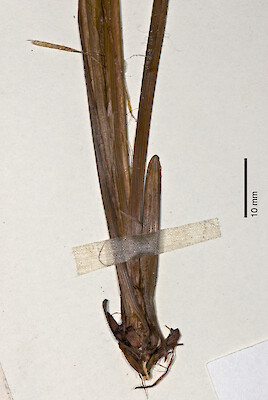
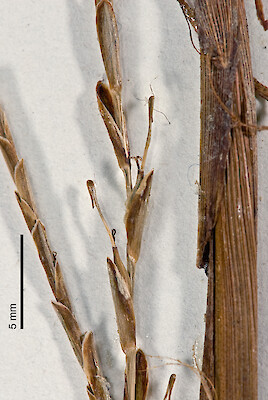
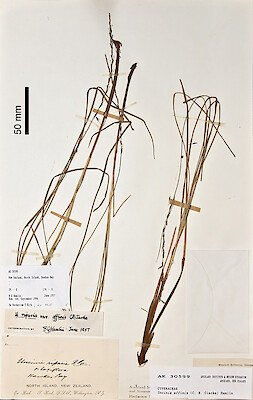
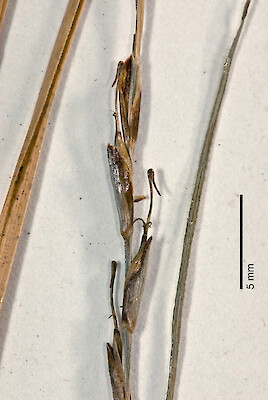
Stoutly erect, densely caespitose, yellow-green to dark green plants. Culms 100.0–800.0 × 0.5–1.0 mm diameter, sharply trigonous, scabrid below inflorescence, often drooping; basal sheaths dull dark brown. Leaves 3–4 per culm, = or slightly < culms, 1.5–2.0 mm wide, yellow-green to dark green, margins harshly scabrid, slightly involute when dry. Spikes 50–140 mm long, female flowers c. 15–20, lax, internodes 11 mm long at base of spike, 3–6 mm long above. Glumes ± = or rarely much < utricles, persistent, obtuse or lowermost subacute, coriaceous, pale brown. Utricles 6–7 × c. 1 mm., plano-convex, lanceolate or oblong-lanceolate, grey-brown, nerved, slightly contracted or cuneate at the base forming a stipe 1.5–2.0 mm long, beak 2 mm long.
Similar taxa
Distinguished from the other New Zealand species by the lax inflorescences, and utricles which are c. 1 mm diameter. It is most likely to be confused with Carex erythrovaginata K.A.Ford from which it differs by the leaf-sheaths, leaves and glumes which lack red colouration. Carex potens is very closely allied to the Australian Carex umbricola K.L.Wilson.
Distribution
Endemic. New Zealand. North Island (Mt Egmont, Central Volcanic Plateau, Ruahine and Tararua Ranges), South Island.
Habitat
Mostly montane to alpine, rarely coastal in southern part of its range. In forests, subalpine scrub and frost flats.
Detailed taxonomy
Genus
Family
Synonyms
Uncinia affinis (C.B.Clarke) Hamlin; Uncinia riparia R.Br. var. affinis Col. ex C.B.Clarke; Uncinia purpurata Petrie var. subcaespitosa Kük.
Endemic taxon
Yes
Endemic genus
No
Endemic family
No
Ecology
Flowering
October–November
Fruiting
November–January
Propagation technique
Easily grown from fresh seed and by division of established plants. Prefers a permanently moist, peaty soil but will grow in most substrates. Best in semi-shade.
Other information
Etymology
carex: Latin name for a species of sedge, now applied to the whole group.
Manaaki Whenua Online Interactive Key
NVS code
The National Vegetation Survey (NVS) Databank is a physical archive and electronic databank containing records of over 94,000 vegetation survey plots - including data from over 19,000 permanent plots. NVS maintains a standard set of species code abbreviations that correspond to standard scientific plant names from the Ngä Tipu o Aotearoa - New Zealand Plants database.
CARPOT
Chromosome number
2n = 88
Previous conservation statuses
The conservation status of all known New Zealand vascular plant taxa at the rank of species and below were reassessed in 2022-2023 using the New Zealand Threat Classification System (NZTCS) – more information about this can be found on the NZTCS website. This report includes replaces all previous NZTCS lists for vascular plants. Previous assessments can be found here.
- Conservation status of vascular plants in Aotearoa New Zealand, 2023. 2024. Peter J. de Lange, Jane Gosden, Shannel P. Courtney, Alexander J. Fergus, John W. Barkla, Sarah M. Beadel, Paul D. Champion, Rowan Hindmarsh-Walls, Troy Makan and Pascale Michel Department of Conservation. Source: NZTCS and licensed by DOC for reuse under the Creative Commons Attribution 4.0 International licence.
2017 | Not Threatened
2012 | Not Threatened
2009 | Not Threatened
2004 | Not Threatened
Regional conservation statuses
Otago: 2025 | Regionally Data Deficient | Qualifiers: NStr, TL
Current regional threat status assessments prepared according to Crisp et al. (2025) are displayed when available. The Otago conservation status information is sourced from the “Conservation Status of Indigenous Vascular Plants in Otago, 2025” Jarvie S et al. (2025) report.
Referencing and citations
References and further reading
Moore LB, Edgar E. 1970. Flora of New Zealand, Volume II. Indigenous Tracheophyta: Monocotyledones except Gramineae. Government Printer, Wellington, NZ. 354 p.
Attribution
Description adapted from Moore and Edgar (1970).
Some of this factsheet information is derived from Flora of New Zealand Online and is used under a Creative Commons Attribution 3.0 New Zealand licence.