
Pimelea aridula subsp. aridula
Common names
pimelea
Biostatus
Native – Endemic taxon
Current conservation status
The conservation status of all known New Zealand vascular plant taxa at the rank of species and below were reassessed in 2022-2023 using the New Zealand Threat Classification System (NZTCS) – more information about this can be found on the NZTCS website. This report includes replaces all previous NZTCS lists for vascular plants. Previous assessments can be found here.
- Conservation status of vascular plants in Aotearoa New Zealand, 2023. 2024. Peter J. de Lange, Jane Gosden, Shannel P. Courtney, Alexander J. Fergus, John W. Barkla, Sarah M. Beadel, Paul D. Champion, Rowan Hindmarsh-Walls, Troy Makan and Pascale Michel Department of Conservation. Source: NZTCS and licensed by DOC for reuse under the Creative Commons Attribution 4.0 International licence.
2023 | At Risk – Declining | Qualifiers: RR, Sp
Category
Vascular
Structural class
Trees & Shrubs - Dicotyledons
Simplified description
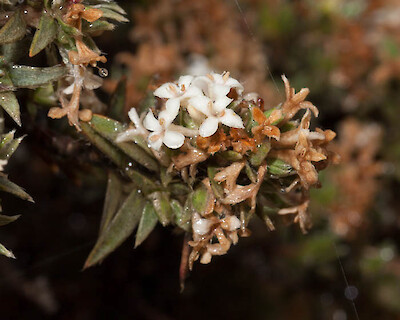
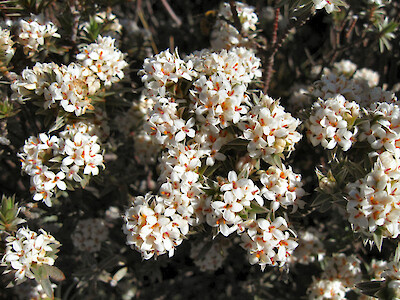
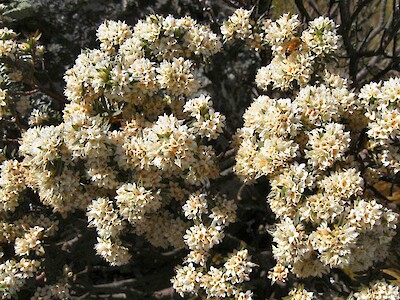
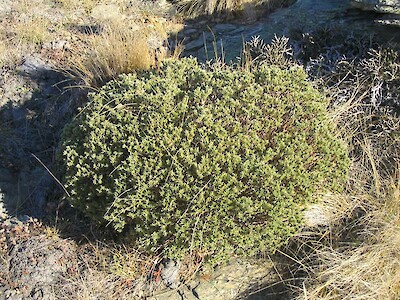
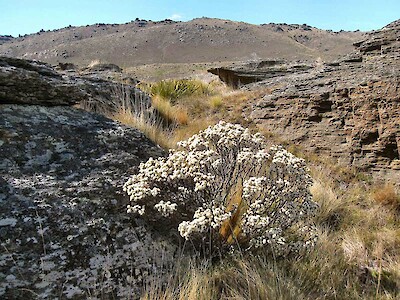
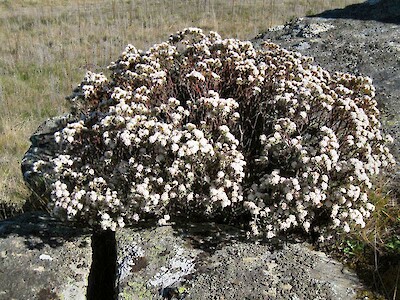
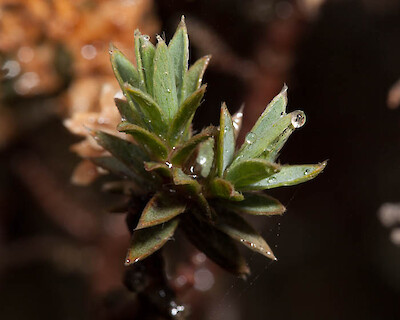
Bushy small shrub with pairs of greyish hairy pointed leaves inhabiting very dry rocky sites in Central Otago. Twigs hairy. Leaves 8-12mm long by 2-3mm wide, widest at base, pointed, hairy on both surfaces. Flowers white with a hairy pinkish body, in clusters. Fruit dry, enclosing black seed.
Flower colours
White
Detailed description
A robust, upright, stiff-stemmed shrub, up to 1 m tall. Long-stemmed plants may be fastigiate; short-stemmed plants often have more divergent branches. Branching mainly sympodial. Main stems stiff or flexible. Young branchlets brown, moderately to densely covered with long hair; internodes 0.5-2.0 mm; old stems at the base may be stout (= 10 mm diameter), grey-brown, glabrous. Node buttresses lunate, brown, hairy, often masked by hairs on young stems, moderately conspicuous on leafless stems. Leaves usually decussate, on short, red petioles (0.5 mm), rarely alternate on some young branchlets, ascending, loosely imbricate. Lamina 8-12 × 2-3 mm, medium green, slightly adaxially concave, narrow-ovate, acute, base cuneate, both surfaces often densely covered by long, fine hispid, appressed dull to shining white or yellowish, usually penicillate hairs. Stomata on both leaf surfaces. Inflorescences terminal, 5-10-flowered, sometimes in small clusters. Involucral bracts similar in size to adjacent leaves or slightly wider (8.0-10 × 3.2 mm), partly hiding the flowers. Receptacle densely hairy. Plants gynodioecious. Flowers white, on short pedicels (0.5 mm), tube densely hairy outside, sparsely so inside. Female tube 3.5 mm long, ovary portion 2 mm, calyx lobes 1.5 × 0.6 mm; hermaphrodite tube 6.5 mm long, ovary portion 2.5 mm, calyx lobes 2.5 × 1.5 mm. Anther dehiscence introrse. Ovary hairy from summit to two thirds of the way down. Fruits ovoid, dry, brown, 4.0 × 2.3 mm. Seeds ovoid 4.0 × 2.1 mm.
Similar taxa
Pimelea aridula subsp. aridula is most likely to be confused with P. concinna, a species from which it is allopatrically separated. Both Pimelea form relatively tall shrubs with mostly upright growth habits. From Pimelea concinna, P. aridula subsp. aridula differs by the leaves which are 10-15 mm rather than 5-8 mm long. Pimelea aridula subsp. aridula differs from P. aridula subsp. olga by its allopatric distribution (being geographically confined to Otago), and vegetatively by the taller more robust habit, and by the narrowly ovate leaves whose surfaces are densely covered by appressed dull to shining white or yellowish, long hispid hairs.
Distribution
Endemic. South Island: Waitaki Valley and central Otago, in Kawerau, Clutha, and lower Manuherikia Valleys
Habitat
Montane to subalpine. Characteristic of schist country where it grows on schist outcrops and rocky hillsides especially on soils derived from schist
Threats
Field surveys indicate that Pimelea aridula subsp. aridula populations mostly comprise mature plants and at few places are seedlings and juveniles seen. For this reason P. aridula (at species rank) was listed as “Declining” by de Lange et al. (2009). Despite the species recircumscription to comrpise two subspecies by Burrows (2011) the comments he offers in his paper for P. aridula subsp. aridula remain unchallenged here.
Detailed taxonomy
Genus
Family
Synonyms
Pimelea lyallii var. sericea Cheeseman
Endemic taxon
Yes
Endemic genus
No
Endemic family
No
Ecology
Flowering
October - February
Fruiting
January - April
Propagation technique
Easily grown from semi-hardwood cuttings. Does best in a free draining, sunny site, planted within a rich. fertile soil. Dislikes competition from taller plants and humidity. Will not long tolerate being shaded out. An excellent pot plant or small shrub for a rockery.
Other information
Etymology
pimelea: from Greek pimelē, meaning “lard” or “soft fat,” presumably referring to the oily seeds or fleshy cotyledons.
Previous conservation statuses
The conservation status of all known New Zealand vascular plant taxa at the rank of species and below were reassessed in 2022-2023 using the New Zealand Threat Classification System (NZTCS) – more information about this can be found on the NZTCS website. This report includes replaces all previous NZTCS lists for vascular plants. Previous assessments can be found here.
- Conservation status of vascular plants in Aotearoa New Zealand, 2023. 2024. Peter J. de Lange, Jane Gosden, Shannel P. Courtney, Alexander J. Fergus, John W. Barkla, Sarah M. Beadel, Paul D. Champion, Rowan Hindmarsh-Walls, Troy Makan and Pascale Michel Department of Conservation. Source: NZTCS and licensed by DOC for reuse under the Creative Commons Attribution 4.0 International licence.
2017 | At Risk – Declining | Qualifiers: RR, Sp
2012 | At Risk – Declining | Qualifiers: RR, Sp
2009 | At Risk – Declining | Qualifiers: DP
2004 | Not Threatened
Regional conservation statuses
Otago: 2025 | Regionally Threatened – Regionally Vulnerable | Qualifiers: DPS, NR, NStr, PF, RF, Sp, TL
Current regional threat status assessments prepared according to Crisp et al. (2025) are displayed when available. The Otago conservation status information is sourced from the “Conservation Status of Indigenous Vascular Plants in Otago, 2025” Jarvie S et al. (2025) report.
Referencing and citations
References and further reading
Burrows, C.J. 2011: Genus Pimelea (Thymelaeaceae) in New Zealand 5. The taxonomic treatment of five endemic species with both adaxial and abaxial leaf hair. New Zealand Journal of Botany 49: 367-412.
de Lange, P.J.; Norton, D.A.; Courtney, S.P.; Heenan, P.B.; Barkla, J.W.; Cameron, E.K.; Hitchmough, R.; Townsend, A.J. 2009: Threatened and uncommon plants of New Zealand (2008 revision). New Zealand Journal of Botany 47: 61-96
Attribution
Fact sheet prepared for NZPCN by P.J. de Lange (30 September 2011). Description from Burrows (2011)
NZPCN Fact Sheet citation
Please cite as: de Lange, P.J. (Year at time of access): Pimelea aridula subsp. aridula Fact Sheet (content continuously updated). New Zealand Plant Conservation Network. https://www.nzpcn.org.nz/flora/species/pimelea-aridula-subsp-aridula/ (Date website was queried)