
Pimelea mesoa subsp. macra
Common names
pimelea
Biostatus
Native – Endemic taxon
Current conservation status
The conservation status of all known New Zealand vascular plant taxa at the rank of species and below were reassessed in 2022-2023 using the New Zealand Threat Classification System (NZTCS) – more information about this can be found on the NZTCS website. This report includes replaces all previous NZTCS lists for vascular plants. Previous assessments can be found here.
- Conservation status of vascular plants in Aotearoa New Zealand, 2023. 2024. Peter J. de Lange, Jane Gosden, Shannel P. Courtney, Alexander J. Fergus, John W. Barkla, Sarah M. Beadel, Paul D. Champion, Rowan Hindmarsh-Walls, Troy Makan and Pascale Michel Department of Conservation. Source: NZTCS and licensed by DOC for reuse under the Creative Commons Attribution 4.0 International licence.
2023 | Threatened – Nationally Vulnerable | Qualifiers: OL
Category
Vascular
Structural class
Trees & Shrubs - Dicotyledons
Simplified description
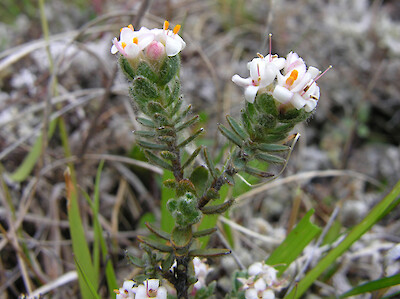
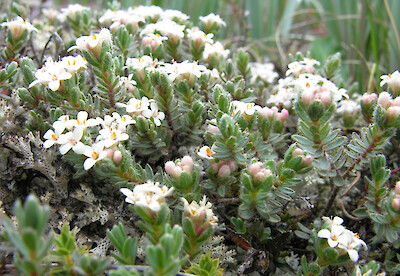
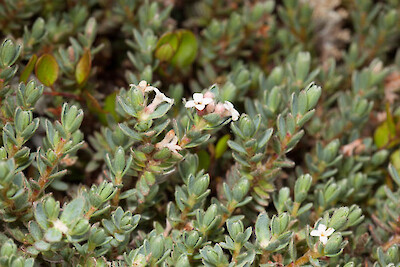
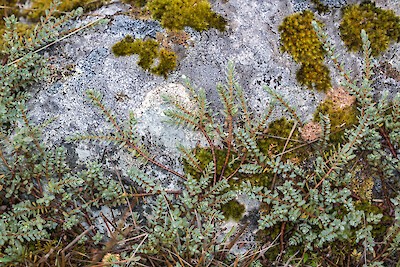
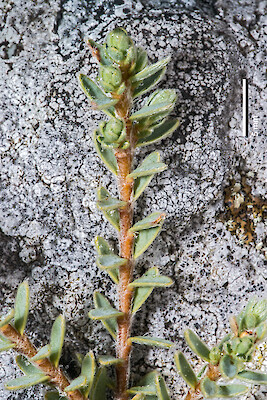
Very low growing shrub with hairy twigs to 30cm long bearing pairs of blueish-green pointed leaves that are hairy underneath and with hairy white flowers and orange fruit inhabiting the Cobb Valley. Leaves 4.5-7mm long by 1.8-2.5mm wide.
Flower colours
White
Detailed description
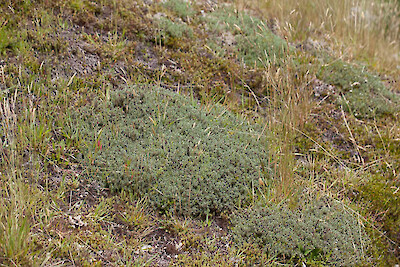
A small sparingly (rarely much) branched, decumbent, widely-spreading, ± appressed, compact shrub forming irregular patches up to 300 mm diameter. Branching mainly sympodial, branches up to 300 mm long, radiating from a stout main stem, usually procumbent, sometimes climbing through other plants. Branches of young stems light brown, moderately covered with long grey-white or yellowish hairs, internodes 2.0–5.0 mm long. Older stems stout (to 4 mm), dark brown, glabrate to glabrous. Node buttresses lunate to elongate, brown, usually not prominent on leafless stems. Leaves decussate, ascending, loosely imbricate, becoming patent, on short (0.3-0.5 mm) reddish petioles. Lamina 4.5-7.0 × 1.8-2.5 mm, dull glaucous-green, elliptic, broad-elliptic or oblong, sometimes ovate, slightly adaxially concave, mid-vein obscure; tip obtuse; base cuneate; abaxial surface moderately densely covered with long, straight or curled hairs; stomata on both adaxial and abaxial leaf surfaces. Inflorescences terminal, 4-12-flowered; involucral bracts 4, wider than ordinary leaves (6-8 × 3-4 mm). Receptacles densely hairy. Plants gynodioecious. Flowers white, scented, on short (0.2 mm) pedicels, very hairy outside, inside hairless. Female tube 3-4 mm long, ovary portion 2 mm, calyx lobes 2 × 1 mm; hermaphrodite tube 5-6 mm long, ovary portion 1.5 mm, calyx lobes 3 × 1.5 mm. Anther dehiscence introrse. Ovary with sparse short hairs on apex. Fruits ovoid, fleshy, yellow to orange 4.0-5.0 × 2.0-3.2 mm. Seeds 2.5 × 1.3 mm.
Similar taxa
Pimelea mesoa subsp. macra has been confused in the past with Pimelea sericeovillosa from which it differs by its larger size, elongate, prostrate stems, larger, adaxially glabrous leaves and larger, more numerous flowers. From Pimelea mesoa subsp. mesoa it differs from by its slender root stock, sprawling procumbent growth habit (though stems may climb through surrounding vegetation), much longer non-radiating stems, longer internodes (2.0-5.0 mm cf. 0.5-2.5 mm in subsp. mesoa) and less tightly imbricating and lax leaf arrangement.
Distribution
Endemic. New Zealand: South Island (North-West Nelson (Kahurangi National Park - confined to the upper Cobb Valley))
Habitat
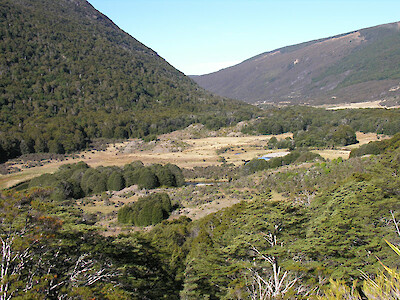
Montane. Confined to the valley bottom within a small area at the head of Cobb Valley which is a large glaciated valley system. Here it grows amongst tall and short tussocks and low scrub.
Threats
Pimela mesoa subsp. macra as Pimelea aff. sericeovillosa (CHR 467766; Cobb) was listed as “Threatened/Nationally Critical” by de Lange et al. (2009) and qualified as “RR” (Range Restricted), “St” (stable). This threat status still applies because the subspecies is still only known from a single small area (area < 1 ha). However, within its only known location the population is reasonably large and apparently stable. There are no known threats affecting P. mesoa subsp. macra and all known plants occur within a National Park. Burrows (2011) offers no data contradicting this earlier assessment.
Detailed taxonomy
Genus
Family
Synonyms
None (first described in 2011)
Endemic taxon
Yes
Endemic genus
No
Endemic family
No
Ecology
Flowering
September - February
Fruiting
Unknown
Propagation technique
Unknown. Probably easily grown from semi-hard and hardwood cuttings.
Other information
Etymology
pimelea: from Greek pimelē, meaning “lard” or “soft fat,” presumably referring to the oily seeds or fleshy cotyledons.
Previous conservation statuses
The conservation status of all known New Zealand vascular plant taxa at the rank of species and below were reassessed in 2022-2023 using the New Zealand Threat Classification System (NZTCS) – more information about this can be found on the NZTCS website. This report includes replaces all previous NZTCS lists for vascular plants. Previous assessments can be found here.
- Conservation status of vascular plants in Aotearoa New Zealand, 2023. 2024. Peter J. de Lange, Jane Gosden, Shannel P. Courtney, Alexander J. Fergus, John W. Barkla, Sarah M. Beadel, Paul D. Champion, Rowan Hindmarsh-Walls, Troy Makan and Pascale Michel Department of Conservation. Source: NZTCS and licensed by DOC for reuse under the Creative Commons Attribution 4.0 International licence.
2017 | Threatened – Nationally Vulnerable | Qualifiers: OL, St
2012 | Threatened – Nationally Vulnerable | Qualifiers: OL, St
2009 | Threatened – Nationally Critical
2004 | Threatened – Nationally Critical
Referencing and citations
References and further reading
Burrows, C.J. 2011: Genus Pimelea (Thymelaeaceae) in New Zealand 4. The taxonomic treatment of ten endemic abaxially hairy-leaved species. New Zealand Journal of Botany 49: 41–106.
de Lange, P.J.; Norton, D.A.; Courtney, S.P.; Heenan, P.B.; Barkla, J.W.; Cameron, E.K.; Hitchmough, R.; Townsend, A.J. 2009: Threatened and uncommon plants of New Zealand (2008 revision). New Zealand Journal of Botany 47: 61-96.
Attribution
Fact Sheet Prepared for NZPCN by: P.J. de Lange (30 April 2011) adapted from Burrows (2011).
NZPCN Fact Sheet citation
Please cite as: de Lange, P.J. (Year at time of access): Pimelea mesoa subsp. macra Fact Sheet (content continuously updated). New Zealand Plant Conservation Network. https://www.nzpcn.org.nz/flora/species/pimelea-mesoa-subsp-macra/ (Date website was queried)