
New Zealand Plant Conservation Network
  • Member login
  • Join
Facebook
  • Home
  • Flora
    • Flora species
    • Tag names
    • Vascular
    • Non-vascular
    • Lichens
    • Plant identification
    • Fungi
    • Make your own book
    • Quiz
  • Threats
    • Exotic Plants (Weeds)
    • Pest Animals
    • Other threats
  • Ecosystems
    • Plant communities
    • Ecosystem services
    • Novel ecosystems
  • Publications
    • Documents
    • Newsletter
    • Plant lists
    • Botanical Society journals
    • NZPCN publications
  • Conservation
    • Seedbank
    • Training
    • Restoration
    • Monitoring
    • Habitat protection
    • Funding
    • Botanic gardens
    • Botanic Societies
  • NZPCN
    • News
    • Trilepidea newsletter
    • Events
    • David Given Scholarship
    • Council members
    • Awards
    • Shop
    • Donate
    • Favourite Plant
    • Why join NZPCN?
    • Join
  • Help
    • FAQ
    • Query
    • Glossary
  • Contact us

Search flora

  1. Tracheophyta
    • Tracheophyta
  2. Magnoliopsida
    • Lycopodiopsida
    • Magnoliopsida
    • Pinopsida
    • Polypodiopsida
  3. Malvales
    • Alismatales
    • Apiales
    • Arecales
    • Asparagales
    • Asterales
    • Boraginales
    • Brassicales
    • Canellales
    • Caryophyllales
    • Celastrales
    • Chloranthales
    • Crossosomatales
    • Cucurbitales
    • Dioscoreales
    • Ericales
    • Fabales
    • Fagales
    • Gentianales
    • Geraniales
    • Gunnerales
    • Lamiales
    • Laurales
    • Liliales
    • Malpighiales
    • Malvales
    • Myrtales
    • Nymphaeales
    • Oxalidales
    • Pandanales
    • Paracryphiales
    • Piperales
    • Poales
    • Proteales
    • Ranunculales
    • Rosales
    • Santalales
    • Sapindales
    • Saxifragales
    • Solanales
  4. Thymelaeaceae
    • Malvaceae
    • Thymelaeaceae
  5. Pimelea
    • Kelleria
    • Pimelea
  6. Pimelea hirta
    • Pimelea tomentosa
    • Pimelea villosa
    • Pimelea lyallii
    • Pimelea poppelwellii
    • Pimelea pseudolyallii
    • Pimelea microphylla
    • Pimelea suteri
    • Pimelea aridula subsp. aridula
    • Pimelea buxifolia
    • Pimelea concinna
    • Pimelea gnidia
    • Pimelea longifolia
    • Pimelea oreophila subsp. oreophila
    • Pimelea prostrata subsp. prostrata
    • Pimelea sericeovillosa subsp. pulvinaris
    • Pimelea sericeovillosa subsp. sericeovillosa
    • Pimelea traversii subsp. traversii
    • Pimelea urvilleana subsp. urvilleana
    • Pimelea actea
    • Pimelea telura
    • Pimelea traversii subsp. boreus
    • Pimelea traversii subsp. exedra
    • Pimelea prostrata subsp. seismica
    • Pimelea prostrata subsp. vulcanica
    • Pimelea prostrata subsp. thermalis
    • Pimelea prostrata subsp. ventosa
    • Pimelea sporadica
    • Pimelea urvilleana subsp. nesica
    • Pimelea eremitica
    • Pimelea carnosa
    • Pimelea xenica
    • Pimelea orthia subsp. orthia
    • Pimelea acra
    • Pimelea ignota
    • Pimelea oreophila subsp. lepta
    • Pimelea oreophila subsp. hetera
    • Pimelea oreophila subsp. ephaistica
    • Pimelea mesoa subsp. mesoa
    • Pimelea mesoa subsp. macra
    • Pimelea dura
    • Pimelea notia
    • Pimelea declivis
    • Pimelea cryptica
    • Pimelea nitens subsp. nitens
    • Pimelea nitens subsp. aspera
    • Pimelea hirta
    • Pimelea sericeovillosa subsp. alta
    • Pimelea aridula subsp. oliga
    • Pimelea barbata subsp. barbata
    • Pimelea barbata subsp. omoia
    • Pimelea mimosa
    • Pimelea orthia subsp. protea

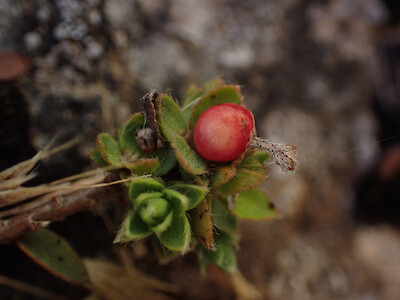
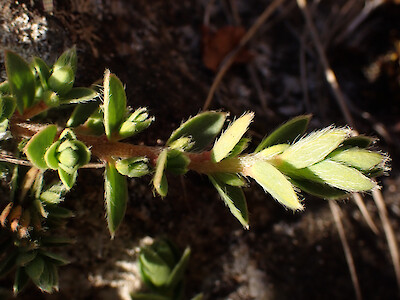
Pimelea hirta

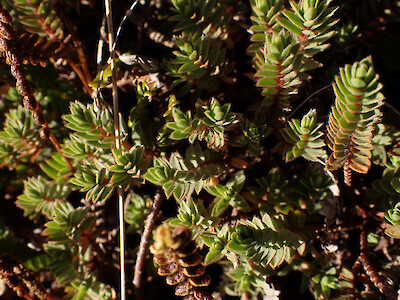
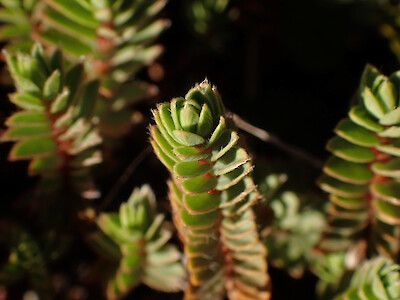
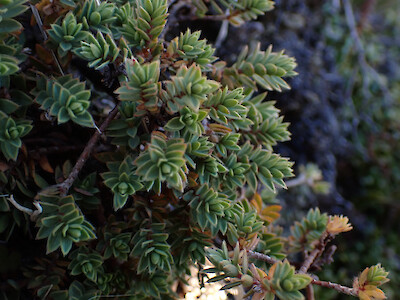
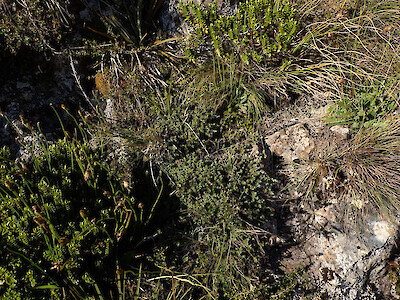
Rocky slopes of of alpine summit, Mt Hikurangi Gisborne.<br>Photographer: Marley Ford, Date taken: 25/02/2026, Licence: <a target='_blank' href='https://creativecommons.org/licenses/by-nc/4.0'>CC BY-NC</a>. <a class='member-message' href='/nzpcn/why-join-nzpcn/' target='_blank'>Members can view a larger version of this image.</a>
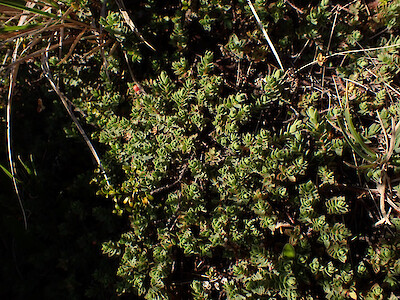
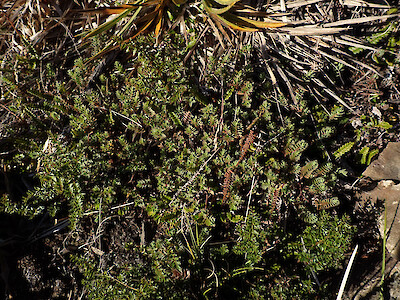
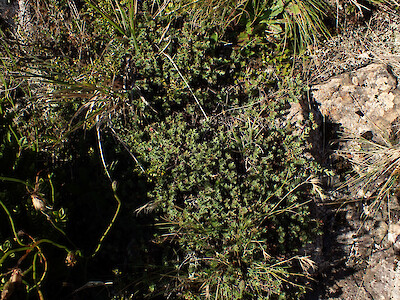
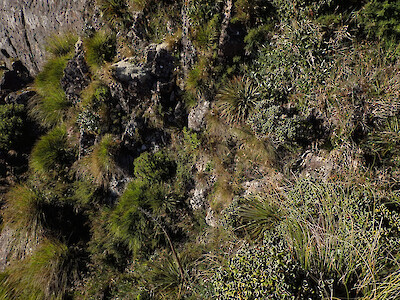
Habitat, Mt Hikurangi Gisborne.<br>Photographer: Marley Ford, Date taken: 25/02/2026, Licence: <a target='_blank' href='https://creativecommons.org/licenses/by-nc/4.0'>CC BY-NC</a>. <a class='member-message' href='/nzpcn/why-join-nzpcn/' target='_blank'>Members can view a larger version of this image.</a>
Download PDF Comment on factsheet

NZPCN members can select up to 20 plant species and automatically create a full colour, fully illustrated A4 book describing them (in PDF format).

  • Find out more...
  • Join NZPCN...
Find in plant lists
iNaturalist NZ View observations Biota of NZ Click here to view NZ Flora Click here to view Herbarium View AVH specimens Donate Support NZPCN

Common names

pimelea

Biostatus

Native – Endemic taxon

Current conservation status

The conservation status of all known New Zealand vascular plant taxa at the rank of species and below were reassessed in 2022-2023 using the New Zealand Threat Classification System (NZTCS) – more information about this can be found on the NZTCS website. This report includes replaces all previous NZTCS lists for vascular plants. Previous assessments can be found here.

  • Conservation status of vascular plants in Aotearoa New Zealand, 2023. 2024. Peter J. de Lange, Jane Gosden, Shannel P. Courtney, Alexander J. Fergus, John W. Barkla, Sarah M. Beadel, Paul D. Champion, Rowan Hindmarsh-Walls, Troy Makan and Pascale Michel Department of Conservation. Source: NZTCS and licensed by DOC for reuse under the Creative Commons Attribution 4.0 International licence.

2023 | Data Deficient | Qualifiers: CR

Jump to previous conservation statuses

Category

Vascular

Structural class

Trees & Shrubs - Dicotyledons

Simplified description

Shrub with sprawling hairy dark twigs to 40cm long bearing pairs of small pointed leaves that are inconspicuously hairy underneath and hairy white flowers and red fruit inhabiting upland areas of the East Cape and Kaweka to Ruahine Ranges. Leaves 6-9mm long by 2.5-5mm wide.

Flower colours

White

Detailed description

A robust, much-branched procumbent to decumbent shrub with stems up to 400 mm long. Branching sympodial and lateral. Young stems brown, with a moderately dense cover of long, dull-white hairs; internodes 1-3 mm long. Older stems glabrous, dark brown to black. Node buttresses lunate, 0.2 mm long, smooth, brown, masked by hairs on young stems, not very prominent on leafless stems. Leaves decussate, ascending and loosely imbricate to patent, on short, dark red petioles (0.3 mm). Lamina 6.0-9.0 × 2.5-5.0 mm, medium green, elliptic to broad-elliptic, or broad-ovate or oblong slightly adaxially concave to keeled, mid-vein evident, sunken adaxially; tip acute; base cuneate; abaxial surface moderately sparsely covered by dull white, relatively long, straight (rarely curled) hairs; stomata on both adaxial and abaxial leaf surfaces. Inflorescences terminal, loose, 4-7-flowered. Involucral bracts 4, similar in size to ordinary leaves or larger (6-3 mm). Receptacle moderately densely hairy. Plants gynodioecious. Flowers white on short (0.8 mm) pedicels, very hairy outside, inside hairless. Female tube 5 mm long, ovary portion wrinkled, 2 mm, calyx lobes 1.9 × 1.1 mm; hermaphrodite tube 6 mm long, ovary portion 2 mm, calyx lobes 2.8 × 2.0 mm. Anther dehiscence introrse. Ovary with a few short hairs at summit. Fruits red, ovoid, fleshy 4.0 × 2.7 mm. Seeds ovoid, 3.5 × 2.0 mm, crest thin.

Similar taxa

Potentially confused in the field with Pimelea oreophila subsp. ephaistica from which it differs by its larger overall stature and leaves, and by the obviously longer, denser abaxial leaf hairs.

Distribution

Endemic. New Zealand: North Island (Raukumara, Maungaharuru, Kaweka and Ruahine Ranges)

Habitat

Alpine. Usually on limestone outcrops but a component of tall tussock grassland and subalpine scrub

Threats

Pimelea hirta is newly described that has not been recognised by an informal tag name previously. Therefore this species has not been formally listed by the New Zealand Threat Listing Panel (see de Lange et al. 2009). However Burrows (2011) did not use the New Zealand Threat Listing Classification System (see Townsend et al. 2008) in his conservation assessment, and his comments, unquantified as they are suggest that the best course of action is to list this species as “Data Deficient” until such time as better data is obtained, and the species can be assessed by an appropriate threat listing panel.

Detailed taxonomy

Genus

Pimelea

Family

Thymelaeaceae

Authority

Pimelea hirta C.J.Burrows

Synonyms

None (first described in 2011)

Endemic taxon

Yes

Endemic genus

No

Endemic family

No

Ecology

Flowering

December - February

Fruiting

Unknown

Propagation technique

Unknown. Probably easily grown from semi-hard and hardwood cuttings.

Other information

Etymology

pimelea: from Greek pimelē, meaning “lard” or “soft fat,” presumably referring to the oily seeds or fleshy cotyledons.

Previous conservation statuses

The conservation status of all known New Zealand vascular plant taxa at the rank of species and below were reassessed in 2022-2023 using the New Zealand Threat Classification System (NZTCS) – more information about this can be found on the NZTCS website. This report includes replaces all previous NZTCS lists for vascular plants. Previous assessments can be found here.

  • Conservation status of vascular plants in Aotearoa New Zealand, 2023. 2024. Peter J. de Lange, Jane Gosden, Shannel P. Courtney, Alexander J. Fergus, John W. Barkla, Sarah M. Beadel, Paul D. Champion, Rowan Hindmarsh-Walls, Troy Makan and Pascale Michel Department of Conservation. Source: NZTCS and licensed by DOC for reuse under the Creative Commons Attribution 4.0 International licence.

2017 | Data Deficient

2012 | Data Deficient

2009 | Data Deficient

Jump to current conservation status

Referencing and citations

References and further reading

Burrows, C.J. 2011: Genus Pimelea (Thymelaeaceae) in New Zealand 4. The taxonomic treatment of ten endemic abaxially hairy-leaved species. New Zealand Journal of Botany 49: 41–106.

de Lange, P.J.; Norton, D.A.; Courtney, S.P.; Heenan, P.B.; Barkla, J.W.; Cameron, E.K.; Hitchmough, R.; Townsend, A.J. 2009: Threatened and uncommon plants of New Zealand (2008 revision). New Zealand Journal of Botany 47: 61-96.

Townsend, A.J.; de Lange, P.J.; Norton, D.A.; Molloy, J.; Miskelly, C.; Duffy, C. 2008: The New Zealand Threat Classification System manual. Wellington, Department of Conservation

Attribution

Fact Sheet Prepared for NZPCN by: P.J. de Lange (1 May 2011). Description adapted from Burrows (2011).

NZPCN Fact Sheet citation

Please cite as: de Lange, P.J. (Year at time of access): Pimelea hirta Fact Sheet (content continuously updated). New Zealand Plant Conservation Network. https://www.nzpcn.org.nz/flora/species/pimelea-hirta/ (Date website was queried)

▲ Back to top
  • Home
  • Flora
  • Threats
  • Ecosystems
  • Publications
  • Conservation
  • NZPCN
  • Help
  • Contact us

© 2026 New Zealand Plant Conservation Network • Website by RS

Coastlands Plant Nursery Wildlands

Website sponsor

  • Home
  • Flora
    • Flora species
    • Tag names
    • Vascular
      • Ferns
        • King fern
        • True ferns
        • Adder's tongue ferns
        • Fork ferns and whisk ferns
        • Horsetails
      • Conifers
        • Celery pines
        • Kauri
        • Podocarps
          • Podocarpus
          • Dacrydium
          • Prumnopitys
          • Dacrycarpus
          • Halocarpus
          • Lepidothamnus
          • Manoao
        • Cypress
      • Flowering plants
        • Parasites
          • Leafy mistletoes
          • Pygmy mistletoes
            • Korthalsella flowers
            • Korthalsella hosts
            • Dispersal of Korthalsella
            • Associates of Korthalsella
          • Root parasites
          • Saprophytes
        • Epiphytes
          • NZ
            • Typical
            • Occasional
            • Hemi-epiphytes
            • Ephemeral
            • NZ list
        • Monocots
          • Orchids
            • Structure
          • Grasses
        • Dicots
          • Hebes
          • Kowhai
          • Coprosma
          • Beech
          • Rata
        • Carnivorous
        • Deciduous plants
        • Aquatic plants
      • Poisonous natives
      • Threatened plant lists
      • What's a vascular plant?
      • Club mosses
    • Non-vascular
      • Bryophytes
        • Liverworts
        • Mosses
        • Hornworts
      • Algae
        • Seaweeds
    • Lichens
    • Plant identification
      • Written descriptions
      • Experts
      • Plant keys
        • Key to parasitic plant genera
      • Collecting plants
        • Should I collect
        • Choosing a specimen
        • Field notes
        • Fresh plant material
        • Pressing and drying
        • Mounting specimens
        • Labelling specimens
    • Fungi
    • Make your own book
    • Quiz
  • Threats
    • Exotic Plants (Weeds)
      • Unwanted organisms
      • DOC weeds
      • Plant me instead
      • Pest Plant Accord
    • Pest Animals
      • Mammals
        • Mustelids
        • Rodents
        • Ungulates
        • Possums
      • Fish
      • Insects
    • Other threats
      • Natural events
        • Insects
      • Human induced
        • Habitat loss
        • Collection
        • Climate change
  • Ecosystems
    • Plant communities
      • Dunes
        • Volcanic
        • Coastal
          • Threats
          • Common species
          • Research on dunes
          • Pingao research
          • What you can do
      • Wetlands
        • Estuaries
          • Common estuarine species
          • Research on estuaries
        • Ephemeral
        • Restiad peat bogs
      • Forests
        • Kauri-podocarp-broadleaved
        • Podocarp broadleaved
        • Beech
      • Scrub/shrublands
        • Geothermal
          • Distribution of geothermal vegetation
          • Geothermal plants
          • Geothermal vegetation types
          • Threats to geothermal vegetation
        • Frost flat/hollow
        • Manuka fens
        • Gumlands
      • Grasslands
        • Tussock grasslands
      • Bare ground
        • Braided rivers
        • Alpine
        • Cliff
        • Scree and boulderfields
        • Shingle beaches
      • Herbfields
        • Saltpan
    • Ecosystem services
    • Novel ecosystems
  • Publications
    • Documents
    • Newsletter
    • Plant lists
      • Search plant lists
      • Plant lists by political region/district
      • Plant lists by ecological region/district
      • National plant lists
      • How to prepare a plant list
    • Botanical Society journals
    • NZPCN publications
  • Conservation
    • Seedbank
      • Project 1 - Pohutukawa, Rata and Myrtaceae
      • Project 2 - Alpine flora and the Forget-Me-Nots
      • Project 3 - Kowhai and its relatives
      • Project 4 - Podocarps and trees of the forest
    • Training
      • Module 1: Plant life
      • Module 2: Covenants
      • Module 3: Propagation
      • Module 4: Wetlands
      • Pilot course 2006
    • Restoration
      • Gardening
        • Being weed wise
        • Garden plants
          • Trees and shrubs
          • Broad-leaved herbs
          • Grass-like herbs
          • Climbers
          • Ferns
        • Attracting wildlife
        • Planting for lizards
          • Rules
      • Species recovery
        • Plant translocations
      • Ecological restoration
        • Case studies
          • Tavora Reserve
          • Waiwhakareke
      • Revegetation
      • Eco-sourcing
      • Find a restoration group
    • Monitoring
      • Number count
        • Number count method
        • Pros and cons of number counts
        • Data analysis and interpretation
      • Presence/absence surveys
        • Presence/absence survey methods
        • Pros and cons of presence/absence surveys
        • Data analysis and interpretation
      • Mapping spatial extent
        • Spatial extent mapping methods
        • Pros and cons of spatial extent mapping
        • Data analysis and interpretation
      • Photo points
        • Photo point guidelines
    • Habitat protection
      • Legal protection
        • Nga Whenua Rahui
        • QEII covenants
        • DOC Covenants
      • Animal pest control
      • Weed control
      • Fencing
    • Funding
    • Botanic gardens
    • Botanic Societies
  • NZPCN
    • News
    • Trilepidea newsletter
    • Events
      • 2026 NZPCN conference
        • 2026 Conference field trips
        • 2026 Conference workshops
        • 2026 conference sponsors
        • 2026 Conference keynote speakers
      • 2024 AGM
      • Conference 2024
        • 2024 conference overview
        • Conference 2024 workshops
        • Conference 2024 Field Trips
        • 2024 conference sponsors
        • Conference 2024 accommodation options
        • 2024 Conference Programme
      • Conference 2022
        • Conference programme summary
        • 2022 conference workshops
        • 2022 conference field trips
        • Code of conduct
        • COVID-19 information
        • 2022 conference sponsors
        • Abstract and poster submission
        • 2022 Conference venue and accommodation
        • Conference Workshop: Restoration Pathways
        • 2022 conference postponement
      • Conference 2019
      • Conference 2017
      • Conference 2015
        • Speakers
        • Workshops
        • Field trips
        • Charity auction
      • Conference 2013
        • Speakers
        • Timetable
      • 2023 Restoration Pathways Workshop
      • 2023 AGM
    • David Given Scholarship
      • David Given Scholarship Recipients
    • Council members
      • NZPCN council member profiles
      • Council 2023
      • Council 2022
      • Council 2021
      • Council 2020
      • Council 2019
      • Council 2018
      • Council 2017
      • Council 2016
      • Council 2015
      • Council 2014
      • Council 2024
      • Council 2013
      • Council 2012
      • Council 2011
      • Council 2010
      • Council 2009
      • Council 2008
      • Council 2007
      • Council 2006
      • Council 2005
      • Council 2004
      • Council 2003
    • Awards
      • NZPCN Awards
        • 2024 Plant Conservation Awards
        • 2022
        • 2019
        • 2018
        • 2017
        • 2016
        • 2015
        • 2014
        • 2013
        • 2012
        • 2011
        • 2010
        • 2009
        • 2008
        • 2007
        • 2006
        • 2005
    • Shop
    • Donate
    • Favourite Plant
    • Why join NZPCN?
    • Join
  • Help
    • FAQ
      • Joining the Network
      • The Network
      • Network website
      • New Zealand plants
      • The law
      • Your discoveries
    • Query
    • Glossary
  • Contact us
  • Facebook