
Pimelea oreophila subsp. oreophila


Common names
pimelea
Biostatus
Native – Endemic taxon
Current conservation status
The conservation status of all known New Zealand vascular plant taxa at the rank of species and below were reassessed in 2022-2023 using the New Zealand Threat Classification System (NZTCS) – more information about this can be found on the NZTCS website. This report includes replaces all previous NZTCS lists for vascular plants. Previous assessments can be found here.
- Conservation status of vascular plants in Aotearoa New Zealand, 2023. 2024. Peter J. de Lange, Jane Gosden, Shannel P. Courtney, Alexander J. Fergus, John W. Barkla, Sarah M. Beadel, Paul D. Champion, Rowan Hindmarsh-Walls, Troy Makan and Pascale Michel Department of Conservation. Source: NZTCS and licensed by DOC for reuse under the Creative Commons Attribution 4.0 International licence.
2023 | Not Threatened
Category
Vascular
Structural class
Trees & Shrubs - Dicotyledons
Simplified description
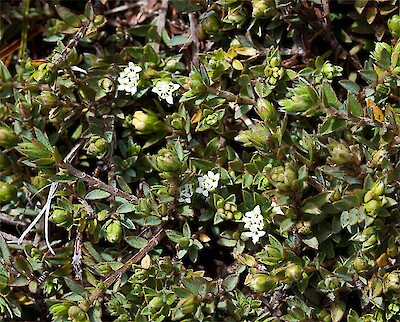
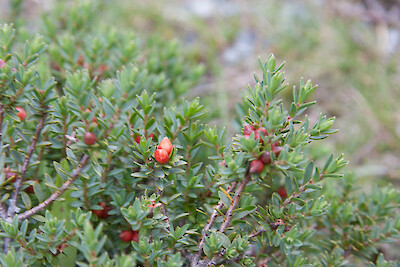
Low-growing spreading shrub with hairy branches 2.5-3.5 mm thick and to 50 cm, bearing pairs of narrow pointed leaves that are sparsely hairy underneath, and with hairy white flowers and red or orange fruit. Mostly inhabits the wetter southern South Island. Leaves 4-8 mm long by 2-4 mm wide.
Flower colours
White
Detailed description
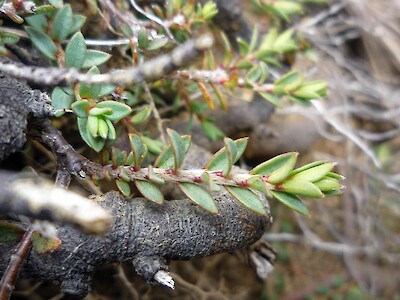
Procumbent, trailing shrub, with few to many, moderately thick (2.5–3.5 mm), flexible light brown young stems these covered invested with a moderate cover of short, appressed hairs; internodes 2.5–5.0 mm, node buttresses usually lunate, sometimes elongate. Older stems up to 6.0 mm diameter, 100–500 mm long, occasionally with adventitious roots, sometimes climbing in upright shrubs. Reduced in stature on exposed sites with rocky substrates, sometimes forming short-stemmed, appressed rosettes. Branching mainly sympodial. Young stems brown, moderately densely covered in short or moderately long, white, grey or sometimes yellowish appressed hair cover; older stems darker brown, glabrate. Internodes of young stems 1–5mm long. Node buttresses lunate to elongate, or sometimes extending the full length of internodes, with bands of hair between; usually not very prominent on leafless stems. Leaves decussate, on short (0.5–1.0 mm), often red petioles, ascending at first, usually becoming patent, often with a distichous appearance on prostrate stems. Lamina 4–8 × 2–4 mm, glaucous or medium to dark green, usually elliptic, sometimes ovate, adaxially concave and slightly keeled, mid-vein evident; tip acute but usually blunt-pointed, sometimes obtuse; base cuneate; abaxially bearing sparse, short, white to dull-white hairs along lamina margins, mid-veins and tips; with or without an apical coma, often becoming glabrous as leaves age; stomata on both adaxial and abaxial surfaces. Inflorescences terminal, 5–15-flowered, receptacle densely covered in short hairs. Involucral bracts 4, the same size as ordinary leaves, or larger (6 × 4 mm). Plants gynodioecious. Flowers white, fragrant, on short pedicels (0.3 mm) densely covered with short hairs outside; inside hairless. Female tube 2.5–4.0 mm long, ovary portion 3 mm, calyx lobes 1–2 ×1 mm; hermaphrodite tube 4–6 mm long, ovary portion 2 mm, calyx lobes 2.0–3.0 × 1.5–2.0 mm. Anther dehiscence introrse. Ovary with dense clump of short or long hairs at summit. Fruits ovoid, fleshy, orange or red, 4 × 3 mm. Seeds ovoid 2.7 × 2.3 mm.
Similar taxa
Recognised by the stems which are 2.5–3.5 mm diameter, and elliptic, slightly keeled leaves whose abaxial surface leaf margins, mid-vein and apex are sparsely covered in short, sparse often caducous abaxial hairs. Further Pimelea oreophila subsp. oreophila is confined to the Southern Alps, northern Canterbury, and from Westland to southern Fiordland.
Distribution
Endemic. New Zealand: Canterbury, Westland, Otago (mostly western but also sparse in central areas), western Southland and Fiordland
Habitat
Montane to alpine, in open forest near the treeline, in tall and short tussock grassland associated with a wide range of other small grasses, forbs, dwarf shrubs and some medium height shrubs. Usually above the treeline but also at lower levels (500 m or less) in places where frosts are severe in valley floors and where forest has been removed by fire.
Detailed taxonomy
Genus
Family
Endemic taxon
Yes
Endemic genus
No
Endemic family
No
Ecology
Flowering
September - February
Fruiting
October - May
Propagation technique
Easily grown from semi-hardwood and hardwood cuttings. Does best in a well drained soil and planted in a sunny situation (such as in a rockery or pot)
Other information
Etymology
pimelea: from Greek pimelē, meaning “lard” or “soft fat,” presumably referring to the oily seeds or fleshy cotyledons.
oreophila: Mountain lover
NVS code
The National Vegetation Survey (NVS) Databank is a physical archive and electronic databank containing records of over 94,000 vegetation survey plots - including data from over 19,000 permanent plots. NVS maintains a standard set of species code abbreviations that correspond to standard scientific plant names from the Ngä Tipu o Aotearoa - New Zealand Plants database.
PIMOSO
Chromosome number
2n = 36
Previous conservation statuses
The conservation status of all known New Zealand vascular plant taxa at the rank of species and below were reassessed in 2022-2023 using the New Zealand Threat Classification System (NZTCS) – more information about this can be found on the NZTCS website. This report includes replaces all previous NZTCS lists for vascular plants. Previous assessments can be found here.
- Conservation status of vascular plants in Aotearoa New Zealand, 2023. 2024. Peter J. de Lange, Jane Gosden, Shannel P. Courtney, Alexander J. Fergus, John W. Barkla, Sarah M. Beadel, Paul D. Champion, Rowan Hindmarsh-Walls, Troy Makan and Pascale Michel Department of Conservation. Source: NZTCS and licensed by DOC for reuse under the Creative Commons Attribution 4.0 International licence.
2017 | Not Threatened
2012 | Not Threatened
2009 | Not Threatened
2004 | Not Threatened
Referencing and citations
References and further reading
Burrows, C.J. 2011: Genus Pimelea (Thymelaeaceae) in New Zealand 4. The taxonomic treatment of ten endemic abaxially hairy-leaved species. New Zealand Journal of Botany 49: 41–106.
Attribution
Fact Sheet Prepared for NZPCN by: P.J. de Lange (28 April 2011). Description adapted from Burrows (2011).