
Pimelea sericeovillosa subsp. alta
Common names
pimelea
Biostatus
Native – Endemic taxon
Current conservation status
The conservation status of all known New Zealand vascular plant taxa at the rank of species and below were reassessed in 2022-2023 using the New Zealand Threat Classification System (NZTCS) – more information about this can be found on the NZTCS website. This report includes replaces all previous NZTCS lists for vascular plants. Previous assessments can be found here.
- Conservation status of vascular plants in Aotearoa New Zealand, 2023. 2024. Peter J. de Lange, Jane Gosden, Shannel P. Courtney, Alexander J. Fergus, John W. Barkla, Sarah M. Beadel, Paul D. Champion, Rowan Hindmarsh-Walls, Troy Makan and Pascale Michel Department of Conservation. Source: NZTCS and licensed by DOC for reuse under the Creative Commons Attribution 4.0 International licence.
2023 | At Risk – Naturally Uncommon | Qualifiers: Sp, DPS, DPT, RR
Category
Vascular
Structural class
Trees & Shrubs - Dicotyledons
Simplified description
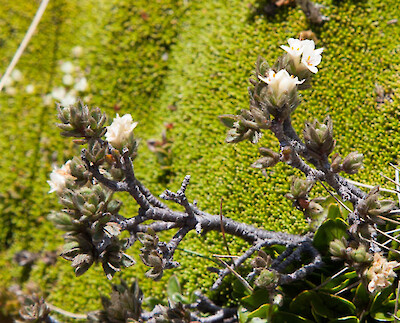
Low growing sprawling shrub with hairy twigs bearing pairs of hairy pointed leaves, hairy white flowers inhabiting the Pisa Range and possibly nearby. Leaf dimensions unknown, hairs denser on underside. Fruit unknown.
Flower colours
White
Detailed description
A low, much-branched, dull-green loose cushion-forming shrublet to 50 × 250 mm. with brown, clustered, appressed, leafy, densely villous young branchlets, and with older, gnarled, leafless stems often visible (these often leafless and glabrous, dark brown to black, often partly buried by windblown silt or sand). Internode length 0.3-0.6 mm. Branching mainly sympodial and radiating from a stout main stem up to 15 mm in diameter. Node buttresses lunate, dark brown, masked by hairs on young stems, not prominent on leafless branchlets. Leaves decussate, ascending, imbricate, sessile or with very short petioles (0.2 mm). Lamina medium to pale green, elliptic to oblong, 2.2-4.0 × 1.0-1.3 mm, adaxially concave, mid-vein not evident, abaxial surface very densely covered with straight, grey-white, moderately long hairs; adaxial surface sparsely hairy, sometimes glabrous, obtuse, base cuneate, stomata on both adaxial and abaxial surfaces. Inflorescences terminal, with 1 or 2, sometimes 3, flowers. Involucral bracts 4, the same size as, or slightly wider than adjacent leaves (2.3 × 1.5 mm). Receptacle usually with abundant long hairs. Plants gynodioecious. Flowers 1-2-3 per inflorescence, white, on very short (0.1 mm) pedicels, very hairy outside, inside hairless. Female tube 2.5 mm long, ovary portion 2 mm, calyx lobes 1.0-1.2 × 0.5 mm; hermaphrodite tube 3-4 mm long, ovary portion 2 mm, calyx lobes 1.5 × 0.8-1.0 mm. Anther dehiscence introrse. Ovary with dense short hairs on summit, less dense to half way down. Fruits not seen.
Similar taxa
Resembling subsp. sericeovillosa from which it differs by its allopatric distribution, more open (loose) cushion forming growth habit, dull-green colour, and leave investiture comprised solely of long straight hairs
Distribution
Endemic. New Zealand: South Island, Pisa Range
Habitat
Subalpine to alpine. Usually in open fell-field on mountain tops, ridge crests and in open stonefields. occasionally found at lower levels in short short-tussock grassland.
Threats
See comments about the “Conservation Status” opinions and their validity as offered by Burrows (2011) under the Fact Sheet for Pimelea sericeovillosa subsp. sericeovillosa. As Pimelea (d) (CHR 472016; Pisa) Pimelea sericeovillosa subsp. alta was listed by de Lange et al. (2009; p. 91) as Taxonomically Indeterminate/Naturally Uncommon. This assessment may still be appropriate as it was based on critical field data obtained by Department of Conservation Staff surveying the Pisa Range. However, due to the recircumscription of P. sericeovillosa by Burrows (2011) and comments regarding possible introgression between subsp. alta and P. aridulla and P. oreophila (comments which seem to be solely based on limited observations), this assessment may need to change.
Detailed taxonomy
Genus
Family
Synonyms
None first described in 2011
Taxonomic notes
Pimelea sericeovillosa subsp. alta was listed by de Lange et al. (2009; p. 91) as Taxonomically Indeterminate/Naturally Uncommon as Pimelea (d) (CHR 472016; Pisa).
Endemic taxon
Yes
Endemic genus
No
Endemic family
No
Ecology
Flowering
October - January
Fruiting
Unknown
Propagation technique
Easily grown from semi-hardwood cuttings but difficult to maintain in cultivation. Prefers a moist free-draining soil, planted in full sun. Dislikes humidity, shade and poor drainage.
Other information
Etymology
pimelea: from Greek pimelē, meaning “lard” or “soft fat,” presumably referring to the oily seeds or fleshy cotyledons.
Previous conservation statuses
The conservation status of all known New Zealand vascular plant taxa at the rank of species and below were reassessed in 2022-2023 using the New Zealand Threat Classification System (NZTCS) – more information about this can be found on the NZTCS website. This report includes replaces all previous NZTCS lists for vascular plants. Previous assessments can be found here.
- Conservation status of vascular plants in Aotearoa New Zealand, 2023. 2024. Peter J. de Lange, Jane Gosden, Shannel P. Courtney, Alexander J. Fergus, John W. Barkla, Sarah M. Beadel, Paul D. Champion, Rowan Hindmarsh-Walls, Troy Makan and Pascale Michel Department of Conservation. Source: NZTCS and licensed by DOC for reuse under the Creative Commons Attribution 4.0 International licence.
2017 | At Risk – Naturally Uncommon | Qualifiers: DP, RR, Sp
2012 | At Risk – Naturally Uncommon | Qualifiers: RR, Sp
2009 | At Risk – Naturally Uncommon | Qualifiers: DP, RR
2004 | At Risk – Naturally Uncommon
Regional conservation statuses
Otago: 2025 | Regionally At Risk – Regionally Naturally Uncommon | Qualifiers: DPR, DPS, DPT, NS, NStr, RE, RR, Sp, St, TL
Current regional threat status assessments prepared according to Crisp et al. (2025) are displayed when available. The Otago conservation status information is sourced from the “Conservation Status of Indigenous Vascular Plants in Otago, 2025” Jarvie S et al. (2025) report.
Referencing and citations
References and further reading
Burrows, C.J. 2011: Genus Pimelea (Thymelaeaceae) in New Zealand 5. The taxonomic treatment of five endemic species with both adaxial and abaxial leaf hair. New Zealand Journal of Botany 49: 367-412.
de Lange, P.J.; Norton, D.A.; Courtney, S.P.; Heenan, P.B.; Barkla, J.W.; Cameron, E.K.; Hitchmough, R.; Townsend, A.J. 2009: Threatened and uncommon plants of New Zealand (2008 revision). New Zealand Journal of Botany 47: 61-96.
Attribution
Fact sheet prepared for NZPCN by P.J. de Lange (29 September 2011). Description adapted from Burrows (2011).
NZPCN Fact Sheet citation
Please cite as: de Lange, P.J. (Year at time of access): Pimelea sericeovillosa subsp. alta Fact Sheet (content continuously updated). New Zealand Plant Conservation Network. https://www.nzpcn.org.nz/flora/species/pimelea-sericeovillosa-subsp-alta/ (Date website was queried)