
Pimelea barbata subsp. barbata
Common names
pimelea
Biostatus
Native – Endemic taxon
Current conservation status
The conservation status of all known New Zealand vascular plant taxa at the rank of species and below were reassessed in 2022-2023 using the New Zealand Threat Classification System (NZTCS) – more information about this can be found on the NZTCS website. This report includes replaces all previous NZTCS lists for vascular plants. Previous assessments can be found here.
- Conservation status of vascular plants in Aotearoa New Zealand, 2023. 2024. Peter J. de Lange, Jane Gosden, Shannel P. Courtney, Alexander J. Fergus, John W. Barkla, Sarah M. Beadel, Paul D. Champion, Rowan Hindmarsh-Walls, Troy Makan and Pascale Michel Department of Conservation. Source: NZTCS and licensed by DOC for reuse under the Creative Commons Attribution 4.0 International licence.
2023 | At Risk – Naturally Uncommon | Qualifiers: DPS, DPT, RR
Category
Vascular
Structural class
Trees & Shrubs - Dicotyledons
Simplified description
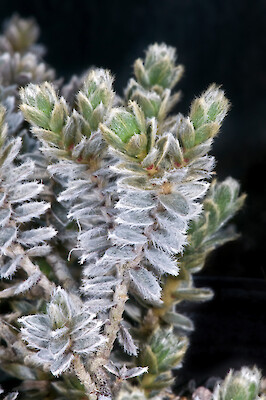
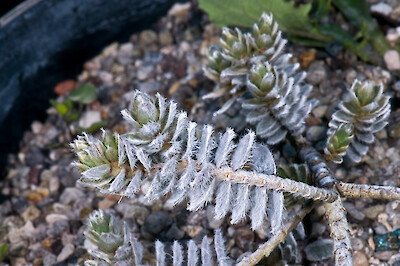
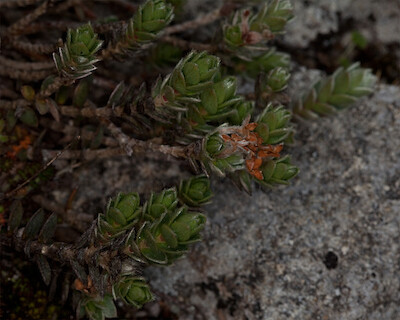
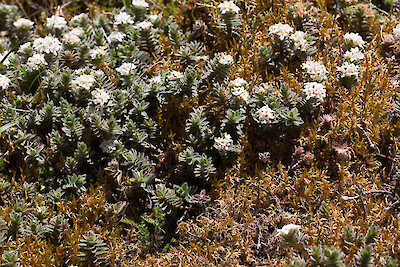
Low growing greyish shrub bearing pairs of hairy oval leaves and clusters of white flowers inhabiting the Maungaharuru and Te Waka Ranges in Hawkes Bay. Twigs hairy. Leaves dense, 7-10mm long by 4-6mm wide, hairier underneath. Flowers white, body hairy. Fruit red.
Flower colours
White
Detailed description
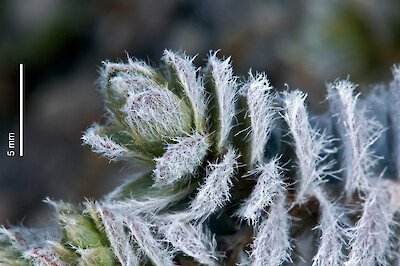
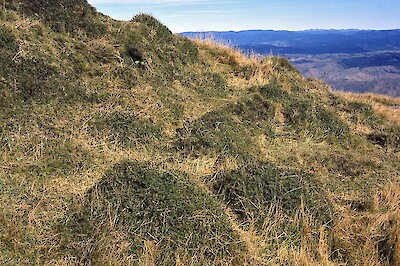
Prostrate shrubs, sometimes forming large patches, to 1 m or more wide; may be pendent on cliffs. Branching mainly sympodial. Young branchlets brown, densely covered by relatively long white to dull-white hairs; internodes 1.5-6.0 mm long; older stems glabrate, grey-brown to brown. Node buttresses lunate (0.4 mm long) masked by hairs on young branchlets, not very prominent on leafless stems. Leaves decussate, on very short petioles (0.4 mm), ascending, often becoming patent to deflexed. Lamina 7-10 × 4-6 mm, broad-ovate, sometimes oblong, slightly adaxially concave, obtuse (rarely acute), base cuneate. Adaxial leaf hairs usually sparse; abaxial hairs dense. Vesture moderately long, white to dull-white, hispid, villous, or rarely curled, appressed and often antrorse. Older leaves may be glabrate, dull-green. Mid-vein may be evident abaxially. Stomata on both adaxial and abaxial surfaces. Inflorescences terminal on branchlets, compact, 2-7-flowered. Involucral bracts 4, the same size as or larger than adjacent leaves (7-10 × 4-6 mm). Receptacle with dense, long hairs. Plants gynodioecious. Flowers white on very short pedicels (0.6 mm). Outside densely hairy, inside hairless. Female tube 4 mm long, ovary portion 2 mm, calyx lobes 1.8 × 1.2 mm; hermaphrodite tube 6.5 mm long, ovary portion 2 mm, calyx lobes 2.3 × 1.9 mm. Anther dehiscence introrse. Ovary with short sparse hairs on summit. Fruits ovoid, fleshy, red 5.0-6.0 × 3.5-4.0 mm; seeds ovoid 3.2 × 2.0 mm, crest thin.
Similar taxa
Pimelea barbata is allied to P. mimosa from which it differs by its smaller leaf length and wide leaves (7-10 × 4-6 mm in P. barbata cf. 9.0-2.0 × 2.5-5.0 mm in P. mimosa). Pimelea barbata subsp. barbata is closely allied to Pimelea barbata subsp. omoia from which it is geographically isolated (being confined to the Hawkes Bay mountains (with one lowland record from near Gisborne)) and ecologically distinct (being restricted to calcareous (limestone) substrates. Morphologically it differs by its leaf size (7-10 mm long cf. 8-12 mm long). Further study of Pimelea barbata (including subsp. omoia) and P. mimosa using DNA sequence data would be useful, as these distinctions seem relatively minor and there is much overlap in the key characters (leaf length and width) used by Burrows (2011) to define them.
Distribution
Endemic. New Zealand: North Island (near Gisborne (?Historic), Hawke’s Bay (Maungaharuru Range south to Titiokura and the Te Waka ridge). Also nearby Hukanui peak (M. Thorsen pers. obs.).
Habitat
Montane to subalpine in short grassland on limestone cliffs, cliff tops, and below these on fallen limestone blocks talus slopes.
Threats
Pimelea barbata subsp. barbata was formerly listed as “Taxonomically Indeterminate/Naturally Uncommon in Appendix 2 of de Lange et al. (2009) as Pimelea aff. aridula (d) (CHR 221089; Maungaharuru) qualified RR (Range Restricted). Beyond its formal taxonomic recognition, Burrows (2011) offers no concrete data or reasons to suggest a change in this status. His paper does note however that the key habitat for subsp. barbata is being considered for a future wind farm.
Detailed taxonomy
Genus
Family
Synonyms
None - first described in 2011
Endemic taxon
Yes
Endemic genus
No
Endemic family
No
Ecology
Flowering
September - January
Fruiting
December - May
Propagation technique
Easily propagated from semi-hardwood cuttings and layered pieces. An excellent rockery plant which flourishes in a sunny, well drained rich soil. Intolerant of competition, water logging and humidity.
Other information
Etymology
pimelea: from Greek pimelē, meaning “lard” or “soft fat,” presumably referring to the oily seeds or fleshy cotyledons.
barbata: From the Latin ‘barbus’, meaning bearded or provided with tufts of long weak hairs
Previous conservation statuses
The conservation status of all known New Zealand vascular plant taxa at the rank of species and below were reassessed in 2022-2023 using the New Zealand Threat Classification System (NZTCS) – more information about this can be found on the NZTCS website. This report includes replaces all previous NZTCS lists for vascular plants. Previous assessments can be found here.
- Conservation status of vascular plants in Aotearoa New Zealand, 2023. 2024. Peter J. de Lange, Jane Gosden, Shannel P. Courtney, Alexander J. Fergus, John W. Barkla, Sarah M. Beadel, Paul D. Champion, Rowan Hindmarsh-Walls, Troy Makan and Pascale Michel Department of Conservation. Source: NZTCS and licensed by DOC for reuse under the Creative Commons Attribution 4.0 International licence.
2017 | At Risk – Naturally Uncommon | Qualifiers: DP, RR
2012 | At Risk – Naturally Uncommon | Qualifiers: RR
2009 | Data Deficient
Referencing and citations
References and further reading
Burrows, C.J. 2011: Genus Pimelea (Thymelaeaceae) in New Zealand 5. The taxonomic treatment of five endemic species with both adaxial and abaxial leaf hair. New Zealand Journal of Botany 49: 367-412.
de Lange, P.J.; Norton, D.A.; Courtney, S.P.; Heenan, P.B.; Barkla, J.W.; Cameron, E.K.; Hitchmough, R.; Townsend, A.J. 2009: Threatened and uncommon plants of New Zealand (2008 revision). New Zealand Journal of Botany 47: 61-96.
Attribution
Fact Sheet Prepared for NZPCN by: P.J. de Lange (9 October 2011). Description based on Burrows (2011).
NZPCN Fact Sheet citation
Please cite as: de Lange, P.J. (Year at time of access): Pimelea barbata subsp. barbata Fact Sheet (content continuously updated). New Zealand Plant Conservation Network. https://www.nzpcn.org.nz/flora/species/pimelea-barbata-subsp-barbata/ (Date website was queried)