
Pimelea declivis
Biostatus
Native – Endemic taxon
Current conservation status
The conservation status of all known New Zealand vascular plant taxa at the rank of species and below were reassessed in 2022-2023 using the New Zealand Threat Classification System (NZTCS) – more information about this can be found on the NZTCS website. This report includes replaces all previous NZTCS lists for vascular plants. Previous assessments can be found here.
- Conservation status of vascular plants in Aotearoa New Zealand, 2023. 2024. Peter J. de Lange, Jane Gosden, Shannel P. Courtney, Alexander J. Fergus, John W. Barkla, Sarah M. Beadel, Paul D. Champion, Rowan Hindmarsh-Walls, Troy Makan and Pascale Michel Department of Conservation. Source: NZTCS and licensed by DOC for reuse under the Creative Commons Attribution 4.0 International licence.
2023 | Threatened – Nationally Endangered | Qualifiers: DPT
Category
Vascular
Structural class
Trees & Shrubs - Dicotyledons
Simplified description
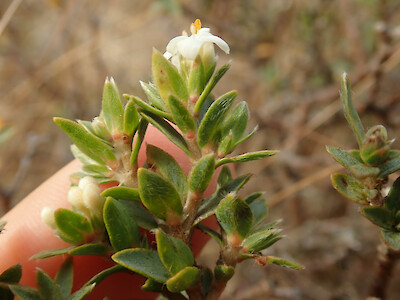
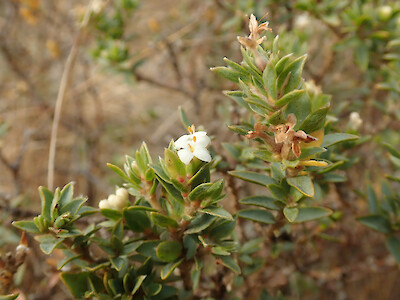
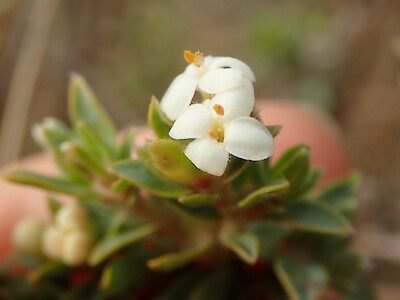
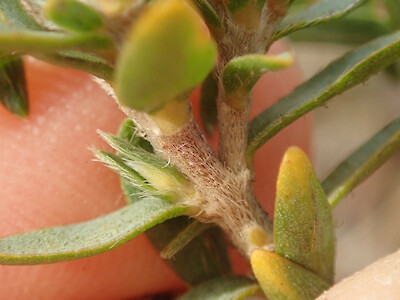
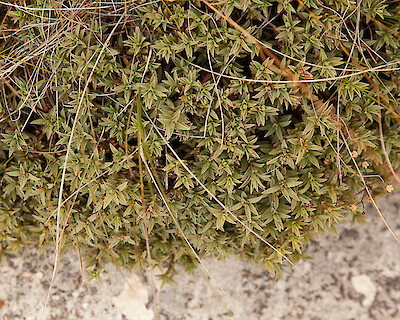
Low shrub to 50 cm tall with hairy twigs bearing pairs of narrow leaves that are slightly hairy underneath and on margin (lens needed), with slightly hairy white flowers and red fruit inhabiting limestone outcrops from south Marlborough to south Canterbury. Leaves 5–14 mm long by 2–3.5 mm wide.
Flower colours
White
Detailed description
Erect, suberect or decumbent, much-branched shrub up to 500 mm tall and 600 mm wide. Branching mainly sympodial. Young branchlets light brown, moderately densely covered in short, appressed hairs; internodes 2-3mm long, older stems brown to grey, some up to 300 mm diameter. Node buttresses lunate, not prominent on leafless stems. Leaves decussate, ascending, becoming patent, on short (0.3-0.5mm) often red petioles. Lamina 5.0-14 × 2.0-3.5 mm, medium glaucous-green, ovate or elliptic, flat or slightly keeled; tip acute, but blunt-pointed; base cuneate; abaxial surface with sparse hairs, mainly along margins and mid-vein, near tip; older leaves glabrous; stomata on both adaxial and abaxial leaf surfaces. Inflorescences terminal, 4-14-flowered; involucral bracts 4, usually broader than ordinary leaves (12 × 5 mm), not hiding the flowers. Receptacle covered with abundant short hair. Plants gynodioecious. Flowers white, scented, on short (0.8 mm) pedicels, densely hairy outside, inside sparsely hairy in tube and ovaryportion. Female tube 3.5 mm long, ovary portion 3 mm, calyx lobes 2.0 × 1.6 mm; hermaphrodite tube 6 mm long, ovary portion 2.5 mm, calyx lobes 3 × 2 mm. Anther dehiscence introrse. Ovary wall thin, summit very hairy. Fruits ovoid, fleshy, red 5 × 3 mm. Seeds narrow-ovoid 2.8 × 1.5 mm, thin crest.
Similar taxa
Distinguished from Pimelea oreophila with which it sometimes grows by its usually erect, bushy habit and larger leaves, and from P. cryptica (which is endemic to the south Wellington coastline) by the typically stiffly erect branches, hairier leaves, and red fruit. Pimelea declivis is (as far as is known) an eastern South Island endemic, which is mostly confined to limestone outcrops, associated talus and soils.
Distribution
Endemic. New Zealand: South Island (southeastern Marlborough, north and south Canterbury)
Habitat
Lowland to lower montane, Mostly found in sparse grassland and grey scrub associated with limestone ridges, scarps, cliffs, outcrops, screes and boulder heaps. Pimelea declivis is also known sparingly from igneous rock.
Threats
Burrows (2011) outlines a range of threats, which include the past quarrying of limestone, competition from weeds (especially invasive shrubs such as broom (Cytisus scoparius) and briar (Rosa rubiginosa), farming, pine plantations (and the spread of wildling pines from these), and introgression with other Pimelea. Unfortunately none of these threats were quantified, and the species was not assessed using the New Zealand Threat Classification Manual (Townsend et al. 2008). Accordingly it was assessed in the 2012 Conservation Status assessment of vascular plants as ‘Data Deficient’ (de Lange et al. 2013). In the 2017 assessment, it was reassessed as ‘Threatened – Nationally Critical’ based on improved information about the population size (de Lange et al. 2018).
Detailed taxonomy
Genus
Family
Synonyms
None (first described in 2011)
Endemic taxon
Yes
Endemic genus
No
Endemic family
No
Ecology
Flowering
October–May
Fruiting
Unknown
Propagation technique
Unknown. Probably easily grown from semi-hard and hardwood cuttings.
Other information
Etymology
pimelea: from Greek pimelē, meaning “lard” or “soft fat,” presumably referring to the oily seeds or fleshy cotyledons.
Previous conservation statuses
The conservation status of all known New Zealand vascular plant taxa at the rank of species and below were reassessed in 2022-2023 using the New Zealand Threat Classification System (NZTCS) – more information about this can be found on the NZTCS website. This report includes replaces all previous NZTCS lists for vascular plants. Previous assessments can be found here.
- Conservation status of vascular plants in Aotearoa New Zealand, 2023. 2024. Peter J. de Lange, Jane Gosden, Shannel P. Courtney, Alexander J. Fergus, John W. Barkla, Sarah M. Beadel, Paul D. Champion, Rowan Hindmarsh-Walls, Troy Makan and Pascale Michel Department of Conservation. Source: NZTCS and licensed by DOC for reuse under the Creative Commons Attribution 4.0 International licence.
2017 | Threatened – Nationally Critical | Qualifiers: DP
2012 | Data Deficient
Referencing and citations
References and further reading
Burrows CJ. 2011. Genus Pimelea (Thymelaeaceae) in New Zealand 4. The taxonomic treatment of ten endemic abaxially hairy-leaved species. New Zealand Journal of Botany 49(1): 41–106. https://doi.org/10.1080/0028825X.2010.536558.
de Lange PJ, Rolfe JR, Barkla JW, Courtney SP, Champion PD, Perrie LR, Beadel SM, Ford KA, Breitwieser I, Schönberger I, Hindmarsh-Walls R, Heenan PB, Ladley K. 2018. Conservation status of New Zealand indigenous vascular plants, 2017. New Zealand Threat Classification Series 22. Department of Conservation, Wellington, NZ. 82 p. https://www.doc.govt.nz/globalassets/documents/science-and-technical/nztcs22entire.pdf.
de Lange PJ, Rolfe JR, Champion PD, Courtney SP, Heenan PB, Barkla JW, Cameron EK, Norton DA, Hitchmough RA. 2013. Conservation status of New Zealand indigenous vascular plants, 2012. New Zealand Threat Classification Series 3. Department of Conservation, Wellington, NZ. 70 p. https://www.doc.govt.nz/globalassets/documents/science-and-technical/nztcs3entire.pdf.
Townsend AJ, de Lange PJ, Norton DA, Molloy J, Miskelly C, Duffy C. 2008. New Zealand Threat Classification manual. Department of Conservation, Wellington, NZ. 35 pp. https://www.doc.govt.nz/globalassets/documents/science-and-technical/sap244.pdf.
Attribution
Fact Sheet prepared for NZPCN by P.J. de Lange (30 April 2011). Description adapted from Burrows (2011).
NZPCN Fact Sheet citation
Please cite as: de Lange, P.J. (Year at time of access): Pimelea declivis Fact Sheet (content continuously updated). New Zealand Plant Conservation Network. https://www.nzpcn.org.nz/flora/species/pimelea-declivis/ (Date website was queried)