
Veronica bollonsii
Common names
hebe
Biostatus
Native – Endemic taxon
Current conservation status
The conservation status of all known New Zealand vascular plant taxa at the rank of species and below were reassessed in 2022-2023 using the New Zealand Threat Classification System (NZTCS) – more information about this can be found on the NZTCS website. This report includes replaces all previous NZTCS lists for vascular plants. Previous assessments can be found here.
- Conservation status of vascular plants in Aotearoa New Zealand, 2023. 2024. Peter J. de Lange, Jane Gosden, Shannel P. Courtney, Alexander J. Fergus, John W. Barkla, Sarah M. Beadel, Paul D. Champion, Rowan Hindmarsh-Walls, Troy Makan and Pascale Michel Department of Conservation. Source: NZTCS and licensed by DOC for reuse under the Creative Commons Attribution 4.0 International licence.
2023 | At Risk – Naturally Uncommon | Qualifiers: RR
Category
Vascular
Structural class
Trees & Shrubs - Dicotyledons
Simplified description
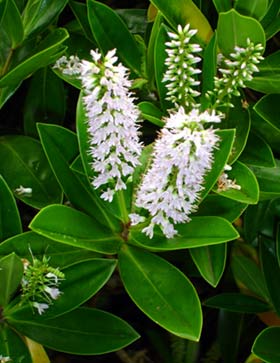
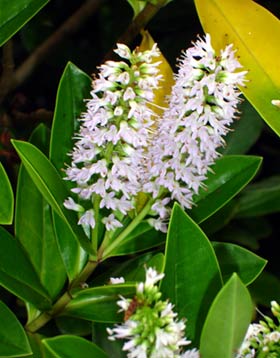
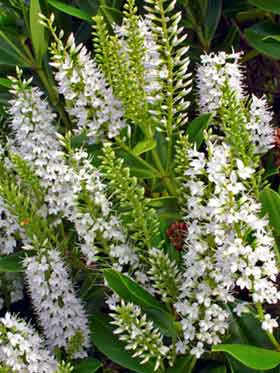
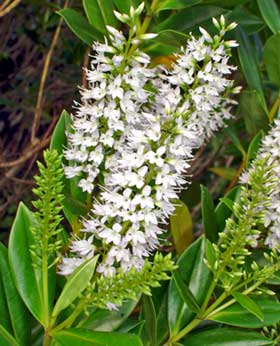
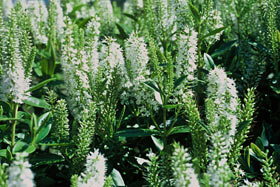
Bushy shrub bearing pairs of dark green oval pointed leaves inhabiting coastal sites in eastern Northland and offshore islands. Leaves 20–95 mm long by 15–31 mm wide. Leaf bud with gap at base. Twigs green. Flowers tinged pink becoming white with age, in short spikes, to 15 cm long.
Flower colours
Violet/Purple, White
Detailed description
Heavily branched, rather bushy shrub 2 × 3 m. Branches numerous, erect, old stems grey to grey-brown; branchlets green, minutely puberulent, glabrate; internodes 1–45 mm; leaf decurrencies evident. Leaf bud with sinus. Leaves erect to patent; lamina 14–130 × 8–42 mm, upper surface dark green, usually glossy, hairy along midrib, undersides light green dull or glossy oblanceolate, obovate to oblong or elliptic, coriaceous, more or less flat, apex shortly apiculate, subacute to obtuse, secondary veination evident in young leaves; margin narrowly cartilaginous, glabrous or minutely ciliate. Inflorescences lateral, unbranched racemes, 35–150 mm long, bearing 24–125 flowers; peduncle 6–30 mm, rachis 27–126 mm. Bracts alternate or lowermost pair opposite, then subopposite or alternate above, lanceolate to linear-lanceolate or ovate, acute. Flowers on pedicels 1–7 mm long. Calyx 2.5–5.5 mm; lobes lanceolate, acute, rarely sparsely hairy on the outside. Corolla tube 3–5 × 1.9–2.5 mm, funnelform, hairy inside and often outside (near where lobes diverge); corolla lobes equalling or longer than corolla tube, tinged very pale mauve at anthesis soon fading to white, lanceolate or narrowly elliptic, subacute, anterior lobe obtuse; patent to recurved. Stamen filaments 3.8–7 mm; anthers 2–2.7 mm, mauve or purple. Ovary 0.6–1.2 mm; style 5.5–8.5 mm. Capsules 2.5–5.5 × 1.8–4 mm, subacute. Seeds 1–1.7 × 0.9–1.3 mm, straw-yellow, broad-ellipsoid, more or less winged, flattened.
Similar taxa
Most similar to Veronica pubescens subsp. sejuncta from which it differs by its glabrescent to minutely puberulent stems and foliage, consistent lack of a leaf bud sinus, usually much broader leaves, and uniformly lighter coloured flowers—V. bollonsii never has the deep violet or dark mauve flower colours occasionally seen in V. pubescens subsp. sejuncta.
Distribution
Endemic. New Zealand: North Island (outer Hauraki Gulf where it is mainly found on the Poor Knights and Hen & Chicken island groups. Also local on rock stacks and headlands from Tutukaka north to about Mimiwhangata).
Habitat
Petrel scrub, low wind shorn shrubland and open coastal forest or on rock stacks. On the Poor Knights Islands and Hen & Chicken Islands it is often in low wind shorn petrel scrub on exposed shore platforms or on slip scars or in wind damaged coastal forest. Frequent on rocky headlands and sometimes on rock stacks.
Threats
A naturally uncommon, range restricted species virtually confined to offshore islands where it is under no obvious threats.
Detailed taxonomy
Genus
Family
Synonyms
Hebe bollonsii (Cockayne) Cockayne
Taxonomic notes
It has been reported from Ponui Island in the southern Hauraki Gulf e.g., Metcalf (2006). That record is erroneous being based on a plant collected wild from Ponui by Scott Lowry in 1993 and first cultivated at Percy Reserve, Petone in that year before general distribution. That plant, which is vegetatively somewhat similar to Veronica bollonsii (though it has a leaf bud sinus) is a hybrid cultivar involving H. speciosa and possibly V. bollonsii which was planted on that island as part of a revegetation project (David Chamberlin pers. comm., 2005). It is not Veronica bollonsii.
Endemic taxon
Yes
Endemic genus
No
Endemic family
No
Ecology
Flowering
September–February (often sporadic throughout the year)
Fruiting
Present throughout the year
Life cycle and dispersal
Seeds are wind dispersed (Thorsen et al., 2009).
Propagation technique
Easy from semi-hard wood cuttings and fresh seed. A spectacular shrub which deserves to be more widely grown. It is extremely floriferous. Plants respond well to a very hard pruning immediately after flowering—cut back by at least one-third—and do best in full sun, in a free draining, fertile soil.
Other information
Etymology
veronica: Named after Saint Veronica, who gave Jesus her veil to wipe his brow as he carried the cross through Jerusalem, perhaps because the common name of this plant is ‘speedwell’. The name Veronica is often believed to derive from the Latin vera ‘truth’ and iconica ‘image’, but it is actually derived from the Macedonian name Berenice which means ‘bearer of victory’.
bollonsii: Named in honour of Captain John P. Bollon (1862-1929)
Chromosome number
2n = 40
Previous conservation statuses
The conservation status of all known New Zealand vascular plant taxa at the rank of species and below were reassessed in 2022-2023 using the New Zealand Threat Classification System (NZTCS) – more information about this can be found on the NZTCS website. This report includes replaces all previous NZTCS lists for vascular plants. Previous assessments can be found here.
- Conservation status of vascular plants in Aotearoa New Zealand, 2023. 2024. Peter J. de Lange, Jane Gosden, Shannel P. Courtney, Alexander J. Fergus, John W. Barkla, Sarah M. Beadel, Paul D. Champion, Rowan Hindmarsh-Walls, Troy Makan and Pascale Michel Department of Conservation. Source: NZTCS and licensed by DOC for reuse under the Creative Commons Attribution 4.0 International licence.
2017 | At Risk – Naturally Uncommon | Qualifiers: RR
2012 | At Risk – Naturally Uncommon | Qualifiers: RR
2009 | At Risk – Naturally Uncommon
2004 | Range Restricted
Regional conservation statuses
Northland: 2026 | Regionally At Risk – Regionally Naturally Uncommon
Current regional threat status assessments prepared according to Crisp et al. (2025) are displayed when available. The Northland conservation status information is sourced from the “Conservation status of indigenous vascular plants in Northland | Taitokerau” Ford et al. 2026 report.
Referencing and citations
References and further reading
Bayly MJ, Kellow AV. 2006. An illustrated guide to New Zealand Hebes. Te Papa Press, Wellington, NZ. 388 p.
Metcalf L. 2006. Hebes - a guide to species, hybrids, and allied genera. Timber Press, Portland, Oregon, USA. 260 p.
Thorsen MJ, Dickinson KJM, Seddon PJ. 2009. Seed dispersal systems in the New Zealand flora. Perspectives in Plant Ecology, Evolution and Systematics 11: 285–309. https://doi.org/10.1016/j.ppees.2009.06.001.
Attribution
Fact sheet prepared for NZPCN by P.J. de Lange 1 October 2006. Description based on Bayly & Kellow (2006).