
Veronica stenophylla var. oliveri
Common names
hebe
Biostatus
Native – Endemic taxon
Current conservation status
The conservation status of all known New Zealand vascular plant taxa at the rank of species and below were reassessed in 2022-2023 using the New Zealand Threat Classification System (NZTCS) – more information about this can be found on the NZTCS website. This report includes replaces all previous NZTCS lists for vascular plants. Previous assessments can be found here.
- Conservation status of vascular plants in Aotearoa New Zealand, 2023. 2024. Peter J. de Lange, Jane Gosden, Shannel P. Courtney, Alexander J. Fergus, John W. Barkla, Sarah M. Beadel, Paul D. Champion, Rowan Hindmarsh-Walls, Troy Makan and Pascale Michel Department of Conservation. Source: NZTCS and licensed by DOC for reuse under the Creative Commons Attribution 4.0 International licence.
2023 | At Risk – Naturally Uncommon | Qualifiers: IE, OL, RR
Category
Vascular
Structural class
Trees & Shrubs - Dicotyledons
Simplified description
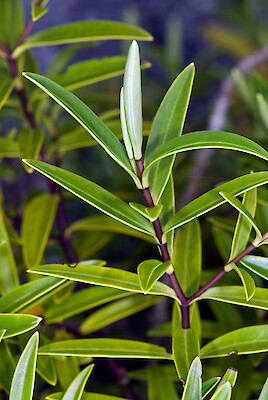
Bushy shrub bearing pairs of long narrow leaves that have small pits near margin (lens needed) inhabiting coastal Stephens Island. Leaves to 37mm long by 10mm wide. Flowers white, tubular, in spikes to 60mm long.
Detailed description
Spreading low or bushy shrub (often openly branched) to 2 m tall. Branches erect. old stems grey; branchlets olive-green or red-brown, glabrous or bifariously puberulent; internodes (1-) 4-13 (-24) mm; leaf decurrencies evident (usually, weakly), or obscure. Leaf bud distinct; sinus absent. Leaves lanceolate or elliptic, 22-37 x 5-10 mm; upper surface mostly smooth, not conspicuously pitted except toward margins, stomata sparse except near apex; margins broad, glabrous (usually) or with very fine hairs, lower surface green (often paler than upper), conspicuously pitted with small depressions that each contain a twin-headed glandular hair. Inflorescences with (35-) 55-130 (-170) flowers, lateral, unbranched, 26-60 mm long; peduncle (0.5-) 1-1.5 (-2.1) cm; rachis (2-) 4.5-6 (-9) cm. Bracts alternate, ovate or deltoid, acute (mostly) or obtuse. Flowers, hermaphrodite or female (on different plants). Pedicels longer than or equal to bracts, (0.5-) 1-3 (-5) mm, hairy or glabrous. Calyx 1.5-2.5 mm; lobes ovate or oblong, obtuse to acute, eglandular ciliate (usually) or with mixed glandular and eglandular cilia (glandular hairs often with a single, rounded cell at the apex; twin-headed hairs, when present, usually sparse). Corolla tube glabrous within, 2.5-3.8 mm long, tube of hermaphrodite flowers (1.8) 3-4.9 x 1.3-2 mm, contracted at base and cylindric or expanded in lower half, longer than calyx; lobe white or tinged mauve at anthesis, ovate (often broadly) or circular or elliptic, obtuse (posterior sometimes emarginate), suberect to recurved (mostly patent), shorter than corolla tube. Stamen filaments incurved at apex in bud, 2.5-4.4 mm; anthers magenta, 1-1.5 mm. Ovary approximately 0.8-0.9 mm; ovules 4-10 per locule; style 3-7 mm. Capsules acute or obtuse. (2-) 2.5-3.5 x (0.8-) 1.5-3 mm, loculicidal split extending ¼-¾-way to base. Seeds flattened, more or less ellipsoid to oblong, straw-yellow to pale brown, 0.9-1 .5 (-2) x 0.7-0.9 (-1.1) mm, micropylar rim 0.2-0.3 mm.
Similar taxa
Key distinguishing features include: the presence of small pits, at least on the lower leaf surface (usually conspicuous under a dissecting microscope, each containing a recessed glandular hair); leaf margins that are usually smooth and glabrous (only occasionally hairy); corolla tubes that are longer than calyces and usually glabrous within; and calyx cilia only rarely including twin-headed glandular hairs.
Similar to: V. traversii, is distinguished by the combination of non-pitted leaves, minutely hairy leaf margins, and hairs inside the corolla tubes.
V. parviflora (in which it was included, as var. angustifolia, by Moore, in Allan 1961), is distinguished by having often smooth (only sometimes pitted) leaf surfaces, minutely hairy leaf margins, corolla tubes that are hairy within and calyx cilia always including twin headed glandular hairs.
V. strictissima distinguished by having corolla tubes equal to or slightly exceeding surrounding calyces.
V. stenophylla var. stenophylla has leave less than 6 times as long as broad, or, if not then upper leaf surface with many stomata.
V. stenophylla var. hesperia has corolla tube 1.8-3 (3.5) mm long, hairy within; branchlets bifariously to uniformly puberulent; upper surface of leaves with few stomata; V. stenophylla var. oliveri has corolla tube less than 3 mm long, glabrous or (very rarely) hairy within; branchlets glabrous or bifariously to (rarely) uniformly puberulent; upper surface of leaves with many stomata.
Distribution
Stephens Island - Cook Strait.
Habitat
Mostly in wind-shorn vegetation on exposed bluffs on the western side.
Detailed taxonomy
Genus
Family
Synonyms
Hebe stenophylla var. oliveri Bayly et Garn.-Jones
Endemic taxon
Yes
Endemic genus
No
Endemic family
No
Ecology
Flowering
December-April (-September)
Fruiting
January-July (-December)
Other information
Etymology
veronica: Named after Saint Veronica, who gave Jesus her veil to wipe his brow as he carried the cross through Jerusalem, perhaps because the common name of this plant is ‘speedwell’. The name Veronica is often believed to derive from the Latin vera ‘truth’ and iconica ‘image’, but it is actually derived from the Macedonian name Berenice which means ‘bearer of victory’.
stenophylla: From the Greek steno ‘narrow’ and phyllum ‘leaf”, referring to the narrow leaves
Chromosome number
2n = 40
Previous conservation statuses
The conservation status of all known New Zealand vascular plant taxa at the rank of species and below were reassessed in 2022-2023 using the New Zealand Threat Classification System (NZTCS) – more information about this can be found on the NZTCS website. This report includes replaces all previous NZTCS lists for vascular plants. Previous assessments can be found here.
- Conservation status of vascular plants in Aotearoa New Zealand, 2023. 2024. Peter J. de Lange, Jane Gosden, Shannel P. Courtney, Alexander J. Fergus, John W. Barkla, Sarah M. Beadel, Paul D. Champion, Rowan Hindmarsh-Walls, Troy Makan and Pascale Michel Department of Conservation. Source: NZTCS and licensed by DOC for reuse under the Creative Commons Attribution 4.0 International licence.
2017 | At Risk – Naturally Uncommon | Qualifiers: IE, OL, RR
2012 | At Risk – Naturally Uncommon | Qualifiers: IE, OL, RR
2009 | At Risk – Naturally Uncommon | Qualifiers: OL, IE
2004 | Range Restricted
Referencing and citations
References and further reading
Allan, H. H. 1961. Flora of New Zealand. Vol. 1. Wellington: Government Printer.
Bayly, M.J., Kellow, A.V. 2006 An illustrated guide to New Zealand Hebes. Wellington, N.Z.: Te Papa press pg. 170-172.
Attribution
Description adapted by M. Ward from Bayly & Kellow (2006).