
Veronica spectabilis
Common names
Takitimu parahebe
Biostatus
Native – Endemic taxon
Current conservation status
The conservation status of all known New Zealand vascular plant taxa at the rank of species and below were reassessed in 2022-2023 using the New Zealand Threat Classification System (NZTCS) – more information about this can be found on the NZTCS website. This report includes replaces all previous NZTCS lists for vascular plants. Previous assessments can be found here.
- Conservation status of vascular plants in Aotearoa New Zealand, 2023. 2024. Peter J. de Lange, Jane Gosden, Shannel P. Courtney, Alexander J. Fergus, John W. Barkla, Sarah M. Beadel, Paul D. Champion, Rowan Hindmarsh-Walls, Troy Makan and Pascale Michel Department of Conservation. Source: NZTCS and licensed by DOC for reuse under the Creative Commons Attribution 4.0 International licence.
2023 | At Risk – Naturally Uncommon | Qualifiers: Sp, DPS, DPT, RR
Category
Vascular
Structural class
Herbs - Dicotyledons other than Composites
Flower colours
Violet/Purple, White
Detailed description
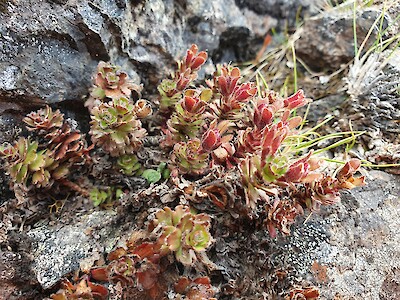
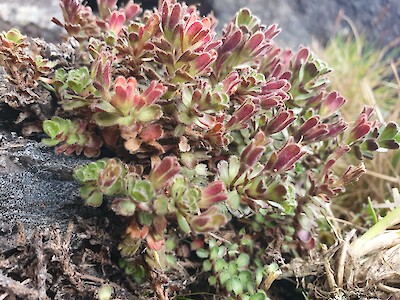
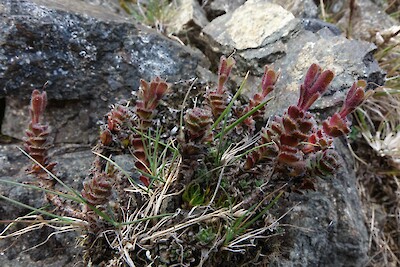
Subshrub, 30-200 tall. Old stems brown. Branches decumbent to ascending. Branchlets red-brown or purplish. Vegetative internodes 1-4 mm long. Stem pubescence uniform, eglandular pubescent and glandular pubescent. Leaves decussate, erecto-patent to spreading. Lamina obovate to spathulate, 4.5-13.0 × 2.5-6.0 mm. Upper surface of leaves dark green or purple, dull. Under surface of leaves dark green or fruiting, 2.5–5 mm long, eglandular-pubescent and glandular-pubescent; hairs all around pedicel. Flowers: Calyx 4-lobed, 6.5-10.0 mm long. Calyx lobes spathulate, subacute to obtuse. Calyx hairs on both both surfaces, mixed eglandular and glandular (upper surface glandular hairs few). Calyx lobe margins entire. Corolla white at anthesis. Nectar guides absent. Corolla throat same colour as lobes. Corolla 18-25 mm diameter. Corolla tube 2.5-4.5 mm long, 1.5-2.0 mm wide, glabrous. Corolla lobes glabrous. Posterior corolla lobe circular or obovate, obtuse, 10-12 × 10-12 mm. Lateral corolla lobes circular, obtuse, flat, not enfolding stamens, 10-13 × 8-11 mm. Anterior corolla lobe circular or obovate, obtuse, 9-12 × 10-12 mm. Stamen filaments white, 3-4 mm long, not narrowed at base. Anthers magenta or purple, 1.2-1.5 mm long. Nectarial disc glabrous. Ovary ovoid, acute or subacute, eglandular hairy and glandular hairy (at apex), 2–2.5 mm long. Style 3.5-4.5 mm long. Stigma 0.4-0.6 mm wide. Capsules, narrowly angustiseptate, emarginate, 4-5 × 4-5 mm, 1-2 mm thick, hairy. Hairs eglandular and glandular. Septicidal split of capsule extending 1/2 way to base to base. Loculicidal split of capsule extending to base. Seeds ellipsoid, straw yellow or pale brown, 0.9-1.0 × 0.5–0.7 mm.
Similar taxa
Veronica spectabilis is very similar to V. birleyi, with which it shares leaves with dull grey green upper leaf surfaces and with rounded lobes and reddish abaxial surfaces. In its large pedicellate flowers, glandular leaf hairs, and trilobed leaves it also resembles V. trifida. Both Veronica birleyi and V. spectabilis occupy alpine rock crevices, although V. spectabilis is at much lower elevations (1340–1460 m) than V. birleyi (1800–2900 m). Veronica trifida is a plant primarily of snow-bank meltwater sites.
Distribution
Endemic, South Island, Takitimu Mountains, where it is only known between Tower and Excelsior Peak, and from cirques east of that ridge
Habitat
High alpine to nival ledges and snow banks.
Threats
Unknown, though it is unlikely to be threatened by browsing animals or weeds because of its stature, apparent habitat preferences and altitudinal ranges. Further field work is needed to clarify its status.
Detailed taxonomy
Genus
Family
Synonyms
Parahebe spectabilis Garn.-Jones
Endemic taxon
Yes
Endemic genus
No
Endemic family
No
Ecology
Flowering
Unknown - has been collected in flower in January
Fruiting
Unknown - has been collected in fruit in January
Propagation technique
Difficult. Should not be removed from the wild.
Other information
Where To Buy
Not commercially available.
Etymology
veronica: Named after Saint Veronica, who gave Jesus her veil to wipe his brow as he carried the cross through Jerusalem, perhaps because the common name of this plant is ‘speedwell’. The name Veronica is often believed to derive from the Latin vera ‘truth’ and iconica ‘image’, but it is actually derived from the Macedonian name Berenice which means ‘bearer of victory’.
spectabilis: Notable
Previous conservation statuses
The conservation status of all known New Zealand vascular plant taxa at the rank of species and below were reassessed in 2022-2023 using the New Zealand Threat Classification System (NZTCS) – more information about this can be found on the NZTCS website. This report includes replaces all previous NZTCS lists for vascular plants. Previous assessments can be found here.
- Conservation status of vascular plants in Aotearoa New Zealand, 2023. 2024. Peter J. de Lange, Jane Gosden, Shannel P. Courtney, Alexander J. Fergus, John W. Barkla, Sarah M. Beadel, Paul D. Champion, Rowan Hindmarsh-Walls, Troy Makan and Pascale Michel Department of Conservation. Source: NZTCS and licensed by DOC for reuse under the Creative Commons Attribution 4.0 International licence.
2017 | At Risk – Naturally Uncommon | Qualifiers: DP, RR, Sp
2012 | At Risk – Naturally Uncommon | Qualifiers: DP, RR
2009 | At Risk – Naturally Uncommon
2004 | Range Restricted
Referencing and citations
References and further reading
Garnock-Jones, P.J.; Lloyd, D.G. 2003: A taxonomic revision of Parahebe (Plantaginaceae) in New Zealand. New Zealand Journal of Botany 42: 181-232
Attribution
Fact Sheet by P.J. de Lange (5 October 2006). Description adapted from Garnock-Jones and Lloyd (2003).