
Veronica hulkeana subsp. evestita
Biostatus
Native – Endemic taxon
Current conservation status
The conservation status of all known New Zealand vascular plant taxa at the rank of species and below were reassessed in 2022-2023 using the New Zealand Threat Classification System (NZTCS) – more information about this can be found on the NZTCS website. This report includes replaces all previous NZTCS lists for vascular plants. Previous assessments can be found here.
- Conservation status of vascular plants in Aotearoa New Zealand, 2023. 2024. Peter J. de Lange, Jane Gosden, Shannel P. Courtney, Alexander J. Fergus, John W. Barkla, Sarah M. Beadel, Paul D. Champion, Rowan Hindmarsh-Walls, Troy Makan and Pascale Michel Department of Conservation. Source: NZTCS and licensed by DOC for reuse under the Creative Commons Attribution 4.0 International licence.
2023 | At Risk – Naturally Uncommon | Qualifiers: DPS, DPT, RR
Category
Vascular
Structural class
Trees & Shrubs - Dicotyledons
Simplified description
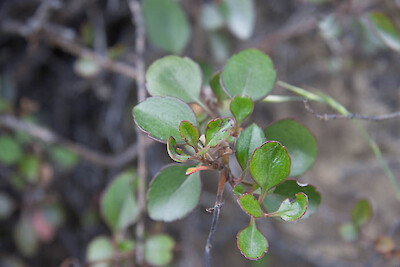
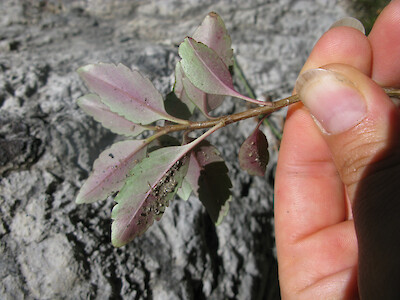
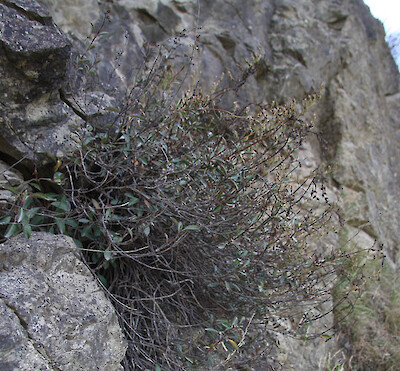
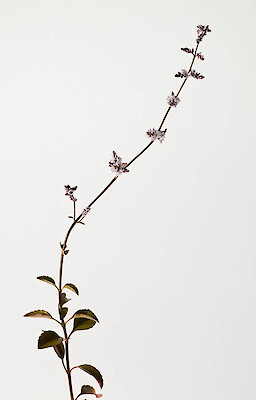
Bushy small shrub bearing fleshy pairs of red edged glossy oval toothed leaves inhabiting limestone areas near Kaikoura. Twigs hairless (except occasionally near tip). Leaves 30-50mm long by 15-20mm wide on a 10-20mm long stalk that widens towards leaf. Flowers pinkish, in clusters to 50cm long.
Detailed description
Stems usually glabrous throughout, rarely sparsely puberulent when young, hairs glandular and eglandular; eglandular stem hairs recurved. Leaves erecto-patent; lamina lanceolate, rhomboid, or rarely elliptic, (15-)30-50( -60) x (8-)15-20(-25) mm; apex acute, apiculate, or rarely obtuse; marginal teeth in 5-10(-15) pairs; adaxial surface glabrous or with minute twin-headed glandular hairs on midrib; abaxial surface glabrous. Petiole (8-)10-20(-25) mm long. Rachis glabrous basally, individual rachises of racemes glandular puberulent or sparsely puberulent. Pedicels glabrous or glandular-puberulent, 0-1 mm long. Calyx 2-3 mm long; lobes lanceolate, ovate, or deltoid, acuminate or acute, glandular-ciliolate or with mixed glandular and eglandular cilia. Corolla tube cylindric to narrowly funnelform; lobes glabrous. Stamen filaments inserted about middle of corolla tube, approximately1 mm long. Nectarial disk ciliolate or glabrous. Ovary glabrous or eglandular or glandular hairy (hairs short), 0.7-1.0 x 0.6-0.9 mm, 0.5-0.7 mm thick. Capsule 3.5-4.5 mm long, 2.0-2.5(-3.0) mm thick, usually glabrous, sometimes with unicellular eglandular or glandular hairs. Loculicidal split of capsule extending 1/3-way to base
Similar taxa
The absence of a dense puberulent covering, particularly in the distal parts of the inflorescence, distinguishes Veronica hulkeana subsp. evestita from Veronica hulkeana subsp. hulkeana. When hairs are present on rachises, they are sparse and often glandular. The base of the calyx is glabrous or has a few sparse hairs, which may be glandular. The calyx lobes are ovate to lanceolate with acute to acuminate apices; their marginal cilia are more sparse and include some glandular hairs. The leaves tend to be more ovate to lanceolate than in Veronica hulkeana subsp. hulkeana, and the inflorescence tends to be more graceful, with flowers more distantly spaced.
Distribution
Endemic. South Island – Marlborough
Habitat
Rocky gorges, cliffs, and outcrops, on limestone.
Detailed taxonomy
Genus
Family
Synonyms
Heliohebe hulkeana subsp. evestita Garn.-Jones
Endemic taxon
Yes
Endemic genus
No
Endemic family
No
Ecology
Flowering
November
Fruiting
January-February (March)
Other information
Etymology
veronica: Named after Saint Veronica, who gave Jesus her veil to wipe his brow as he carried the cross through Jerusalem, perhaps because the common name of this plant is ‘speedwell’. The name Veronica is often believed to derive from the Latin vera ‘truth’ and iconica ‘image’, but it is actually derived from the Macedonian name Berenice which means ‘bearer of victory’.
Chromosome number
2n = 42
Previous conservation statuses
The conservation status of all known New Zealand vascular plant taxa at the rank of species and below were reassessed in 2022-2023 using the New Zealand Threat Classification System (NZTCS) – more information about this can be found on the NZTCS website. This report includes replaces all previous NZTCS lists for vascular plants. Previous assessments can be found here.
- Conservation status of vascular plants in Aotearoa New Zealand, 2023. 2024. Peter J. de Lange, Jane Gosden, Shannel P. Courtney, Alexander J. Fergus, John W. Barkla, Sarah M. Beadel, Paul D. Champion, Rowan Hindmarsh-Walls, Troy Makan and Pascale Michel Department of Conservation. Source: NZTCS and licensed by DOC for reuse under the Creative Commons Attribution 4.0 International licence.
2017 | At Risk – Naturally Uncommon | Qualifiers: DP, RR
2012 | At Risk – Naturally Uncommon | Qualifiers: RR
2009 | At Risk – Naturally Uncommon
2004 | Not Threatened
Referencing and citations
References and further reading
Garnock-Jones, P.J. 1993: Heliohebe (Scrophulariaceae Veroniceae), a new genus segregated from Hebe. New Zealand Journal of Botany 31: 323-339.
Garnock-Jones, P.J.; Albach, D.; Briggs, B.G. 2007: Botanical names in Southern Hemisphere Veronica (Plantaginaceae): sect. Detzneria, ect. Hebe, and sect. Labiatoides. Taxon 56: 571-582
Attribution
Description adapted by M. Ward from Garnock-Jones, P.J. 1993: Heliohebe (Scrophulariaceae Veroniceae), a new genus segregated from Hebe. New Zealand Journal of Botany 31: 331. © The Royal Society of New Zealand, reproduced by permission of Taylor & Francis Ltd, www.tandfonline.com on behalf of The Royal Society of New Zealand.