
Veronica pareora
Biostatus
Native – Endemic taxon
Current conservation status
The conservation status of all known New Zealand vascular plant taxa at the rank of species and below were reassessed in 2022-2023 using the New Zealand Threat Classification System (NZTCS) – more information about this can be found on the NZTCS website. This report includes replaces all previous NZTCS lists for vascular plants. Previous assessments can be found here.
- Conservation status of vascular plants in Aotearoa New Zealand, 2023. 2024. Peter J. de Lange, Jane Gosden, Shannel P. Courtney, Alexander J. Fergus, John W. Barkla, Sarah M. Beadel, Paul D. Champion, Rowan Hindmarsh-Walls, Troy Makan and Pascale Michel Department of Conservation. Source: NZTCS and licensed by DOC for reuse under the Creative Commons Attribution 4.0 International licence.
2023 | Threatened – Nationally Critical | Qualifiers: Sp, DPT, RR
Category
Vascular
Structural class
Trees & Shrubs - Dicotyledons
Simplified description
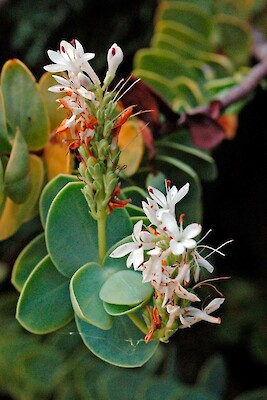
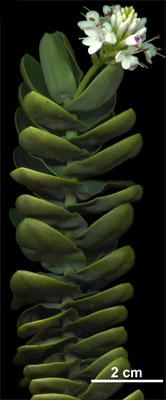
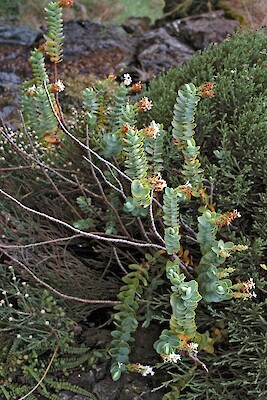
Low growing sprawling shrub bearing pairs of blue-green dished oval leaves on short branches inhabiting rocky areas in the vicinity of Pareora (south Canterbury). Leaves 20-30mm long by 15-18mm, leaf base clasps the stem. Flowers white, in a spike to 7cm long near tip of branches.
Flower colours
Violet/Purple, White
Detailed description
Large shrubs, branching from the base. Stems hanging or trailing, ascending at tips, naked except near apex, sparingly branched, glabrous, 1-3 m long, and up to 0.5 m tall. Leaf bud without sinus. Leaves oblong, ovate, obovate or elliptic, very fleshy-coriaceous, concave, spreading, glaucous, glabrous, amplexicaul to subauriculate, 15-30 × 10-18 mm; apex broadly obtuse; margins never red. Inflorescence a 12-60-flowered raceme; peduncle glabrous, 20-30 mm. Flowers pedicellate, pedicels glandular/eglandular-hairy, 2-5 mm. Bracts narrow-lanceolate, 2-4 mm, glabrous or minutely ciliolate. Calyx glabrous or minutely ciliolate, lobes lanceolate or narrowly oblong, acute or subacute, 2 mm. Corolla white, tube exceeding calyx, lobes narrow. Anthers purple. Capsule broadly angustiseptate, latiseptate or turgid, ellipsoid, emarginate or strongly didymous, glabrous, dark brown, about 3.5-5.0 × 2.5-3.5 mm, 1.5-2.8 mm thick, loculicidial split extending ½-way to base
Similar taxa
Similar to Veronica amplexicaulis from which it is distinguished by its much longer, widely spreading stems, much larger leaves, glabrous peduncles, and consistently pedicellate flowers
Distribution
Endemic. New Zealand: South Island (south Canterbury – Hunter Hills (Rock Gully, upper Pareora Gorge, White Rock River and Nimrod Stream), possibly also Blue Duck Stream and Opihi River)
Habitat
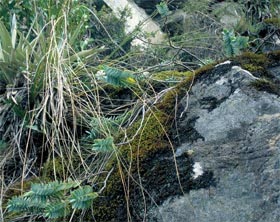
Lower montane to montane. A riparian species of gorges where it grows on rock outcrops, on cliff faces, within ledges and crevices above fast flowing streams and rivers
Threats
Veronica pareora has a naturally sparse distribution and it was never common within its few known habitats. Prior to 2012, it had been assessed as At Risk – Naturally Uncommon but by 2012 decline in the population was evident and by 2017 the extent and rate of decline warranted its assessment as Threatened – Nationally Critical. Browsing animals are thought to be significant agents of the decline of V. pareora..
Detailed taxonomy
Genus
Family
Synonyms
Hebe pareora Garn.-Jones et Molloy
Endemic taxon
Yes
Endemic genus
No
Endemic family
No
Ecology
Flowering
November - January
Fruiting
December - October
Life cycle and dispersal
Seeds are wind dispersed (Thorsen et al., 2009).
Propagation technique
Easily grown from cuttings and fresh seed. Prefers a sunny site and should be planted in a free draining soil. Dislikes humidity
Other information
Etymology
veronica: Named after Saint Veronica, who gave Jesus her veil to wipe his brow as he carried the cross through Jerusalem, perhaps because the common name of this plant is ‘speedwell’. The name Veronica is often believed to derive from the Latin vera ‘truth’ and iconica ‘image’, but it is actually derived from the Macedonian name Berenice which means ‘bearer of victory’.
pareora: Named after the Pareora Range, the type locality of this species
Chromosome number
2n = 40
Previous conservation statuses
The conservation status of all known New Zealand vascular plant taxa at the rank of species and below were reassessed in 2022-2023 using the New Zealand Threat Classification System (NZTCS) – more information about this can be found on the NZTCS website. This report includes replaces all previous NZTCS lists for vascular plants. Previous assessments can be found here.
- Conservation status of vascular plants in Aotearoa New Zealand, 2023. 2024. Peter J. de Lange, Jane Gosden, Shannel P. Courtney, Alexander J. Fergus, John W. Barkla, Sarah M. Beadel, Paul D. Champion, Rowan Hindmarsh-Walls, Troy Makan and Pascale Michel Department of Conservation. Source: NZTCS and licensed by DOC for reuse under the Creative Commons Attribution 4.0 International licence.
2017 | Threatened – Nationally Critical | Qualifiers: DP, RR, Sp
2012 | Threatened – Nationally Vulnerable | Qualifiers: DP, RR, Sp
2009 | At Risk – Naturally Uncommon
2004 | Range Restricted
Referencing and citations
References and further reading
Garnock-Jones, P.J.; Molloy, B.P.J. 1982: Polymorphism and the taxonomic status of the Hebe amplexicaulis complex (Scrophulariaceae). New Zealand Journal of Botany 20: 391-399.
Thorsen, M. J.; Dickinson, K. J. M.; Seddon, P. J. 2009. Seed dispersal systems in the New Zealand flora. Perspectives in Plant Ecology, Evolution and Systematics 11: 285-309
Attribution
Fact Sheet by Peter J. de Lange (1 August 2006). Description from Garnock-Jones and Molloy (1982)